How to Make Math Cards

Many of the games on this blog call for Math Cards. You do not need to look for these in stores or in your school supply catalog. Math cards are simply a modified deck of normal, poker-style playing cards. Remove all face cards and jokers from the deck, leaving the ace through ten of each suit. Or use a set of Rook cards, without the bird.

Using the ace as a one, this gives you four sets of numbers 1-10, and you will be ready to play your way to fluency in almost any arithmetical topic: addition, subtraction, multiplication, division, greater-than/less-than, fractions, negative numbers, and more.

Card Holder for Young Hands

Math card holder

Little hands often have trouble holding more than a few cards at a time. Your child may enjoy making and using a card holder.

Save the plastic lids from two large margarine tubs or similar containers. Place the lids together, top to top. Line up the edges, then staple them together, putting two or three staples near the center of the lids. Let your child decorate the card holder with stickers, if desired.

To use the card holder, slip playing cards between the two lids and fan them out. The lids will hold the cards upright, so the child can easily see them all.

 
* * *

This blog is reader-supported.

If you’d like to help fund the blog on an on-going basis, then please join me on Patreon for mathy inspiration, tips, and an ever-growing archive of printable activities.

If you liked this post, and want to show your one-time appreciation, the place to do that is PayPal: paypal.me/DeniseGaskinsMath. If you go that route, please include your email address in the notes section, so I can say thank you.

Which I am going to say right now. Thank you!

“How to Make Math Cards” copyright © 2007 by Denise Gaskins.

How To Start a Homeschool Math Club

From a recent e-mail:

“Hello! I am on the board of a homeschool co-op. We have had requests for a math club and wondered if you have any tips for starting one. We service children from K-10th and would need to try to meet the needs of as many ages as possible.”

There are several ways you might organize a homeschool math club, depending on the students you have and on your goals. I think you would have to split the students by age groups — it is very hard to keep that wide of a range of students interested. Then decide whether you want an activity-oriented club or a more academic focus.

When I started my first math club, I raided the math shelves in the children’s section at my library (510-519) for anything that interested me. I figured that if an activity didn’t interest me, I couldn’t make it fun for the kids. Over the years we have done a variety of games, puzzles, craft projects, and more — always looking for something that was NOT like whatever the kids would be doing in their textbooks at home.

Continue reading How To Start a Homeschool Math Club

Solution: The Cat’s Lasagna

The puzzle (from The mysterious temporal freeze) was:

A certain famous cat snarfs down an 11″x13″ pan of lasagna in 3 seconds flat. Assuming the fat feline has a bottomless pit for a stomach and continues to eat at the same rate, how long will it take him to devour a pasta the size of the state of Illinois?

Remember the Math Adventurer’s Rule: Figure it out for yourself! Whenever I give a problem in an Alexandria Jones story, I will try to post the answer soon afterwards. But don’t peek! If I tell you the answer, you miss out on the fun of solving the puzzle. Figure it out for yourself — and then check the answer just to prove that you got it right.

Continue reading Solution: The Cat’s Lasagna

The Mysterious Temporal Freeze

Pyramids clip artAlexandria Jones stepped into the huge tent that protected her father’s excavation site from the desert winds. She laughed to herself. It was like walking into a circus.

She knelt down to whisper in the ear of her faithful dog Ramus. “In this ring, grad students carefully brush away another layer of sand. In the next ring, the artist sketches every piece as it is found.” She waved her arm. “And over there, our flashiest attraction — drum roll, please — the photographers shoot each shard of pottery from every possible angle. But where is the Master of Ceremonies?”

Alex and Rammy found Professor Jones near the back of the tent, talking to another student. While she waited for her dad, she looked through an assortment of numbered artifacts that were ready to be packed and sent to the museum.

Continue reading The Mysterious Temporal Freeze

Hints and Solutions: Patty Paper Trisection

No peeking! This post is for those of you who have given the trisection proof a good workout on your own. If you have a question about the proof or a solution you would like to share, please post a comment here.

But if you haven’t yet worked at the puzzle, go back and give it a try. When someone just tells you the answer, you miss out on the fun. Figure it out for yourself — and then check the answer just to prove that you got it right.

Continue reading Hints and Solutions: Patty Paper Trisection

Puzzle: Patty Paper Trisection

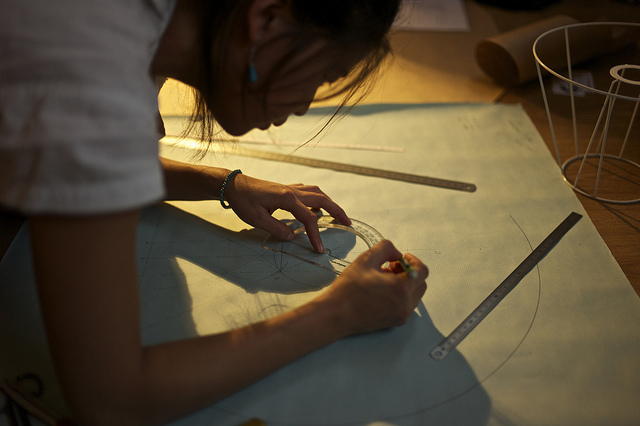
[Feature photo above by Michael Cory via Flickr (CC BY 2.0).]

trisection

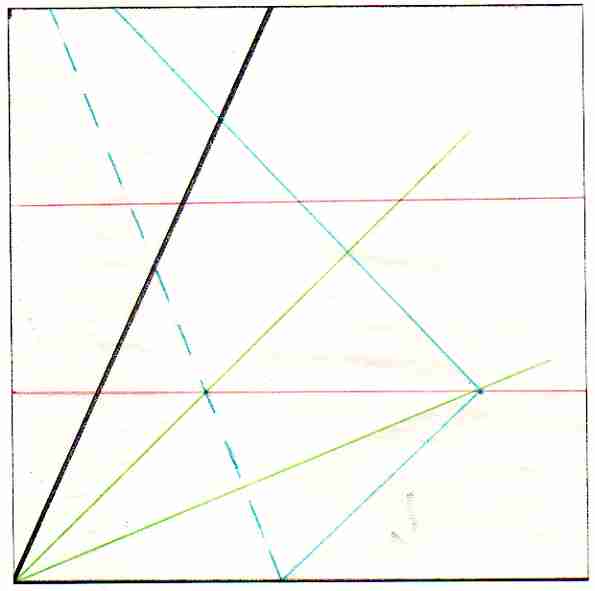
One of the great unsolved problems of antiquity was to trisect any angle using only the basic tools of Euclidean geometry: an unmarked straight-edge and a compass. Like the alchemist’s dream of turning lead into gold, this proved to be an impossible task. If you want to trisect an angle, you have to “cheat.” A straight-edge and compass can’t do it. You have to use some sort of crutch, just as an alchemist would have to use a particle accelerator or something.

One “cheat” that works is to fold your paper. I will show you how it works, and your job is to show why.

Continue reading Puzzle: Patty Paper Trisection

Geometry: Can You Find the Center of a Circle?

Is it possible that AB is a chord but NOT a diameter? That is, could circle ABC have a center that is NOT point O?

For the last couple of days, I have been playing around with this geometry puzzle. If you have a student in geometry or higher math, I recommend you print out the original post (but not the comments — it’s no fun when someone gives you the answer!) and see what he or she can do with it.

[MathNotations offers many other puzzles for 7-12th grade math students. While you are at his blog, take some time to browse past articles.]

Skit: The Handshake Problem

[Feature photo above by Tobias Wolter (CC-BY-SA-3.0) via Wikimedia Commons.]

If seven people meet at a party, and each person shakes the hand of everyone else exactly once, how many handshakes are there in all?

In general, if n people meet and shake hands all around, how many handshakes will there be?

Our homeschool co-op held an end-of-semester assembly. Each class was supposed to demonstrate something they had learned. I threatened to hand out a ten question pop quiz on integer arithmetic, but instead my pre-algebra students presented this skit. You may adjust the script to fit the available number of players.

Continue reading Skit: The Handshake Problem