The new Carnival of Mathematics is up and ready for browsing:
Enjoy!
And if you’re a math blogger who would like to see your best work in print, check out Math Mama’s call for posts:
The new Carnival of Mathematics is up and ready for browsing:
Enjoy!
And if you’re a math blogger who would like to see your best work in print, check out Math Mama’s call for posts:
While browsing the Kim Komando website for ideas I could use in my blogging class, I followed a rabbit trail through Kim’s video archive. I think we will try this in Math Club next semester:
If the embedded video doesn’t work on your computer, you can find the original here: Unbelievable Paper Transformer.
Simon posted a template for the puzzle at his MathsClass blog.
 [Photo by shonk.]
Welcome to the Math Teachers At Play blog carnival — which is not just for math teachers! If you like to learn new things and play around with ideas, you are sure to find something of interest.
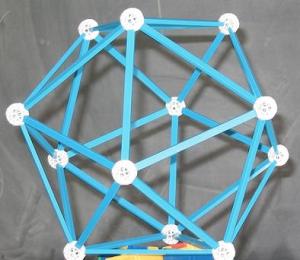
Let’s start the mathematical fun with a couple of puzzles in honor of our 20th edition: First, the shape to our right is an icosahedron, one of the Platonic solids. Each face is an equilateral triangle — can you count them? For more fun, make your own model.
 [Photo by nDevilTV.]
This month, our Math Teachers at Play blog carnival switched to a once-a-month schedule. We’ll publish the third Friday of each month — which is this week!
Teachers, homeschoolers, or anyone else who enjoys playing around with math: Wednesday night is the deadline to send in your thoughts, ideas, tips, or tricks about math using this handy submission form. Posts must be relevant to students or teachers of preK-12th grade mathematics. Old posts are welcome, as long as they haven’t been published in past editions of this carnival. Most bloggers have interesting gems buried in our archives. Why not dust one off and share it anew?
With the schedule change, I also need to rebuild the queue for hosting the Math Teachers at Play. If you blog about teaching or learning in grades K-12, and if you write about math at least occasionally, I would love to have you consider hosting the carnival sometime. Here’s how to sign up:
And don’t worry if you’ve never hosted a blog carnival before — it’s easy, fun, and great publicity for your blog! I’ll send you a detailed email of instructions to get you started.
Hat tip to Dan at mathrecreation.
Welcome to the Carnival of Mathematics! We’ve got a full roster this time, including roller coasters, topological Turán theory, a mathematician arrested as a spy, a plane running out of fuel mid-flight, speed limits in Conway’s Game of Life, and much, much more…
The 59th Carnival of Mathematics features 59 blog posts (counting the multi-part posts and the carnival post itself) on a wide variety of interesting topics. Drop in and enjoy the browsing!
“Let’s give the governor a break,” says Williams College mathematician Edward Burger. “If nothing else, he’s encouraging math education.”
— Carl Bialik
Coincidental Obscenity Deemed Extremely Dubious
Check out the new math carnival to discover plenty of great fun for all ages:
Are you wondering where MTAP #18 went? Here’s the story (contest-winning entry from Lisa Downing), and we’re sticking to it!
“The Odds were at odds with the Evens. It never seemed fair to them that two Odds made an Even but two Evens didn’t make an Odd…”
[Click over to MTaP #19 to read more.]
 [Graphite drawing by Niner.]
Niner (pronounced Neener), who takes the photos for my blog header — which reminds me, we’re about due for a new one of those… — has started a new blog. She calls it 19 & Still Alive, because “the world doesn’t end when you’re 16 if you don’t go to Prom or don’t get your driver’s license. (I never went to Prom, and I didn’t go through Driver’s ED until 17, but I’m alive, amazingly.)”
There won’t be any math there, or at least I don’t expect to see any; the blog will be mostly her rambling thoughts about whatever catches her interest. But she does have a wonderful graphite drawing based on the photo Masarwa man. On her blog, you can click the image to see him up close and personal. Wow!
[Photo by *Irish.]
In my post Elementary Problem Solving: The Tools, I introduced word algebra as a way to help students think their way through a story problem. In the next two posts, I showed how the tool worked with simple word problems.
Now, before I move on to focus exclusively on bar diagrams, I would like to show how word algebra can help a student solve a typical first-year algebra puzzle.
A homeschooling friend who avoided algebra in high school, trying to help her son cope with a subject she never understood, posted: “Help! Our answer is different from the book’s.” Here is the homework problem:
Josh earned $72 less than his sister who earned $93 more than her mom. If they earned a total of $504, how much did Josh earn?

