Trouble with Times Tables

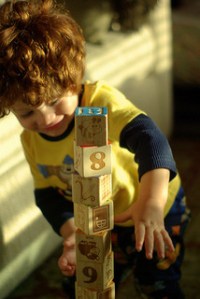
[feature photo above by dsb nola via flickr.]

Food for thought:

Imagine that you wanted your children to learn the names of all their cousins, aunts and uncles. But you never actually let them meet or play with them. You just showed them pictures of them, and told them to memorize their names.

Each day you’d have them recite the names, over and over again. You’d say, “OK, this is a picture of your great-aunt Beatrice. Her husband was your great-uncle Earnie. They had three children, your uncles Harpo, Zeppo, and Gummo. Harpo married your aunt Leonie … yadda, yadda, yadda.

— Brian Foley
Times Tables – The Worst Way to Teach Multiplication

On the other hand, if you want your children to develop relationships with the numbers, to learn the math facts naturally, then be sure to tell lots of math stories. And when you are ready to focus on multiplication, be sure to study the patterns and relationships within the times tables.

Problem-Solving Poll: What’s Your Answer?

[Photo by Alex E. Proimos via flickr.]

Patrick Vennebush, author of Math Jokes 4 Mathy Folks (the book and the blog) wants to know how you and your children would answer a tricky math problem.

He’s taking a poll:

I have often heard that, “Good teachers borrow, great teachers steal.” So today, I am stealing one of Marilyn Burns’s most famous problems. She takes this problem to the streets, and various adults give lots of different answers. When I’ve used it in workshops, even among a mathy crowd, I get lots of different answers, too.

What’s your answer?

“A man buys a truck for $600, then sells it for $700. Later, he decides to buy it back again and pays $800 dollars. However…”

Go to Patrick’s blog to read the whole problem and submit your answer. Let everybody in the family try it!

Update: Patrick posted the solution and percentages correct for students of various ages.

Math Teachers at Play #54 via Epsilon-Delta

Looks like a treasure trove of mathy fun from preschool to calculus at this month’s Math Teachers at Play blog carnival. Check it out!

Welcome to the fifty-fourth edition of Math Teachers at Play! We have a great roundup of articles this month…

  • Literacy
  • Instruction
  • Gamification
  • Great Advice and Insight

Go read the whole thing at Epsilon-Delta blog.

Lockhart’s Measurement

After watching the video on the Amazon.com page, this book has jumped to the top of my wish list.

You may have read Paul Lockhart’s earlier piece, A Mathematician’s Lament, which explored the ways that traditional schooling distorts mathematics. In this book, he attempts to share the wonder and beauty of math in a way that anyone can understand.

According to the publisher: “Measurement offers a permanent solution to math phobia by introducing us to mathematics as an artful way of thinking and living. Favoring plain English and pictures over jargon and formulas, Lockhart succeeds in making complex ideas about the mathematics of shape and motion intuitive and graspable.”

If you take any 4-sided shape at all — make it as awkward and as ridiculous as you want — if you take the middles of the sides and connect them, it always makes a parallelogram. Always! No matter what crazy, kooky thing you started with.

That’s scary to me. That’s a conspiracy.

That’s amazing!

That’s completely unexpected. I would have expected: You make some crazy blob and connect the middles, it’s gonna be another crazy blob. But it isn’t — it’s always a slanted box, beautifully parallel.

WHY is it that?!

The mathematical question is “Why?” It’s always why. And the only way we know how to answer such questions is to come up, from scratch, with these narrative arguments that explain it.

So what I want to do with this book is open up this world of mathematical reality, the creatures that we build there, the questions that we ask there, the ways in which we poke and prod (known as problems), and how we can possibly craft these elegant reason-poems.

— Paul Lockhart
author of Measurement

Rate × Time = Distance Problems

I love how Richard Rusczyk explains math problems. It’s a new school year, and that means it’s time for new MathCounts Mini videos. Woohoo!

Continue reading Rate × Time = Distance Problems

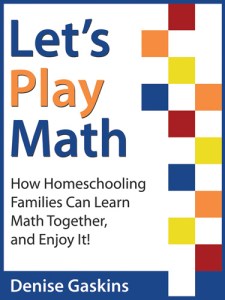
Introducing the “Let’s Play Math!” Book, Beta Version

This blog originally grew out of my Homeschool Math Manuals series published in the 1990s, and when I typed a post, I often added new tips, activities, or examples. Now the stories are coming full circle: I’ve entered the enriched blog-post versions back into the book manuscript, fixed all the typos I could find, deleted obsolete references, and added a list of my favorite “living” math books and internet links.

But no writer can accurately judge her own work. A professional editor is helpful, but he or she can’t see the book with a real homeschooler’s eye. Most writers look for beta-readers among their friends or acquaintances. As we live in a rural area, my supply of potential victims helpers is limited. So I decided to try an ebook experiment: Use Amazon.com to find readers willing to pay the price of a Caramel Macchiato for a pre-publication beta version of my book.

All of the books in the Math Ebooks Beta Series are designed to supplement your current math program — to help you teach math with ANY curriculum. If you would like to help me improve the books, please grab a notepad and jot down your thoughts as you read:

  • Let’s Play Math:
    How Homeschooling Families Can Learn Math Together, and Enjoy It!

    Discover new ways to explore math as a family adventure, playing with ideas. True mathematical thinking involves the same creative reasoning that children use to solve puzzles. Introduce your children to the “Aha!” factor, the thrill of solving a challenging puzzle, and build thinking skills with toys, games, and library books. Find out how to choose math manipulatives, or make your own, and learn how to tackle story problems with confidence. Let’s Play Math will give you a wealth of motivating, hands-on ideas for teaching home school math.

Edited to Add a Clarification

If you are interested in my book but don’t have time to take notes and send me comments, that’s OK. Feel free to take advantage of the beta price anyway — there’s absolutely no obligation.

I hope you and your children enjoy the adventure of learning math together!

Sample from the Introduction to Mathematical Thinking Class

I’m really looking forward to Keith Devlin’s free Introduction to Mathematical Thinking class, which starts in mid-September. There are more than 30,000 nearly 40,000 students signed up already. Will you join us?

These days, mathematics books tend to be awash with symbols, but mathematical notation no more is mathematics than musical notation is music.

A page of sheet music represents a piece of music: the music itself is what you get when the notes on the page are sung or performed on a musical instrument. It is in its performance that the music comes alive and becomes part of our experience. The music exists not on the printed page but in our minds.

The same is true for mathematics. The symbols on a page are just a representation of the mathematics. When read by a competent performer (in this case, someone trained in mathematics), the symbols on the printed page come alive — the mathematics lives and breathes in the mind of the reader like some abstract symphony.

— Keith Devlin
Introduction to Mathematical Thinking

How to Think like a Mathematician

Would you like to learn how to think like a mathematician? Stanford professor (and NPR “Math Guy”) Keith Devlin is teaching a free online course through Coursera. It starts in just a few weeks. I’ve signed up. Will you join us?

The prerequisite is to be taking or have finished high school math. If (like me) you took it so long ago that you can’t quite remember, don’t worry: The focus of the course is not on long-forgotten mathematical procedures, but on “learning to think in a certain (very powerful) way.”

Mathematical thinking is not the same as doing mathematics — at least not as mathematics is typically presented in our school system. School math typically focuses on learning procedures to solve highly stereotyped problems. Professional mathematicians think a certain way to solve real problems, problems that can arise from the everyday world, or from science, or from within mathematics itself.

The key to success in school math is to learn to think inside-the-box. In contrast, a key feature of mathematical thinking is thinking outside-the-box — a valuable ability in today’s world. This course helps to develop that crucial way of thinking.

— Keith Devlin
Introduction to Mathematical Thinking

Continue reading How to Think like a Mathematician

5 Stars at Home School Book Review

Wayne at Home School Book Review just posted a very kind review of my daughter’s book:

Banished is a captivating fantasy story with a well-thought-out plot that would be a credit to any writer. But it is especially remarkable coming from a thirteen-year-old student who has been homeschooled all her life.

However, be forewarned. When you reach the final page and find the words, “Not the End…,” you will cry, “Oh! No!”

I for one feel as if I simply can’t wait to read the next installment to find out what happens to Chris and his friends. It’s that good!