Geometric Math Art, Recovered

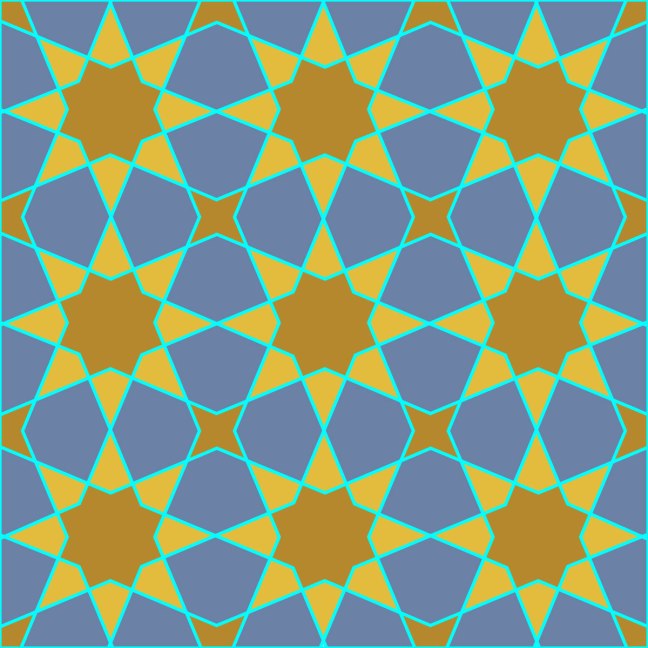
Geometric pattern by Denise Gaskins

I’ve been updating my old book files to a new publishing program, and in the process discovering anew how often websites change and disappear. So frustrating!

Thankfully, the Internet Archive keeps some things that we can look back at. It doesn’t always work, but today it came to the rescue and let me recover the wonderful workbook from the Metropolitan Museum of Art, Islamic Art And Geometric Design, plus some of the pattern pages at the old School of Islamic Geometric Design.

I reference these pages in my Geometric Coloring Designs series (available at my Playful Math Store), so I was glad to find they weren’t lost forever.

Math Art = a great way to spark energy when your students hit the mathematical doldrums.

If you’d like to play around with math art patterns, each image below links to Eric Broug’s step-by-step instructions for creating the design. Also, Broug made printable pages to get students started, which you can download here. No compass construction required!

Pattern 1

Geometric design pattern by Eric Broug

Pattern 2

Geometric design pattern by Eric Broug

Pattern 3

Geometric design pattern by Eric Broug

There are two more patterns on the old SIGD site, but I can’t get those instructions to load. That might be my antique rural internet connection, however, so feel free to do some exploring on your own.

And have fun drawing math with your kids!

 
* * *

Are you looking for more creative ways to play math with your kids? Check out all my books, printable activities, and cool mathy merch at Denise Gaskins’ Playful Math Store. Or join my email newsletter.

This blog is reader-supported. If you’d like to help fund the blog on an on-going basis, then please join me on Patreon for mathy inspiration, tips, and an ever-growing archive of printable activities.

“Geometric Math Art, Recovered” copyright © 2025 by Denise Gaskins. Image at the top of the post copyright © Denise Gaskins.

Two Hands-On Craft Projects

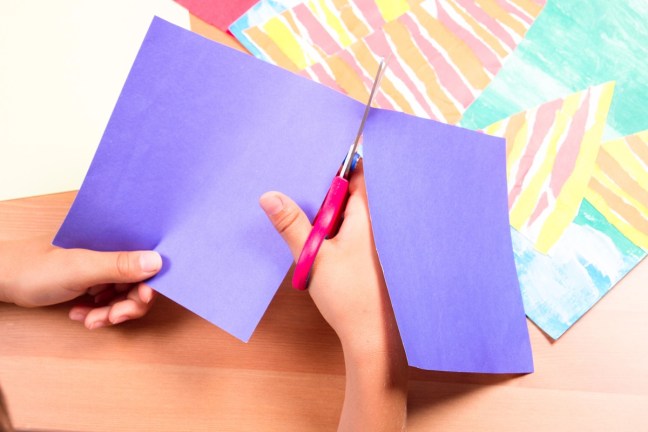
photo: Cutting a paper square

Here are a couple of fun foldable projects to try with your kids.

Both of the projects below start with squares of paper. Do you know how to convert any piece of paper into a square? Here are two methods.

  • Can you tell why they work, how each method creates a true square?
  • What if you didn’t have a rectangular page to start with — could you still create a square?

Minecraft Endless Card

A square flexagon. If you don’t care for Minecraft, just create four square designs of your own to fold, cut, and paste.

https://hattifant.com/minecraft-endless-card-paper-craft

What math do you notice in the finished card? What questions can you ask?

Origami Puzzle Purse

Write a decorative note to a friend, then fold it into a compact little puzzle.

https://hannaleetidd.com/blogs/news/how-to-make-a-victorian-love-token

What do you notice? What do you wonder?

Have fun folding math with your kids!

 
* * *

Are you looking for more creative ways to play math with your kids? Check out all my books, printable activities, and cool mathy merch at Denise Gaskins’ Playful Math Store. Or join my free email newsletter.

This blog is reader-supported. If you’d like to help fund the blog on an on-going basis, then please join me on Patreon for mathy inspiration, tips, and an ever-growing archive of printable activities.

“Two Hands-On Craft Projects” copyright © 2025 by Denise Gaskins. Image at the top of the blog copyright © Vejaa / Depositphotos.

Happy Pythagorean Triple Day!

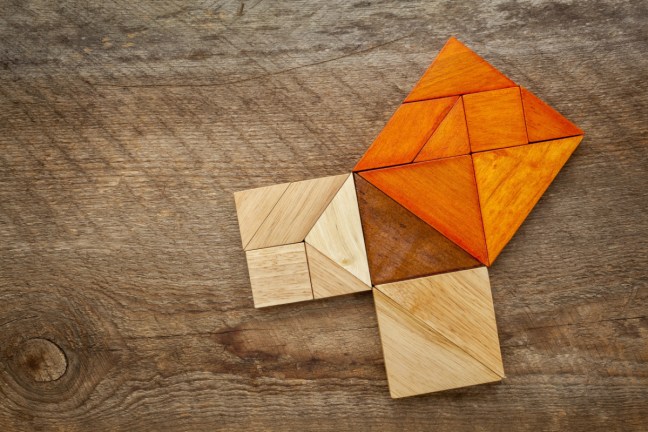
Pythagorean Theorem demonstrated with tangrams

Thursday is Pythagorean Triple Day, one of the rarest math holidays.

The numbers of Thursday’s date: 7/24/25 or 24/7/25, fit the pattern of the Pythagorean Theorem: 7 squared + 24 squared = 25 squared.

Any three numbers that fit the a2 + b2 = c2 pattern form a Pythagorean Triple.

Continue reading Happy Pythagorean Triple Day!

Playful Math for the Summer

playful dog at the beach

I continue to dig myself out of the avalanche of tasks that built up during the years that I spent mostly down south with my mom as she was weakening.

But here are two tidbits of mathy fun that came across my desk recently, which I think you’ll enjoy…

Numberhive Place Value

I think I’ve mentioned before how much I love the Numberhive game. They recently posted a series of print-and-play freebies for their new place value variation.

DiceCulus Core Game — Mini PnP

This cool-looking game is in prelaunch on the crowdfunding site Gamefound, but the creator has posted a free Mini Print & Play version you can download now, suitable for prealgebra and up. (The full game will have multiple variations, including a preschool level.)

Math Journaling and Games

Finally, the Math Journaling Adventures books and kids’ gear are now live in my store, and all my math game books are still on sale through the month of June.

Have fun playing math with your kids!

 
* * *

Are you looking for more creative ways to play math with your kids? Join my free email newsletter.

This blog is reader-supported. If you’d like to help fund the blog on an on-going basis, then please join me on Patreon for mathy inspiration, tips, and an ever-growing archive of printable activities.

“Playful Math for the Summer” copyright © 2025 by Denise Gaskins. Image at the top of the post copyright © damedeeso / Depositphotos.

Monday is Square Root Day

square tree with roots

On May 5, we celebrate one of the rarest math holidays: Square Root Day, 5/5/25.

Here are a few ideas for playing math with squares and roots.

What is a Square Root?

Five is the square root of twenty-five, which means it is the number we can “square” (multiply times itself) to get 25.

The root is the base number from which the square grows. In physical terms, it is the side of the square.

Imagine a straight segment of length 5, perhaps a stick or a piece of chalk. Now lay that segment down and slide it sideways for a distance equal to its length. Drag the stick across sand, or pull the chalk across paper or a slate.

Notice how this sideways motion transforms the one-dimensional length into a two-dimensional shape, a square.

The area of this shape is the square of its root: 5 × 5 = 25.

What do you think would happen if you could drag the square through a third dimension, or drag that resulting shape through a fourth dimension?
How many shapes do you suppose might grow from that original root of 5?

Continue reading Monday is Square Root Day

Math Journal: Playing with My Own Ignorance

photo of a girl wondering about math

Mary Everest Boole, wife of English mathematician George Boole, once described algebra as “thinking logically about the fact of our own ignorance.”

This definition made me chuckle. Like any human being, I am ignorant on many things, but I usually avoid thinking about that.

So I wondered what would happen if I took Mrs. Boole’s advice and tried thinking logically about my ignorance.

How far could I go?

Perhaps you’d like to try this experiment with your children. All you need is a pen and paper or a whiteboard and markers and a bit of curiosity.

Math Journaling Adventures series by Denise GaskinsAnd if you enjoy this exploration, check out my Math Journaling Adventures project to discover how playful writing activities can help your students learn mathematics. Preorder your books today!

Continue reading Math Journal: Playing with My Own Ignorance

Playful Math 179: Our Sweet Sixteen Carnival

Welcome to the sweet-16 birthday edition of the Playful Math Carnival. Originally called Math Teachers at Play, our first carnival was published in February 2009.

Each Playful Math Carnival offers a smorgasbord of delectable tidbits of mathy fun. It’s like a free online magazine devoted to learning, teaching, and playing around with math from preschool to high school.

There’s so much playful math to enjoy!

By tradition, we start the carnival with a math activity in honor of our 179th edition. But if you’d rather jump straight to our featured blog posts, click here to see the Table of Contents.

NOTE: Our wonderful volunteer hosts have kept the Playful Math Carnival going when so many other blog carnivals died off. If you’d like to sign up to host the carnival for a month, email Denise for information.

Try These Prime Puzzles

Did you know there are 179 even-numbered days this year?

  • How many even-numbered days will there be in a leap year?
  • But there are 365 days in a standard year and 366 in a leap year. Shouldn’t there be half that many even-numbered days?

179 is a prime number, and it’s also a knockout prime. You can knock out any of the digits, and what’s left is still prime: 17, 19, or 79.

  • Can you find another knockout prime number?

179 is a twin prime. That means that one of its odd-numbered neighbors is also prime.

  • Is the other twin 177 or 181? Can you tell without looking it up?
  • Why are twin primes limited to the odd numbers? That doesn’t seem fair!

179 is also an emirp. That’s a special kind of prime that forms a different prime number when you write it backwards: 971 is also prime.

  • How many emirps can you find?

“A palindrome is a word that when written in reverse results in the same word. for example, ‘racecar’ reversed is still ‘racecar’. Related to palindromes are semordnilaps. These are words that when written in reverse result in a distinct valid word. For example, ‘stressed’ written in reverse is ‘desserts’. Not all words are palindromes or semordnilaps.

    “While certainly not all numbers are palindromes, all non-palindromic numbers when written in reverse will form semordnilaps.

      “Narrowing to primes brings back the same trichotomy as with words: some numbers are emirps, some numbers are palindromic primes, but some are neither.”

      The On-Line Encyclopedia of Integer Sequences A006567

      Click here for all the mathy goodness!
      Holiday Countdown Craft

      photo of calendar and hourglass timer

      Marking time is hard for children (and often for us adults, as well).

      I don’t mean telling time, which has its own difficulties. But waiting, marking time until the Big Day or Important Event arrives.

      Whether you’re counting down the days to Christmas, or the hours until New Year’s Day, or waiting for a birthday or visit to Grandma — it’s never easy to sit idly during the interim.

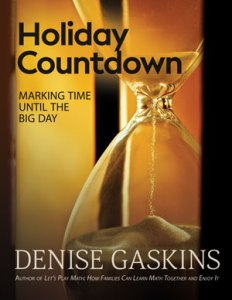
      Holiday Countdown

      Holiday Countdown craft bookHere’s a fun little craft that can make the waiting easier, or at least make it easier to keep track of how much longer until the time is right.

      It’s a spinning time-piece for kids to decorate and put together (with a bit of adult help wielding a craft knife).

      Holiday Countdown is a 28-page printable file includes illustrated instructions, along with countdown timers for birthday, Christmas, and New Year’s Eve celebrations, plus blank timers you can adapt to any occasion.

      Buy Now

      Mandala Version, with Video Instructions

      The ever-creative Manja designed a mandala-coloring version of the countdown timer for New Year’s Eve. Read all about it (and find the download links) on her Hattifant blog.

       
      * * *

      Are you looking for more creative ways to play math with your kids? Check out all my books, printable activities, and cool mathy merch at Denise Gaskins’ Playful Math Store. Or join my email newsletter.

      This blog is reader-supported. If you’d like to help fund the blog on an on-going basis, then please join me on Patreon for mathy inspiration, tips, and an ever-growing archive of printable activities.

      “Holiday Countdown Craft” copyright © 2024 by Denise Gaskins. Image at the top of the post copyright © BrianAJackson / Depositphotos.

      Celebrating Spring with Playful Math Carnival 172

      Playful Math Carnival 172

      Welcome to the 172nd edition of the Playful Math Blog Carnival, a buffet of delectable tidbits of mathy fun. It’s like a free online magazine devoted to learning, teaching, and playing around with math from preschool to high school.

      The carnival went on hiatus for a couple of months due to unexpected life issues facing our volunteer hosts. But we’re back now, and ready to celebrate!

      By tradition, we start the carnival with a puzzle in honor of our 172nd edition. But if you’d rather jump straight to our featured blog posts, click here for the Table of Contents.

      Try This: Lazy Caterers and Clock-Binary Numbers

      172 is a lazy caterer number: Imaging a caterer who brought a single large pie to serve the whole party. He needs to cut it into as many pieces as he can, using the fewest (straight) cuts he can get away with.

      • If each guest gets one piece of pie, what sizes of parties (numbers of people) can the lazy caterer serve?
      • Can you find a pattern in the lazy caterer sequence?

      But for those of you who have followed the carnival for years, you may remember we played with the lazy caterer back in Playful Math 106. (That time, the caterer was serving pizza.) So here’s a bonus activity we’ve never done before…

      The first several stages of a pattern are as follows:

      Clock Binary pattern image

      • What do you notice about this pattern of shapes?
      • What is the next shape in the sequence?
      • Can you figure out how the shape below fits into the pattern?

      Clock Binary puzzle image

      This pattern sequence was named clock binary by its creator, noelements-setempty.

      • What questions can you ask about this sequence?
      • How are these shapes like the binary numbers?
      • How are they different?

      Click here for all the mathy goodness!
      Playful Math Education Carnival 171: Modern Math Artists

      Welcome to the 171st edition of the Playful Math Education Blog Carnival — a smorgasbord of delectable tidbits of mathy fun. It’s like a free online magazine devoted to learning, teaching, and playing around with math from preschool to high school.

      Bookmark this post, so you can take your time browsing over the next week or so.

      There’s so much playful math to enjoy!

      By tradition, we start the carnival with a puzzle/activity in honor of our 171st edition. But if you’d rather jump straight to our featured blog posts, click here to see the Table of Contents.

      Try This Puzzle/Activity

      171 is a triangular number, the sum of all the numbers from 1 to 18:

      • 1 + 2 + 3 + … + 17 + 18 = 171.
      • Can you think why a number like this is called “triangular”?
      • What other triangular numbers can you find?

      Also, 171 is a palindrome number, with the same digits forward and backward. It’s also a palindrome of powers:

      • 171 = 52 + 112 + 52
      • 171 = 23 + 43 + 33 + 43 + 23

      So in honor of our 171st Playful Math Carnival, here is a palindrome puzzle that leads to an unsolved question in math:

      • Does every number turn into a palindrome eventually?

      palindrome number activity

      Click here for all the mathy goodness!