Graph-It Game

[Photo by Scott Schram via Flickr.]

For Leon’s Christmas gift, Alex made the Graph-It game. She wrapped a pad of graph paper and wrote up the instructions:

To play Graph-It, one person designs a picture made by connecting points on a coordinate graph. He reads the points to the other player, who tries to reproduce the picture.

Continue reading Graph-It Game

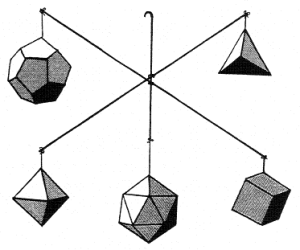
Renée’s Platonic Mobile

Alexandria Jones struggled to think of a Christmas gift that a one-month-old baby could enjoy, but finally she got an idea.

She cut empty cereal boxes to make regular polygons: 6 squares, 12 regular pentagons, and 32 equilateral triangles. Using small pieces of masking tape, she carefully formed the five Platonic solids. Then she mixed flour and water into a runny paste. She tore an old newspaper into small strips and soaked them in the paste. She covered each solid with a thin layer of paper.

Continue reading Renée’s Platonic Mobile

Math Storytelling Day

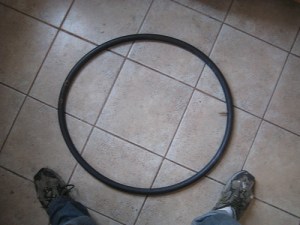
Check out Nick Johnson’s Story of the innertube as a histogram.

Celebrate Math Storytelling Day by making up and sharing math stories. Everyone loves a story, so this is a great way to motivate your children to play around with math. What might a math story involve? Patterns, logic, history, puzzles, relationships, fictional characters, … and yes, even numbers.

What story will you tell?

 
* * *

This blog is reader-supported.

If you’d like to help fund the blog on an on-going basis, then please head to my Patreon page.

If you liked this post, and want to show your one-time appreciation, the place to do that is PayPal: paypal.me/DeniseGaskinsMath. If you go that route, please include your email address in the notes section, so I can say thank you.

Which I am going to say right now. Thank you!

“Math Storytelling Day” copyright © 2010 by Denise Gaskins. Image at the top of the post copyright © Nick Johnson via Flickr (CC BY 2.0).

Math Project: Measure the Earth

Tomorrow, September 23, is the equinox — when night and day are equally balanced (or would be, if the sun appeared as a point, rather than a disc). If we lived on the equator, the sun would appear directly overhead at noon and would cast no shadow. Therefore, it’s a great day to perform Eratosthenes’ experiment of measuring the earth:

Continue reading Math Project: Measure the Earth

Alexandria Jones and the Mathematical Carnival

Alexandria JonesMaria Jones hung up the phone and collapsed at the kitchen table. She buried her head in her hands and groaned. Alex looked up from her game of Solitaire.

“Let me guess,” she said. “Can’t-Say-No Syndrome, again?”

Mrs. Jones nodded. “This time I volunteered to plan an activity for next month’s homeschool group meeting.”

Leon wandered in and pulled an apple from the fruit bowl. “Ha!” he said. “She means she volunteered us to plan an activity, right?”

Mrs. Jones smiled. “That’s my motto: When in doubt, delegate!”

Continue reading Alexandria Jones and the Mathematical Carnival

Sept-Oct 2010 Math Calendars

As I was preparing for Wednesday’s Homeschool Math Club Games & Activities meeting, I remembered my old math calendars and thought, that would be a fun activity to offer. So I pulled up the files and discovered that the days of the week matched perfectly. What a cool coincidence!

So in case you missed the math calendars last year, or in case it’s been long enough that your children have forgotten, here are the “new” versions:

Addendum

Umm Ahmad created an easier version for young students:

Continue reading Sept-Oct 2010 Math Calendars

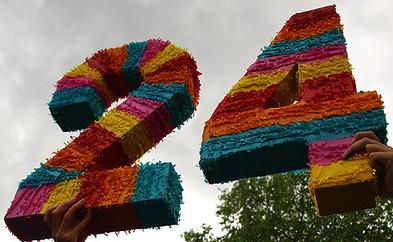
Math Teachers at Play #24

[Photo by internets_dairy.]

Welcome to the Math Teachers At Play blog carnival — which is not just for math teachers! If you like to learn new things and play around with ideas, you are sure to find something of interest. Let’s start the mathematical fun with an arithmetic card game in honor of our 24th edition and a few number puzzles:

Continue reading Math Teachers at Play #24

Game: Target Number (or 24)

[Photo by stevendepolo via Flickr (CC BY 2.0).]

Math concepts: addition, subtraction, multiplication, division, powers and roots, factorial, mental math, multi-step thinking
Number of players: any number
Equipment: deck of math cards, pencils and scratch paper, timer (optional)

Set Up

All players must agree on a Target Number for the game. Try to choose a number that has several factors, which means there will be a variety of ways to make it. Traditionally, I start my math club students with a target of 24.

Shuffle the deck, and deal four cards face down to each player. (For larger target numbers, such as 48 or 100, deal five or six cards to each player.) The players must leave the cards face down until everyone is ready. Set the remainder of the deck to one side.

Continue reading Game: Target Number (or 24)
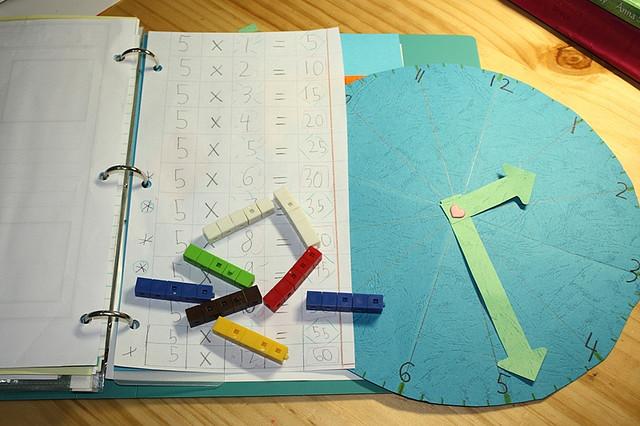
Prime Numbers Are like Monkeys

[Photo by mape_s.]

I’m afraid that Math Club may have fallen victim to the economy, which is worse in our town than in the nation in general. Homeschooling families have tight budgets even in the best of times, and now they seem to be cutting back all non-essentials. I assumed that last semester’s students would return, but I should have asked for an RSVP.

Still, Kitten and I had a fun time together. We played four rounds of Tens Concentration, since I had spread out cards on the tables in the library meeting room before we realized that no one was coming. Had to pick up the cards one way or another, so we figured we might as well enjoy them! She won the first two rounds, which put her in a good mood for our lesson.

I had written “Prime numbers are like monkeys!” on the whiteboard, and Kitten asked me what that meant. That was all the encouragement I needed to launch into my planned lesson, despite the frustrating dearth of students. The idea is taken from Danica McKellar’s book Math Doesn’t Suck.

Continue reading Prime Numbers Are like Monkeys