Penguin Math: Elementary Problem Solving 2nd Grade

The ability to solve word problems ranks high on any math teacher’s list of goals. How can I teach my students to reason their way through math problems? I must help my students develop the ability to translate “real world” situations into mathematical language.

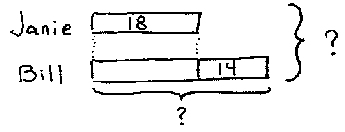
In a previous post, I analyzed two problem-solving tools we can teach our students: algebra and bar diagrams. These tools help our students organize the information in a word problem and translate it into a mathematical calculation.
Now I want to demonstrate these problem-solving tools in action with a series of 2nd grade problems, based on the Singapore Primary Math series, level 2A. For your reading pleasure, I have translated the problems into the universe of one of our family’s favorite read-aloud books, Mr. Popper’s Penguins.

UPDATE: Problems have been genericized to avoid copyright issues.

Continue reading Penguin Math: Elementary Problem Solving 2nd Grade

Elementary Problem Solving: The Tools

[This article begins a series rescued from my old blog. Moving has been a long process, but I’m finally unpacking the last cardboard box! To read the entire series, click here: elementary problem solving series.]

Most young students solve story problems by the flash of insight method: When they read the problem, they know almost instinctively how to solve it. This is fine for problems like:

There are 7 children. 2 of them are girls. How many boys are there?

As problems get more difficult, however, that flash of insight becomes less reliable, so we find our students staring blankly at their paper or out the window. They complain, “I don’t know what to do. It’s too hard!”

We need to give our students a tool that will help them when insight fails.

Continue reading Elementary Problem Solving: The Tools

See You Later! (Quotations XI)

We will be heading out soon on vacation, so I will not be blogging for awhile. The rest of this week is devoted to packing. (I hate packing!) But before I leave, here is a longish quote on teaching math from the book I am reading this week: Ian Stewart’s Letters to a Young Mathematician.

A second reason why few students ever realize that there is mathematics outside the textbook is that no one ever tells them that.

I don’t blame the teachers… If your students are having problems remembering how to solve quadratic equations, the wise teacher will stay well clear of cubic equations, which are even more difficult….

Continue reading See You Later! (Quotations XI)

Mathematics and Imagination

Comments by W. W. Sawyer, in his wonderful, little book, Mathematician’s Delight:

Earlier we considered the argument, ‘Twice two must be four, because we cannot imagine it otherwise.’ This argument brings out clearly the connexion between reason and imagination: reason is in fact neither more nor less than an experiment carried out in the imagination.

Continue reading Mathematics and Imagination