Math Teachers at Play #52

[Photo by bumeister1 via flickr.]

Welcome to the Math Teachers At Play blog carnival — which is not just for math teachers! We have games, lessons, and learning activities from preschool math to calculus. If you like to learn new things and play around with mathematical ideas, you are sure to find something of interest.

Scattered between all the math blog links, I’ve included highlights from the Common Core Standards for Mathematical Practice, which describe the types of expertise that teachers at all levels — whether in traditional, experimental, or home schools — should seek to develop in their math students.

Let the mathematical fun begin…

TRY THESE PUZZLES

By tradition, we start the carnival with a couple of puzzles in honor of our 52nd edition. Since there are 52 playing cards in a standard deck, I chose two card puzzles from the Maths Is Fun Card Puzzles page:

  • A blind-folded man is handed a deck of 52 cards and told that exactly 10 of these cards are facing up. How can he divide the cards into two piles (which may be of different sizes) with each pile having the same number of cards facing up?
  • What is the smallest number of cards you must take from a 52-card deck to be guaranteed at least one four-of-a-kind?

The answers are at Maths Is Fun, but don’t look there. Having someone give you the answer is no fun at all!

Continue reading Math Teachers at Play #52

How Crazy Can You Make It?

And here is yet more fun from Education Unboxed. This type of page was always one of my my favorites in Miquon Math.

Update:

Handmade “How Crazy…?” worksheets are wonderful, but if you want something a tad more polished, I created a printable. The first page has a sample number, and the second is blank so that you can fill in any target:

Add an extra degree of freedom: students can fill in the blanks with equivalent and non-equivalent expressions. Draw lines anchoring the ones that are equivalent to the target number, but leave the non-answers floating in space.

Or don’t draw lines. Let the kids create a worksheet for you to solve. After they finish their expressions, can you figure out which ones connect to the target number?

How CRAZY Can You Make It

PUFM 1.4 Subtraction

Photo by Martin Thomas via flickr. In this Homeschooling Math with Profound Understanding (PUFM) Series, we are studying Elementary Mathematics for Teachers and applying its lessons to home education.

When adding, we combine two addends to get a sum. For subtraction we are given the sum and one addend and must find the “missing addend”.

— Thomas H. Parker & Scott J. Baldridge
Elementary Mathematics for Teachers

Notice that subtraction is not defined independently of addition. It must be taught along with addition, as an inverse (or mirror-image) operation. The basic question of subtraction is, “What would I have to add to this number, to get that number?”

Inverse operations are a very fundamental idea in mathematics. The inverse of any math operation is whatever will get you back to where you started. In order to fully understand a math operation, you must understand its inverse.

Continue reading PUFM 1.4 Subtraction

Multiplication Challenge

Can you explain why the multiplication method in the following video works? How about your upper-elementary or middle school students — can they explain it to you?

Pause the video at 4:30, before he gives the interpretation himself. After you have decided how you would explain it, hit “play” and listen to his explanation.

Continue reading Multiplication Challenge

PUFM 1.2 Place Value

Photo by Chrissy Johnson1 via flickr. In this Homeschooling Math with Profound Understanding (PUFM) Series, we are studying Elementary Mathematics for Teachers and applying its lessons to home education.

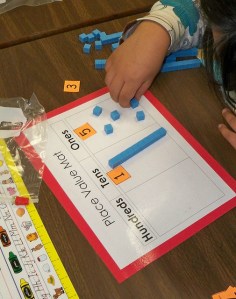
Our decimal system of recording numbers is ingenious. Once learned, it is a simple, versatile, and efficient way of writing numbers. … But the system is not obvious nor easily learned. The use of place value is subtle, and mastering it is the single most challenging aspect of elementary school mathematics.

Ironically, these challenges are largely invisible to untrained parents and teachers — place value is so ingrained in adults’ minds that it is difficult to appreciate how important it is and how hard it is to learn.

— Thomas H. Parker & Scott J. Baldridge
Elementary Mathematics for Teachers

In other words, we take place value for granted. I know this was true of me when I started teaching my kids. Every year, their textbooks would start with the obligatory chapters on place value, which seemed to me just busywork. I began to appreciate the vital importance of place value when I read Liping Ma’s book and saw how the American teachers were unable to properly explain subtraction or multi-digit multiplication.

Place value is the heart of our number system, the foundation on which all the rest of arithmetic must be built. Because of place value, “The simplest schoolboy is now familiar with facts for which Archimedes would have sacrificed his life.”

Continue reading PUFM 1.2 Place Value

Math Teachers at Play #46: Living Books for Math

Welcome to the Math Teachers At Play blog carnival — which is not just for math teachers! Here is a smorgasbord of ideas for learning, teaching, and playing around with math from preschool to pre-college. Some articles were submitted by their authors, others were drawn from the immense backlog in my blog reader. If you like to learn new things, you are sure to find something of interest.

Living Books for Math

A child’s intercourse must always be with good books, the best that we can find… We must put into their hands the sources which we must needs use for ourselves, the best books of the best writers.
…
For the mind is capable of dealing with only one kind of food; it lives, grows and is nourished upon ideas only; mere information is to it as a meal of sawdust to the body.

— Charlotte Mason
Toward A Philosophy of Education

Princess Kitten and I took a longer than usual holiday break from homeschooling, but now I’m in plan-for-the-new-semester mode. I hope to include more living math in our schedule, so I decided to illustrate this edition of the MTaP carnival with a few of my favorite living math books. I’d love to hear more living book suggestions in the comments!

If you click on a book cover, the links take you to Amazon.com, where you can read reviews and other details (and where I earn a small affiliate commission if you actually buy the book), but all of these books should be available through your public library or via inter-library loan.

Let the mathematical fun begin…

Continue reading Math Teachers at Play #46: Living Books for Math

2012 Mathematics Game

photo by Creativity103 via flickr

For our homeschool, January is the time to assess our progress and make a few New Semester’s Resolutions. This year, we resolve to challenge ourselves to more math puzzles. Would you like to join us? Pump up your mental muscles with the 2012 Mathematics Game!

Rules of the Game

Use the digits in the year 2012 to write mathematical expressions for the counting numbers 1 through 100.

Bonus Rules
You may use the overhead-bar (vinculum), dots, or brackets to mark a repeating decimal.

You may use multifactorials:

  • n!! = a double factorial = the product of all integers from 1 to n that have the same parity (odd or even) as n.
  • n!!! = a triple factorial = the product of all integers from 1 to n that are equal to n mod 3

[Note to teachers: Math Forum modified their rules to allow double factorials, but as far as I know, they do not allow repeating decimals or triple factorials.]

Continue reading 2012 Mathematics Game