Giveaway: Hexa-Trex Puzzle Book

Bogusia Gierus, host of this month’s Math Teachers at Play blog carnival, is offering to give away her First Book of Hexa-Trex Puzzles for just the cost of shipping. How generous!

My math club had fun with several of these puzzles a few years ago, and the “Easy” ones (like the sample shown here) were just right for my 4th-5th grade students. One girl enjoyed them enough that she took home extra copies to share with her father.
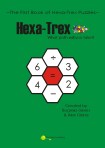
It’s a thin book, just the right size for a stocking-stuffer. To see the full range of difficulty levels, look over the puzzles on Bogusia’s Daily Hexa-Trex page. To get your own copy of the book, read the giveaway instructions on Bogusia’s blog.

Object of the Puzzle

The object of the puzzle is to find the equation pathway that leads through ALL the tiles.

Forming Equations

  • Two or three (or four or five etc.) digit numbers are made up of the individual tiles in the particular order as the equation is read. For example 5 x 5 = 2 5 is correct, but read backwards 5 2 = 5 x 5 is incorrect.
  • The equation must be continuous (no jumping over tiles or empty spaces).
  • Each tile can be used ONLY ONCE.
  • Order of operations is followed. Multiplication and division comes before addition and subtraction.
  • The tile “-” can be used as both a subtraction operation or a negative sign in front of a digit, making it a negative number.
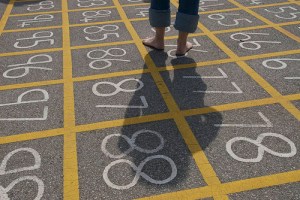
What to Do with a Hundred Chart #27

[Photo by geishaboy500.]

It began with a humble list of 7 things to do with a hundred chart in one of my out-of-print books about teaching home school math. Over the years I added a few new ideas, and online friends contributed still more, so the list grew to its current length of 26. Recently, thanks to several fans at pinterest, it has become the most popular post on my blog:

Now I am working several hours a day revising my old math books, in preparation for publishing new, much-expanded editions. And as I typed in all the new things to do with a hundred chart, I thought of one more to add to the list:

(27) How many numbers are there from 11 to 25? Are you sure? What does it mean to count from one number to another? When you count, do you include the first number, or the last one, or both, or neither? Talk about inclusive and exclusive counting, and then make up counting puzzles for each other.

Share Your Ideas

Can you think of anything else we might do with a hundred chart? Add your ideas in the Comments section below, and I’ll add the best ones to our master list.

How to Conquer the Times Table, Part 5

Photo of Lex times 11, by Dan DeChiaro, via flickr.

We are finishing up an experiment in mental math, using the world’s oldest interactive game — conversation — to explore multiplication patterns while memorizing as little as possible.

Take your time to fix each of these patterns in mind. Ask questions of your student, and let her quiz you, too. Discuss a variety of ways to find each answer. Use the card game Once Through the Deck (explained in part 3)as a quick method to test your memory. When you feel comfortable with each number pattern, when you are able to apply it to most of the numbers you and your child can think of, then mark off that row and column on your times table chart.

So far, we have studied the times-1 and times-10 families and the Commutative Property (that you can multiply numbers in any order). Then we memorized the doubles and mastered the facts built on them. And then last time we worked on the square numbers and their next-door neighbors.

Continue reading How to Conquer the Times Table, Part 5

How to Conquer the Times Table, Part 4

Photo of Miss Karen (and computer) times 3, by Karen, via flickr.

If you remember, we are in the middle of an experiment in mental math. We are using the world’s oldest interactive game — conversation — to explore multiplication patterns while memorizing as little as possible. So far, we have studied the times-1 and times-10 families and the Commutative Property (that you can multiply numbers in any order). Then we memorized the doubles and mastered the facts built on them.

Continue reading How to Conquer the Times Table, Part 4

How to Understand Fraction Division

photo by Scott Robinson via flickr

A comment on my post Fraction Division — A Poem deserves a longer answer than I was able to type in the comment reply box. Whitecorp wrote:

Incidentally, this reminds me of a scene from a Japanese anime, where a young girl gets her elder sister to explain why 1/2 divided by 1/4 equals 2. The elder girl replies without skipping a heartbeat: you simply invert the 1/4 to become 4/1 and hence 1/2 times 4 equals 2.

The young one isn’t convinced, and asks how on earth it is possible to divide something by a quarter — she reasons you can cut a pie into 4 pieces, but how do you cut a pie into one quarter pieces? The elder one was at a loss, and simply told her to “accept it” and move on.

How would you explain the above in a manner which makes sense?

Continue reading How to Understand Fraction Division

How to Conquer the Times Table, Part 3

Photo of Javier times 4, by Javier Ignacio Acuña Ditzel, via flickr.

If you remember, we are in the middle of an experiment in mental math. We are using the world’s oldest interactive game — conversation — to explore multiplication patterns while memorizing as little as possible. Talk through these patterns with your student. Work many, many, many oral math problems together. Discuss the different ways you can find each answer, and notice how the number patterns connect to each other.

So far, we have mastered the times-1 and times-10 families and the Commutative Property (that you can multiply numbers in any order).

Continue reading How to Conquer the Times Table, Part 3

How to Conquer the Times Table, Part 2

Photo of Eeva times 6, by Eric Horst, via flickr.

The question is common on parenting forums:

My daughter is in 4th grade. She has been studying multiplication in school for nearly a year, but she still stumbles over the facts and counts on her fingers. How can I help her?

Many people resort to flashcards and worksheets in such situations, and computer games that flash the math facts are quite popular with parents. I recommend a different approach: Challenge your student to a joint experiment in mental math. Over the next two months, without flashcards or memory drill, how many math facts can the two of you learn together?

We will use the world’s oldest interactive game — conversation — to explore multiplication patterns while memorizing as little as possible.

Continue reading How to Conquer the Times Table, Part 2

How to Conquer the Times Table, Part 1

Photo of Evil Erin times 5 (and dog times 2), via flickr.

Perhaps the biggest challenge for any middle-elementary math student is to master the multiplication facts. It can seem like an unending task to memorize so many facts and be able to pull them out of mental storage in any order on demand. Too often, the rote aspect of such memory work overwhelms students, eclipsing their view of the principles behind the math. Yet rote memory is not enough: A student may be able to recite the times tables perfectly and still be reduced to counting on fingers in the middle of a long division problem.

We will use the world’s oldest interactive game — conversation — to learn the multiplication facts one bite at a time. But first, let’s take some time to think about what multiplication really means.

Continue reading How to Conquer the Times Table, Part 1