Math Game Monday: Domino Fraction War

Learn a new math game every week, for free

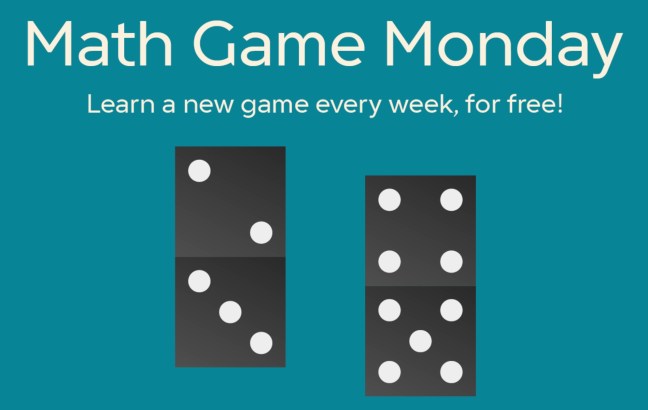
This game offers upper-elementary and middle school students plenty of practice doing estimation and mental math with fractions.

Many parents remember struggling to learn math. We hope to provide a better experience for our children.

And one of the best ways for children to enjoy learning is through hands-on play.

Domino Fraction War

Math Concepts: proper fractions, comparing fractions.

Players: two or more.

Equipment: one set of double-six or double-nine dominoes.

Continue reading Math Game Monday: Domino Fraction War

Musings: Math is Communication

Young boy writing math expressions

The question came up on a homeschool math forum:

“My first grader and I were playing with equivalent expressions. We were trying to see how many ways we could write the value ‘3.’

    “He wrote down 10 – 2 × 3 + 1.

      “When I tried to explain the problem with his calculation, he got frustrated and didn’t want to do math.

        “How can I help him understand order of operations?”

        [If you think this sounds like too complex of a math expression for a first grader, you may want to read my blog post about math manipulatives and big ideas.]

        Order of operations doesn’t matter in this instance. What matters is communication.

        The mother didn’t know how to read what her son wrote.

        He could help her understand by putting parentheses around the part he wanted her to read first.

        He doesn’t need to know abstract rules for arbitrary calculations, or all the different ways we might possibly misunderstand each other. He just needs to know how to say what is in his mind.

        Continue reading Musings: Math is Communication

        Math Game Monday: Nine Cards

        Learn a new math game every week, for free

        This game helps young children build mental math skills. And it’s fun for older kids or adults to play along!

        Many parents remember struggling to learn math. We hope to provide a better experience for our children.

        And one of the best ways for children to enjoy learning is through hands-on play.

        Nine Cards

        Math Concepts: addition, number bonds for ten.

        Players: two or more.

        Equipment: one deck of playing cards, face cards and jokers removed.

        Continue reading Math Game Monday: Nine Cards

        Math Game Monday: Dollar Derby

        Learn a new math game every week, for free

        This simple counting game helps children grow comfortable with 2-digit numbers and learn the value of coins.

        Many parents remember struggling to learn math. We hope to provide a better experience for our children.

        And one of the best ways for children to enjoy learning is through hands-on play.

        Dollar Derby

        Math Concepts: counting, addition, coin value.

        Players: two or more.

        Equipment: printed hundred charts, six-sided dice, and a large pile of assorted coins.

        Continue reading Math Game Monday: Dollar Derby

        Math Game Monday: Cross-Twenties

        Learn a new math game every week, for free

        This game gives young children practice adding numbers within twenty. And it’s great strategic fun for all ages!

        Many parents remember struggling to learn math. We hope to provide a better experience for our children.

        And one of the best ways for children to enjoy learning is through hands-on play.

        Cross-Twenties

        Math Concepts: addition to twenty, thinking ahead.

        Players: two or more.

        Equipment: two decks of playing cards (face cards removed), six tokens per player.

        Continue reading Math Game Monday: Cross-Twenties

        Mental Math: Advanced Subtraction

        mother and daughter talking about math homework

        As our children grow and develop their math skills, the mental math strategies grow with them.

        The basics of mental math don’t change:

        • Use friendly numbers.
        • Estimate and adjust the answer.

        But we have new ways to help children do math in their heads as the numbers get bigger and the problems more challenging.

        For example, how might kids figure out a multi-digit subtraction like 67 − 38?

        First, we need to adjust our mindset…

        Continue reading Mental Math: Advanced Subtraction

        Mental Math: Advanced Addition

        photo of kids having fun with math

        Mental math is doing calculations with our minds, and perhaps with the aid of scratch paper or a whiteboard to jot down notes along the way.

        But we cannot simply transfer the standard pencil-and-paper calculations to a mental chalkboard. That’s far too complicated.

        We still want to follow our basic strategies of using friendly numbers, estimating, and adjusting the answer. So how can we help children do math in their heads as the numbers get bigger and the problems more challenging?

        How might kids figure out a multi-digit addition like 87 + 39?

        Here are three useful strategies…

        Continue reading Mental Math: Advanced Addition

        Mental Math: Early Division

        Boy doing mental math calculation

        Mental math is doing calculations with our minds, though we can use scratch paper or whiteboards to make notes as we work.

        Doing mental math, children use the basic principles of arithmetic to simplify problems so they can think about number relationships, mastering the basic structures of how numbers work, the same structures that underlie algebraic reasoning.

        As always, we rely on two key mental-math strategies.

        • Use friendly numbers.
        • Estimate, then adjust.

        Division is the mirror image of multiplication, the inverse operation that undoes multiplication, which means we are scaling numbers down into smaller parts. Important friendly numbers include halves, thirds, and tenths, plus the square numbers and any multiplication facts the student happens to remember.

        Continue reading Mental Math: Early Division

        Mental Math: Early Multiplication

        mother and daughter talking math together

        Children learn best through interaction with others, and mental math prompts can lead to fascinating conversations, listening as our kids apply their creativity to the many ways numbers interact.

        With mental math, students master the true 3R’s of math: to Recognize and Reason about the Relationships between numbers.

        And these 3Rs are the foundation of algebra, which explains why flexibility and confidence in mental math is one of the best predictors of success in high school math and beyond.

        Let’s Try an Example

        Multiplication involves scaling one number by another, making it grow twice as big, or three times as much, or eightfold the size. Multiplication by a fraction scales the opposite direction, shrinking to half or a third or five-ninths the original amount.

        The key friendly numbers for multiplication and division are the doubles and the square numbers. As with addition and subtraction, students can estimate the answer using any math facts they know and then adjust as needed.

        How many ways might children think their way through the most-missed multiplication fact, 8 × 7?

        Continue reading Mental Math: Early Multiplication

        FAQ: Can I Use Your Books as a Math Curriculum?

        Father helping girl with math homework

        I recently listened to you on Cindy Rollins’ podcast, and I was captivated by your perspective on math. It was exciting, freeing, and wonder-filled. I would absolutely love to be able to teach in the ways you described.

          We use early-elementary Saxon Math right now, which is thorough, but has SO MUCH to do that I’ve always struggled to do it all. Then I feel like I’m missing things, and I never know quite what is important. And yet, the actual lessons move so slowly that my kids get bored with the repetition.

            I use a published curriculum because I have no idea of an appropriate scope and sequence, or similar flow of learning. With your playful approach to math, how do I know where to start, and what to do each day?

              Do you have a suggested order to approach your books to have a full math approach? A sort of curriculum, per se, using your books.

              [For those who missed my chat with Cindy Rollins about a Charlotte Mason approach to math, you can listen to it here.]

              Continue reading FAQ: Can I Use Your Books as a Math Curriculum?