Mental Math: Early Multiplication

mother and daughter talking math together

Children learn best through interaction with others, and mental math prompts can lead to fascinating conversations, listening as our kids apply their creativity to the many ways numbers interact.

With mental math, students master the true 3R’s of math: to Recognize and Reason about the Relationships between numbers.

And these 3Rs are the foundation of algebra, which explains why flexibility and confidence in mental math is one of the best predictors of success in high school math and beyond.

Let’s Try an Example

Multiplication involves scaling one number by another, making it grow twice as big, or three times as much, or eightfold the size. Multiplication by a fraction scales the opposite direction, shrinking to half or a third or five-ninths the original amount.

The key friendly numbers for multiplication and division are the doubles and the square numbers. As with addition and subtraction, students can estimate the answer using any math facts they know and then adjust as needed.

How many ways might children think their way through the most-missed multiplication fact, 8 × 7?

Continue reading Mental Math: Early Multiplication

FAQ: Can I Use Your Books as a Math Curriculum?

Father helping girl with math homework

I recently listened to you on Cindy Rollins’ podcast, and I was captivated by your perspective on math. It was exciting, freeing, and wonder-filled. I would absolutely love to be able to teach in the ways you described.

    We use early-elementary Saxon Math right now, which is thorough, but has SO MUCH to do that I’ve always struggled to do it all. Then I feel like I’m missing things, and I never know quite what is important. And yet, the actual lessons move so slowly that my kids get bored with the repetition.

      I use a published curriculum because I have no idea of an appropriate scope and sequence, or similar flow of learning. With your playful approach to math, how do I know where to start, and what to do each day?

        Do you have a suggested order to approach your books to have a full math approach? A sort of curriculum, per se, using your books.

        [For those who missed my chat with Cindy Rollins about a Charlotte Mason approach to math, you can listen to it here.]

        Continue reading FAQ: Can I Use Your Books as a Math Curriculum?

        FAQ: Real Math for Early Learners

        photo of family hiking a rocky trail

        “I love your image of math as a nature walk. My children are ready to start their homeschooling journey, and I want to put them on the right track from the beginning. How can I help them think about math and problem-solving without using a textbook?”

        The most difficult part of teaching our children real math is to change our own way of thinking about the subject you’ve already taken that step, so it looks like your family’s learning journey is off to a great start.

        [For readers who are wondering what I mean by math as a nature walk, check out this post. You may also enjoy my article on natural learning: Math with Young Children.]

        Continue reading FAQ: Real Math for Early Learners

        Get a Weekly Dose of Playful Math

        Our leaves haven’t started to turn yet, but summer’s on the wane, farmers are busy with harvest, and the back-to-school rush has calmed down into a daily routine.

        But if you’re like me, you keep tweaking that routine, constantly looking for the perfect balance for your family or classroom. I especially love to discover easy ways to add more playful math to our schedule.

        So here’s a collection of sites that offer fresh math resources on a weekly or monthly basis throughout the school year.

        Which one will you try?

        KenKen Classroom

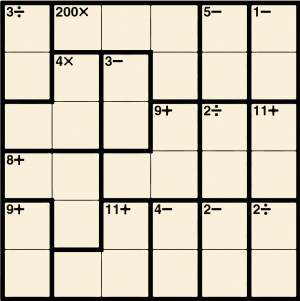
        Every week, they’ll email you a set of free KenKen arithmetic puzzles for all ages. As the challenge level subtly shifts week to week, students develop their math and logical thinking skills without even knowing it.

        Subscribe ❯

        #MathStratChat

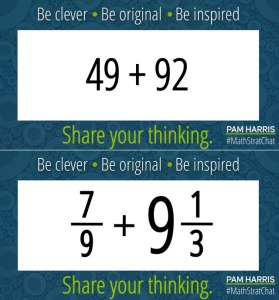
        Pose an interesting math problem. How can you figure it out? What else could you do? How many different ways can you find? Which strategy do you like best for this problem?

        Follow Pam Harris on your favorite social media site to get a new problem every Wednesday.

        Choose a Problem ❯

        The Parallel Universe

        Dr Simon Singh, author of the No. 1 bestseller Fermat’s Last Theorem and The Simpsons and Their Mathematical Secrets has created a set of weekly maths challenges – just 15-30 minutes of interesting, fun and challenging tidbits of mystery and history, activities and oddities, puzzles and problems.

        Help students expand their mathematical horizons beyond the school curriculum and build strong mathematical thinking skills. Stretch your brain every week!

        Learn More ❯

        Numberless Word Problems

        As I mentioned yesterday, my new book includes links to online resources to help you play with word problems. So this week, I’m sharing a few of my favorites.

        Visit the Kickstarter

        Today we examine a time-tested method to help kids reason about math: Leave out the numbers.

        First up, there’s Brian Bushart’s numberless problem bank for young students. Then we’ll look at Farrar Williams’s modern revision of a math teaching classic with problems for upper-elementary and middle school students.

        Have fun thinking math with your kids!

        Word Problem Bank

        Word problems are commonplace in mathematics classrooms, and yet they regularly confound students and lead to frustrated teachers saying things like:

        • “They just add all the numbers! It doesn’t matter what the problem says.”
        • “They don’t stop to think! They just start computing as soon as they’re done reading the problem.”

        Brian Bushart offers a collection of ready-to-go slide presentations that walk through the steps of making a word problem make sense.

        Visit the Site

        Math With No Numbers
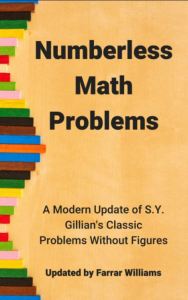
        Discover Farrar Williams’s book Numberless Math Problems: A Modern Update of S.Y. Gillian’s Classic Problems Without Figures, available in ebook or paperback.

        Williams writes: “In order to answer the question, they’ll have to explain it, because the problem doesn’t give you anything to calculate with. The only way to answer is by explaining your process. See how sneaky a numberless problem is? It makes students really think about the process of solving the problem.”

        Find Out More

        “When students face a word problem, they often revert to pulling all the numbers out and “doing something” to them. They want to add, subtract, multiply, or divide them, without really considering which operation is the right one to perform or why.

          “When you don’t have numbers, it sidesteps that problem.

            “For students who freeze up when they see the numbers, this can be a really good way to get them to think about their process with math.”

            —Farrar Williams, Math With No Numbers

            CREDITS: Feature photo (top) by saeed karimi via Unsplash.com.

            How Will You Celebrate this Epic Twosday?

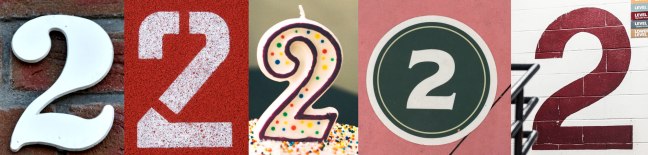
            Tomorrow is Tuesday 2/22/22 (or 22/2/22, if you prefer). What a wonderfully epic Twosday!

            Here’s a puzzle your family or class may enjoy…

            The “All 2s” Challenge

            Use only the digit 2, and try to use as few of them as you can for each calculation. You may use any math operations you know.

            For example:
            0 = 2 − 2
            8 = 2 + 2 + 2 + 2

            • Can you find a way to make 8 using fewer than four 2s?
            • What other numbers can you make?
            • Can you calculate all the numbers from 1–20? 1–100?

            Putting 2 in Perspective

            You might enjoy practicing your math art skills with this 2-digit challenge from Steve Wyborney.

            How many blocks make the digit 2? How did you count them?

            Advent Math Activity Calendars

            Once again, the delightful Nrich Maths website offers a seasonal selection of activities to encourage your children’s (and your own!) mathematical creativity.

            Click the images below to visit the corresponding December Math Calendar pages.

            For Primary Students

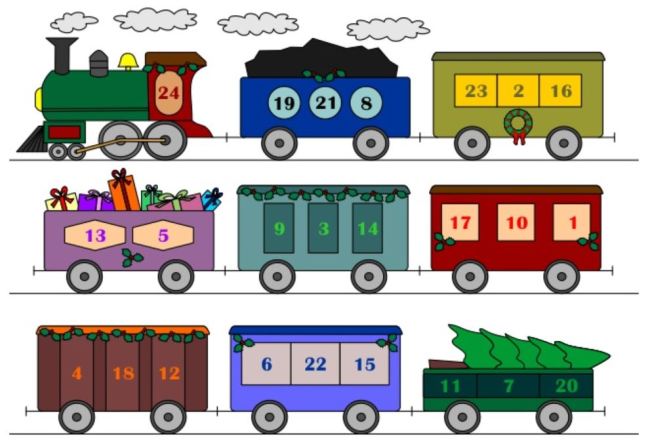
            Here are twenty-four activities for elementary and middle school, one for each day in December during the run-up to Christmas.

            2021 Primary Advent Calendar

            When you get to the Nrich website, click a number to go to that day’s math.

            For Secondary Students

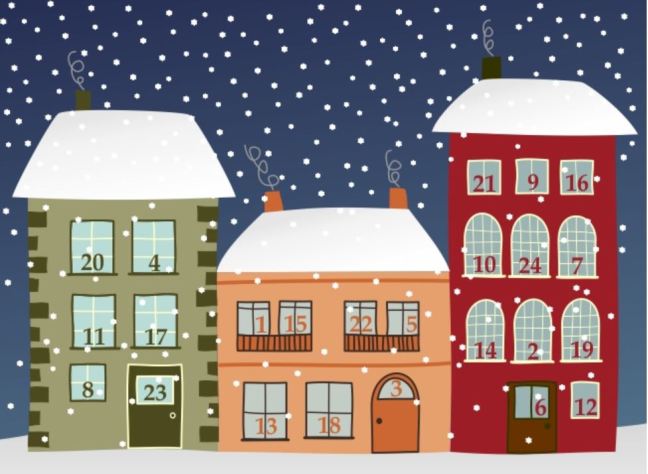
            Here are twenty-four favorite activities for middle and high school, one for each day in December in the run-up to Christmas.

            2021 Secondary Advent Calendar

            When you get to the Nrich website, click a number to go to that day’s math.

            More Holiday Math

            I encourage you also to explore my HUGE holiday math post:

            Or check out these pages for more ideas:

            Have fun playing math with your kids!

            What Is Multiplication, Anyway?

            At some point during the process of teaching multiplication to our children, we really need to come to terms with this question:

            What IS multiplication?

            Did your device hide the video? Find it on YouTube here.

            “What’s my answer? It’s not one that society’s going to like. Because society expects — demands, even — that mathematics be concrete, real-world, absolute, having definitive answers.

              I can’t give a definitive answer.

                Multiplication manifests itself in different ways. So maybe the word ‘is’ there is just too absolute. And it’s actually at odds with what mathematicians do.

                  Mathematicians do attend to real-world, practical scenarios — by stepping away from them, looking at a bigger picture.”

                  —James Tanton, What is Multiplication?

                  For Further Study

                  You may also enjoy these posts from my blog archive:

                  Memorizing the Times Table: A Life Skills Approach

                  Continuing on my theme of times table facts, here’s the inimitable James Tanton:

                  Did your device hide the video? Find it on YouTube here.

                  “If our task is to memorize this table, please make it about mathematics — about thinking your way through a challenge, and what can I do to make my life easier.”

                  —James Tanton, Making Memorising Multiplication Facts (if one really must) a meaningful Life Skill Lesson

                  For Further Study

                  You may also enjoy my blog post series about working through the times tables, paying attention to mathematical relationships (and a bit of prealgebra) along the way.

                  Times Tables Series

                  Click the button to see the whole series. Scroll down to the first post to go through it in order.