FAQ: The Value of Math Rebellion

Math Rebels fight for truth, justice, and creative reasoning

I’ve been getting questions about my Math Journaling Adventures books:

“I’m so excited to try math journaling! We bought your Logbook Alpha, and my 11-year-old math-averse son is trying to be a math rebel at every turn.

    “But I feel uncomfortable with the idea of rebellion. Doesn’t he need to learn how to solve math problems the right way?”

    One of my favorite things about math is that there really is no “right” way to solve math problems.

    As I pointed out in my ongoing Mental Math series, even a problem as basic as 6+8 can be approached from many directions. So perhaps I should say, the “right” way is however the student wants to make sense of the problem.

    In math, sense-making and reasoning are always the most important things.

    Continue reading FAQ: The Value of Math Rebellion

    FAQ: Can I Use Your Books as a Math Curriculum?

    Father helping girl with math homework

    I recently listened to you on Cindy Rollins’ podcast, and I was captivated by your perspective on math. It was exciting, freeing, and wonder-filled. I would absolutely love to be able to teach in the ways you described.

      We use early-elementary Saxon Math right now, which is thorough, but has SO MUCH to do that I’ve always struggled to do it all. Then I feel like I’m missing things, and I never know quite what is important. And yet, the actual lessons move so slowly that my kids get bored with the repetition.

        I use a published curriculum because I have no idea of an appropriate scope and sequence, or similar flow of learning. With your playful approach to math, how do I know where to start, and what to do each day?

          Do you have a suggested order to approach your books to have a full math approach? A sort of curriculum, per se, using your books.

          [For those who missed my chat with Cindy Rollins about a Charlotte Mason approach to math, you can listen to it here.]

          Continue reading FAQ: Can I Use Your Books as a Math Curriculum?

          FAQ: Real Math for Early Learners

          photo of family hiking a rocky trail

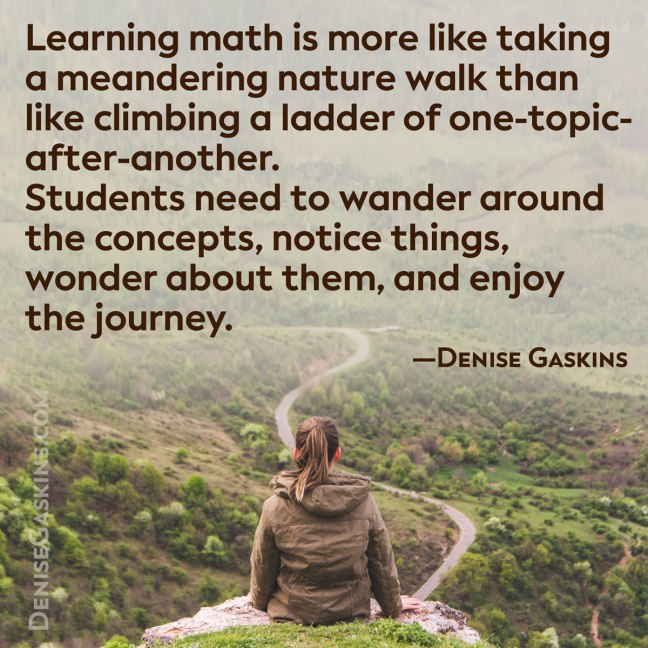
          “I love your image of math as a nature walk. My children are ready to start their homeschooling journey, and I want to put them on the right track from the beginning. How can I help them think about math and problem-solving without using a textbook?”

          The most difficult part of teaching our children real math is to change our own way of thinking about the subject you’ve already taken that step, so it looks like your family’s learning journey is off to a great start.

          [For readers who are wondering what I mean by math as a nature walk, check out this post. You may also enjoy my article on natural learning: Math with Young Children.]

          Continue reading FAQ: Real Math for Early Learners

          FAQ: My Playful Math Books

          Playful math books by Denise Gaskins

          Number Neighborhoods game  book by Denise GaskinsIn the weeks since I opened my new Playful Math Store, I’ve been getting a lot of questions about how all the books relate to each other.

          For example…

          Q: Your books look so interesting! Is the material in the books all different?

            A: There is a bit of overlap between books, but not much in most cases.

          Continue reading FAQ: My Playful Math Books

          FAQ: The Necessity of Math Facts

          Ah, math facts — the topic that just won’t stop giving grief to students and anxiety to their parents. So it happened that I got another question, but this one leaned in a more philosophical direction…

          “I enjoyed your podcast interview on Cultivating Math Curiosity and Reasoning in Kids. I love the idea that we don’t have to make our children memorize everything in math. We can give them freedom to make mental connections for themselves.

            “But on the other hand, we don’t have unlimited time for them to figure things out on their own, do we? What about children who can’t make these connections for themselves?

              “For example, what about the math facts? If my kids aren’t picking them up, don’t they just have to memorize them?”

              Continue reading FAQ: The Necessity of Math Facts

              FAQ: Memorizing the Math Facts

              It came up again this week, one of the most frequently asked questions about homeschooling math:

              “I believe it’s important for children to memorize the math facts, but my kids are struggling with mental math. How can I help them master these important number relationships?”

              We all want our children to own the math facts, those basic relationships between small numbers that form the foundation of all arithmetic.

              But I don’t think emphasizing memorization will develop the sort of fluency your children need.

              The human brain remembers what it thinks about, so we want children using their brains and thinking as deeply as possible about number relationships from as many different perspectives as we can get, noticing patterns, finding connections, making sense of the math.

              Continue reading FAQ: Memorizing the Math Facts

              FAQ: Playful Math for Older Students

              My students are so busy that time-consuming math projects are a luxury. How is it possible for older kids to play with mathematics?

              Too often, the modern American school math curriculum is a relentless treadmill driving students toward calculus. (Does this happen in other countries, too?)

              But that’s definitely not the only way to learn. For most students, it’s not the best way, either.

              Here are a few ideas to get your older children playing with math…

              Continue reading FAQ: Playful Math for Older Students

              FAQ: I’ve Ruined My Daughter

              My daughter is only eleven, but I’m afraid I’ve ruined her chance of getting into college because she is so far behind in math. We’ve tried tutors, but she still has trouble, and standardized testing puts her three years below grade level. She was a late reader, too, so maybe school just isn’t her thing. What else can I do?

              Standardized tests are not placement tests. They cannot tell you at what level your daughter should be studying. They aren’t designed that way. The “placement” they give is vague and general, not indicative of her grade level but rather a way of comparing her performance on that particular test with the performance of other students.

              There can be many different reasons for a low score. I’ve listed a few of them in my post In Honor of the Standardized Testing Season.

              Continue reading FAQ: I’ve Ruined My Daughter

              FAQ: Math with Young Children

              The question came up again:

              “What is the best curriculum for my children? They are four and six years old, and I’m afraid of letting them fall behind.”

              I remember being a young parent, eager to start homeschooling. I used to get mad (without letting it show, like a true introvert) when people told me, “They are young. Just let them play.”

              Now I see the wisdom in it.

              The most important thing for your children right now, by far, is for them to enjoy learning. The joy of learning is a child’s natural state. As a parent, your primary job is to keep yourself from stomping it out.

              But our parental fears can push us into joy-trampling before we realize it.

              And our own experience of school makes it hard for us to see how much of our children’s play really is learning. We expect education to look like schoolwork, but natural learning looks nothing like that.

              Continue reading FAQ: Math with Young Children

              FAQ: Struggling with Arithmetic

              My son can’t stand long division or fractions. We had a lesson on geometry, and he enjoyed that — especially the 3-D shapes. If we can just get past the basics, then we’ll have time for the things he finds interesting. But one workbook page takes so long, and I’m sick of the drama. Should we keep pushing through?

              Those upper-elementary arithmetic topics are important. Foundational concepts. Your son needs to master them.

              Eventually.

              But the daily slog through page after page of workbook arithmetic can wear anyone down.

              Many children find it easier to focus on math when it’s built into a game.

              Take a look at Colleen King’s Math Playground website. Or try one of the ideas on John Golden’s Math Hombre Games blog page.

              Or sometimes a story helps, like my Cookie Factory Guide to Long Division.

              Continue reading FAQ: Struggling with Arithmetic