Fraction Game: My Closest Neighbor

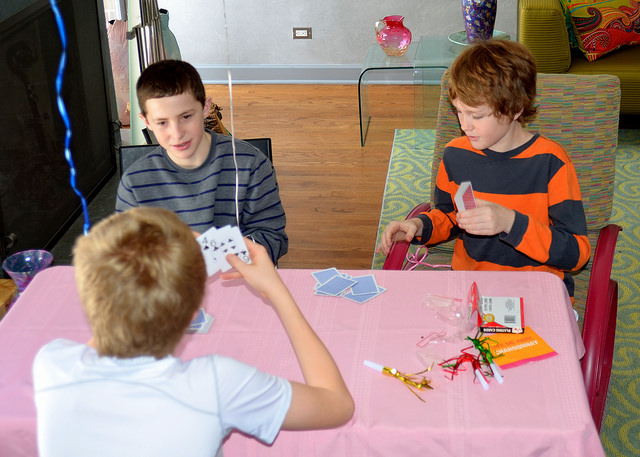
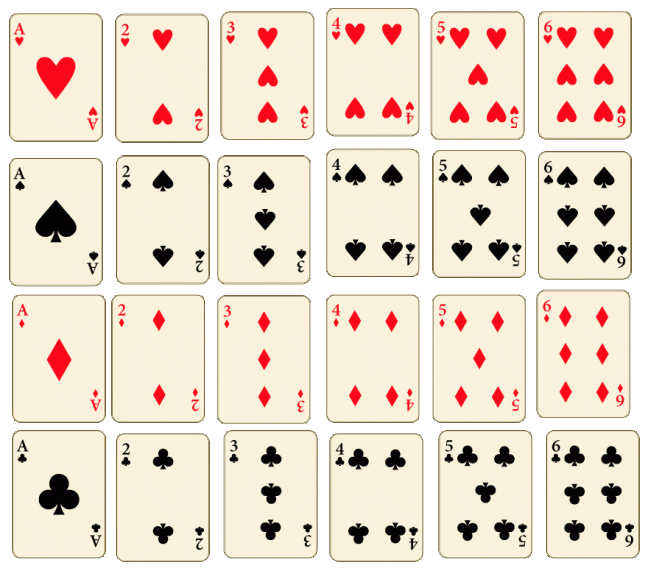
[Feature photo above by Jim Larrison, and antique playing cards below by Marcee Duggar, via Flickr (CC BY 2.0).]

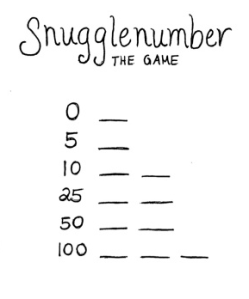
I missed out on the adventures at Twitter Math Camp, but I’m having a great time working through the blog posts about it. I prefer it this way — slow reading is more my speed. Chris at A Sea of Math posted a wonderful game based on one of the TMC workshops. Here is my variation.

Math concepts: comparing fractions, equivalent fractions, benchmark numbers, strategic thinking.

Players: two to four.

Equipment: two players need one deck of playing cards, three or four players need a double deck.

Continue reading Fraction Game: My Closest Neighbor

Math Teachers at Play #70

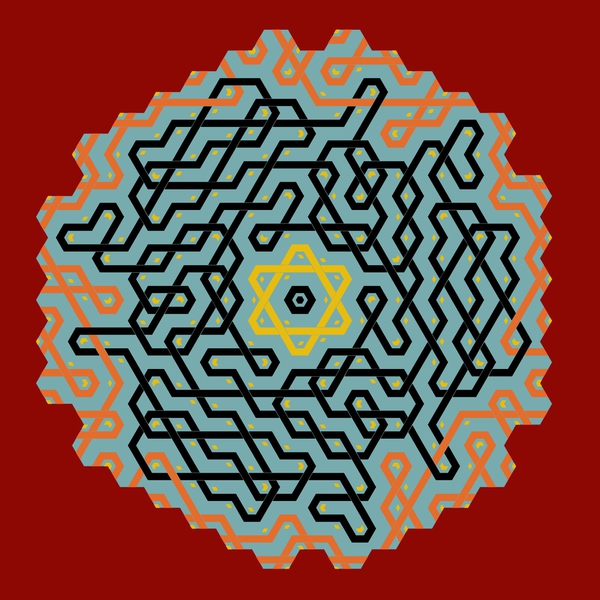
800px-Brauchtum_gesteck_70_1[Feature photo above by David Reimann via Bridges 2013 Gallery. Number 70 (right) from Wikimedia Commons (CC-BY-SA-3.0-2.5-2.0-1.0).]

Do you enjoy math? I hope so! If not, browsing this post just may change your mind.

Welcome to the 70th edition of the Math Teachers At Play math education blog carnival — a smorgasbord of 42+ links to bloggers all around the internet who have great ideas for learning, teaching, and playing around with math from preschool to pre-college. Let the mathematical fun begin!

By tradition, we start the carnival with a puzzle in honor of our 70th edition. But if you would like to jump straight to our featured blog posts, click here to see the Table of Contents.

Click here to continue reading.

Multiplication Models Card Game

multfrac-300Update: An expanded version of this post is featured in my book Multiplication & Fractions: Math Games for Tough Topics, available now at your favorite online book dealer.

Homeschooling parents know that one of the biggest challenges for any middle-elementary math student is to master the multiplication facts. It can seem like an unending task to memorize so many facts and be able to pull them out of mental storage in any order on demand.

Too often, we are tempted to stress the rote aspect of such memory work, which makes our children lose their focus on what multiplication really means. Before practicing the times table facts, make sure your student gets plenty of practice recognizing and using the common models for multiplication.

To help your children see what multiplication looks like in real life, explore the multitude of Multiplication Models collected at the Natural Math website. Or sign up for their Multiplication Explorers Online Course.

You may want to pick up this poster and use it for ideas as you play the Tell Me a (Math) Story game. Word problems are important for children learning any new topic in math, because they give children a mental “hook” on which to hang the abstract number concepts.

And for extra practice, you can play my free card game…

Click here to continue reading.

Maze Game: Land or Water?

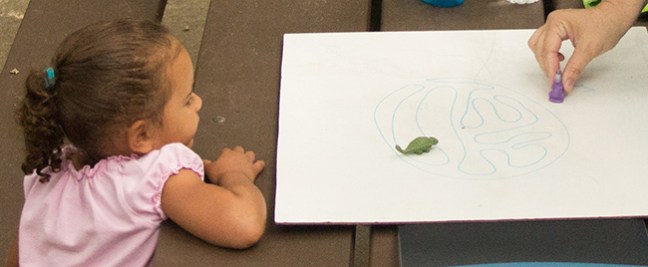
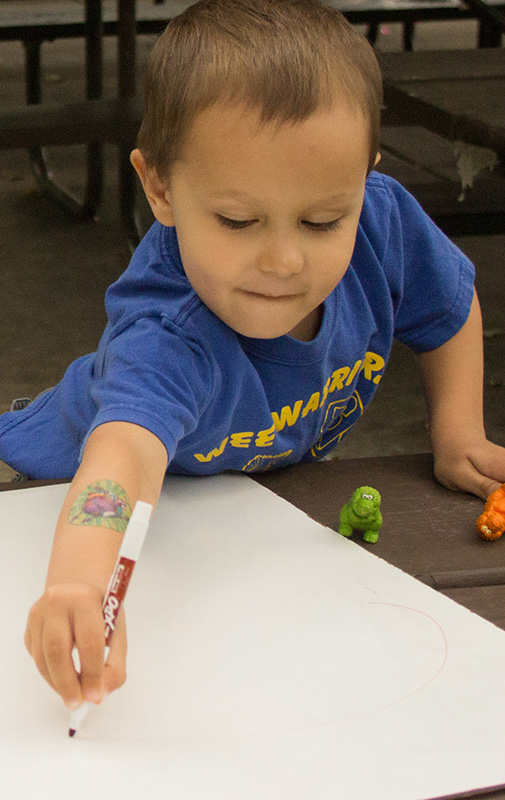
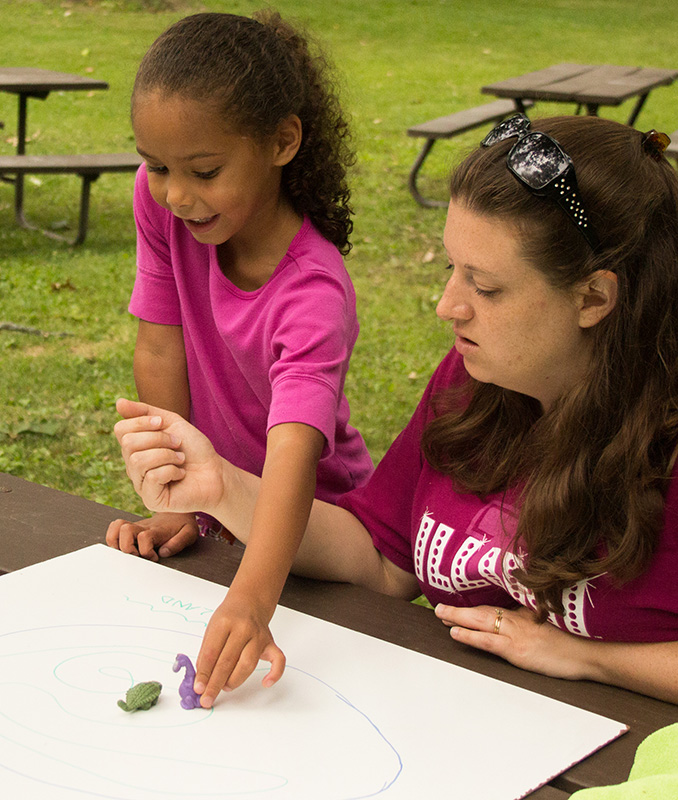
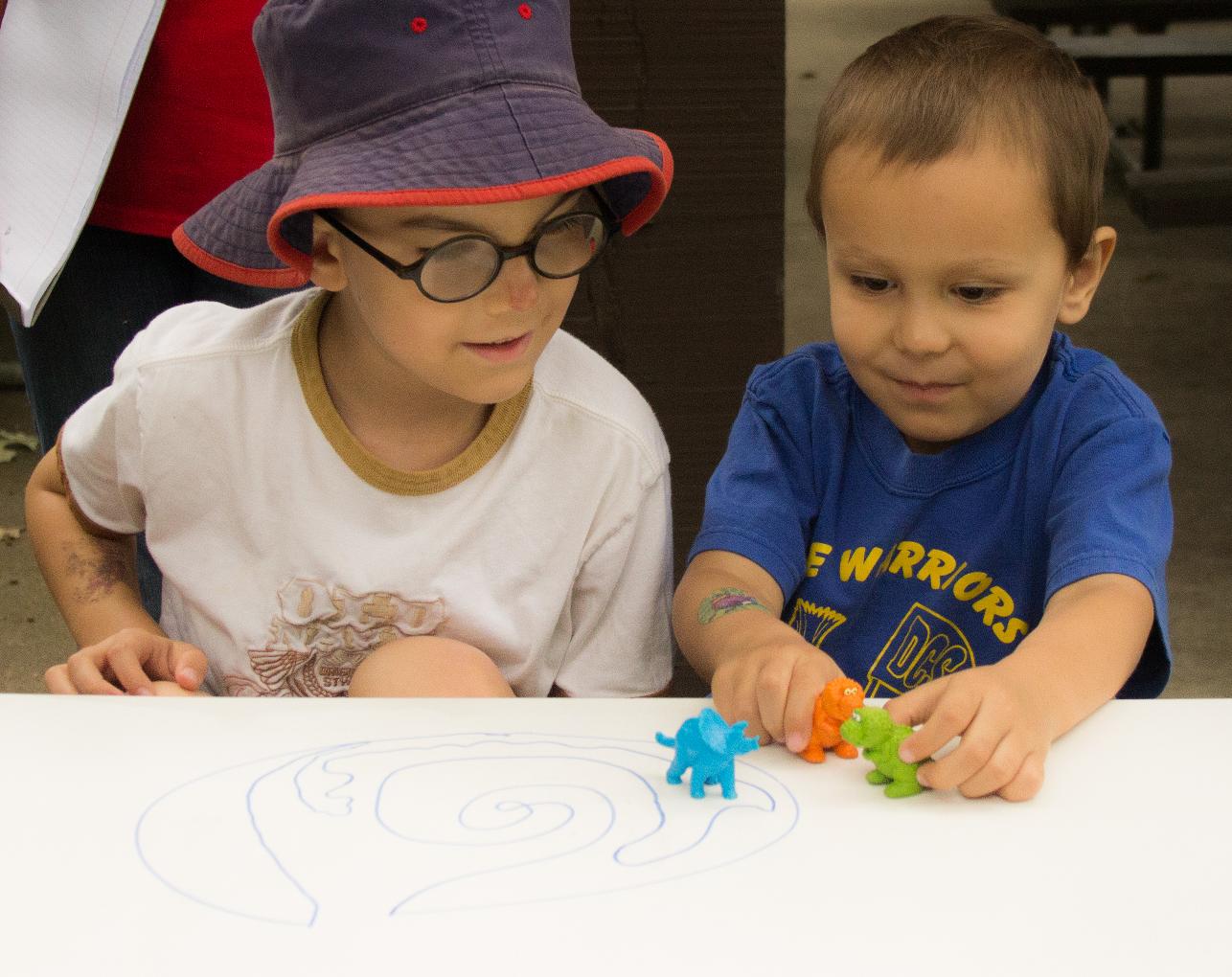
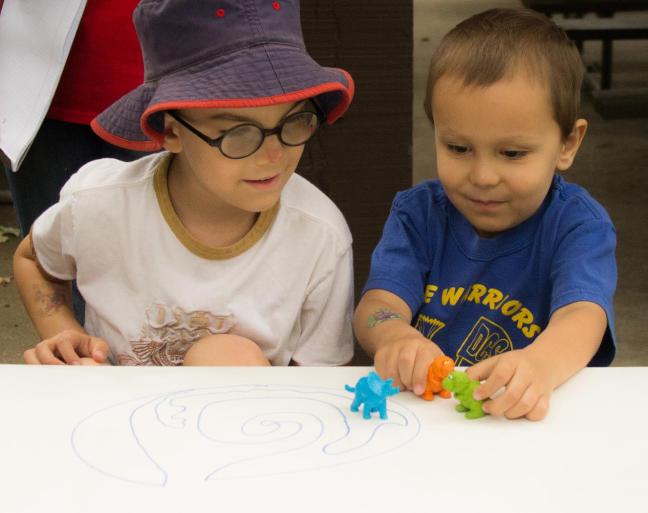
This was a fun activity from Moebius Noodles for our PK-1st grade Homeschool Math in the Park group. The children take turns making a maze and setting a dinosaur inside. Then the other dinosaurs (parents or siblings) try to guess whether their friend is on the land or in the water.

Draw the maze

Player #1

(1) First, draw a big circle on the white board. This is your lake.

(2) With a finger or a bit of cloth, erase a small section of the circle to create the opening for your maze.

(3) Starting at one edge of the opening, draw a random squiggle inside the circle. Make your squiggle end at the other edge of the opening.
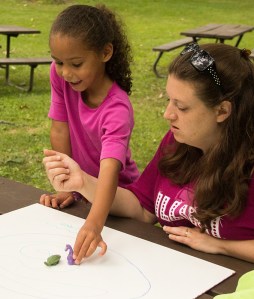
Looks like Land

(4) Set your dinosaur anywhere inside the maze.

Player #2

(1) Now it’s your turn to guess. Is the dinosaur standing on the land? Is it swimming in the water?

(2) How will you figure out if you guessed right?

(3) Check by jumping across the lines of the maze. Each jump takes you across a boundary: Splash! (Into the water.) Thump! (Back on the land.) Splash! Thump! … Until you reach the dinosaur inside.

(4) Or go to the maze entrance and walk your dinosaur along the path. Can you find your way?
land or water

 
* * *

This blog is reader-supported.

If you’d like to help fund the blog on an on-going basis, then please join me on Patreon for mathy inspiration, tips, and an ever-growing archive of printable activities.

If you liked this post, and want to show your one-time appreciation, the place to do that is PayPal: paypal.me/DeniseGaskinsMath. If you go that route, please include your email address in the notes section, so I can say thank you.

Which I am going to say right now. Thank you!

“Maze Game: Land or Water?” copyright © 2013 by Denise Gaskins. All photos copyright © Denise Gaskins.
Math Teachers at Play #66

[Feature photo above by Franz & P via flickr. Route 66 sign by Sam Howzit via flickr. (CC BY 2.0)]
Route 66 Sign

Welcome to the Math Teachers At Play blog carnival — which is not just for math teachers! If you like to learn new things and play around with ideas, you are sure to find something of interest.

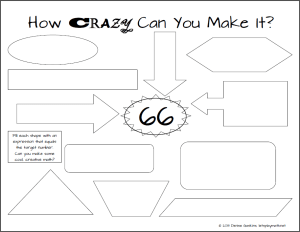
By tradition, we start the carnival with a couple of puzzles in honor of our 66th edition.

Let the mathematical fun begin!

Puzzle 1

how crazy 66

Our first puzzle is based on one of my favorite playsheets from the Miquon Math workbook series. Fill each shape with an expression that equals the target number. Can you make some cool, creative math?

Click the image to download the pdf playsheet set: one page has the target number 66, and a second page is blank so you can set your own target number.

Continue reading Math Teachers at Play #66

Math Teachers at Play #62: A Carnival with Books

by Robert Webb

Do you enjoy math? I hope so! If not, browsing this post just may change your mind. Welcome to the Math Teachers At Play blog carnival — a smorgasbord of ideas for learning, teaching, and playing around with math from preschool to pre-college.

Let the mathematical fun begin!

POLYHEDRON PUZZLE

By tradition, we start the carnival with a puzzle in honor of our 62nd edition:

An Archimedean solid is a polyhedron made of two or more types of regular polygons meeting in identical vertices. A rhombicosidodecahedron (see image above) has 62 sides: triangles, squares, and pentagons.

  • How many of each shape does it take to make a rhombicosidodecahedron?
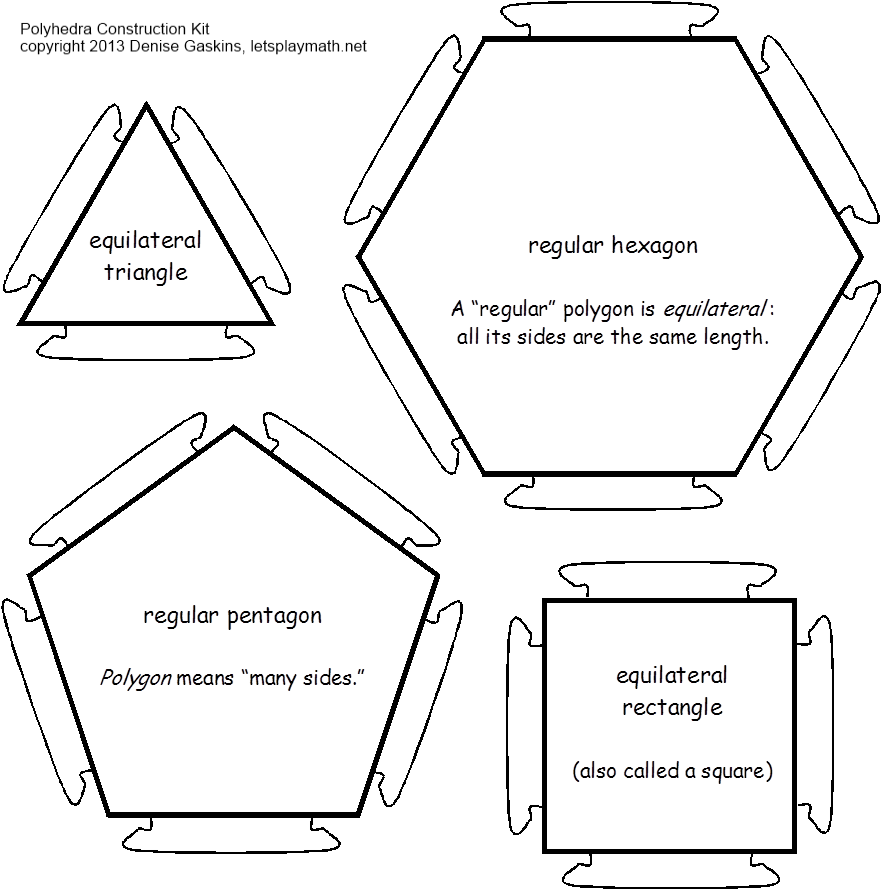
Click for full-size template.
Click for template.

My math club students had fun with a Polyhedra Construction Kit. Here’s how to make your own:

  1. Collect a bunch of empty cereal boxes. Cut the boxes open to make big sheets of cardboard.
  2. Print out the template page (→) and laminate. Cut out each polygon shape, being sure to include the tabs on the sides.
  3. Turn your cardboard brown-side-up and trace around the templates, making several copies of each polygon. I recommend 20 each of the pentagon and hexagon, 40 each of the triangle and square.
  4. Draw the dark outline of each polygon with a ballpoint pen, pressing hard to score the cardboard so the tabs will bend easily.
  5. Cut out the shapes, being careful around the tabs.
  6. Use small rubber bands to connect the tabs. Each rubber band will hold two tabs together, forming one edge of a polyhedron.

So, for instance, it takes six squares and twelve rubber bands to make a cube. How many different polyhedra (plural of polyhedron) will you make?

  • Can you build a rhombicosidodecahedron?

And now, on to the main attraction: the 62 blog posts. Many of the following articles were submitted by their authors; others were drawn from the immense backlog in my blog reader. If you’d like to skip directly to your area of interest, here’s a quick Table of Contents:

Continue reading Math Teachers at Play #62: A Carnival with Books

Math Teachers at Play #58: Crazy, Funny Math

No 58 - gold on blue[Feature photo (above) by Alex Kehr. Photo (right) by kirstyhall via flickr.]

Welcome to the Math Teachers At Play blog carnival — a smorgasbord of ideas for learning, teaching, and playing around with math from preschool to pre-college. If you like to learn new things and play around with ideas, you are sure to find something of interest.

Let the mathematical fun begin…

PUZZLE 1

By tradition, we start the carnival with a pair of puzzles in honor of our 58th edition. Click to download the pdf:

How CRAZY Can You Make It

Continue reading Math Teachers at Play #58: Crazy, Funny Math

Welcome, TIME Readers!

[Photo by Luis Argerich via flickr.]

If you’ve come here from Bonnie Rochman’s article, Bedtime Math: A Problem a Day Keeps Fear of Arithmetic Away, thank you for dropping in! I have nearly 800 published posts about learning and teaching math, which can seem pretty overwhelming.

Here are a few good places to start:

  • Tell Me a (Math) Story
    What better way could there be to do math than snuggled up on a couch with your little one, or side by side at the sink while your middle-school student helps you wash the dishes, or passing the time on a car ride into town?
  • Homeschooling with Math Anxiety Series
    Our childhood struggles with schoolwork gave most of us a warped view of mathematics. Yet even parents who suffer from math anxiety can learn to enjoy math with their children.
  • How to Conquer the Times Table
    Challenge your student to a joint experiment in mental math. Over the next two months, without flashcards or memory drill, how many math facts can the two of you learn together? We will use the world’s oldest interactive game — conversation — to explore multiplication patterns while memorizing as little as possible.

I hope you enjoy your visit to my blog.

PUFM 1.5 Multiplication, Part 2

Poster by Maria Droujkova of NaturalMath.com. In this Homeschooling Math with Profound Understanding (PUFM) Series, we are studying Elementary Mathematics for Teachers and applying its lessons to home education.

Multiplication is taught and explained using three models. Again, it is important for understanding that students see all three models early and often, and learn to use them when solving word problems.

— Thomas H. Parker & Scott J. Baldridge
Elementary Mathematics for Teachers

I hope you are playing the Tell Me a (Math) Story game often, making up word problems for your children and encouraging them to make up some for you. As you play, don’t fall into a rut: Keep the multiplication models from our lesson in mind and use them all. For even greater variety, use the Multiplication Models at NaturalMath.com to create your word problems.

Continue reading PUFM 1.5 Multiplication, Part 2

Math Teachers at Play #52

[Photo by bumeister1 via flickr.]

Welcome to the Math Teachers At Play blog carnival — which is not just for math teachers! We have games, lessons, and learning activities from preschool math to calculus. If you like to learn new things and play around with mathematical ideas, you are sure to find something of interest.

Scattered between all the math blog links, I’ve included highlights from the Common Core Standards for Mathematical Practice, which describe the types of expertise that teachers at all levels — whether in traditional, experimental, or home schools — should seek to develop in their math students.

Let the mathematical fun begin…

TRY THESE PUZZLES

By tradition, we start the carnival with a couple of puzzles in honor of our 52nd edition. Since there are 52 playing cards in a standard deck, I chose two card puzzles from the Maths Is Fun Card Puzzles page:

  • A blind-folded man is handed a deck of 52 cards and told that exactly 10 of these cards are facing up. How can he divide the cards into two piles (which may be of different sizes) with each pile having the same number of cards facing up?
  • What is the smallest number of cards you must take from a 52-card deck to be guaranteed at least one four-of-a-kind?

The answers are at Maths Is Fun, but don’t look there. Having someone give you the answer is no fun at all!

Continue reading Math Teachers at Play #52