The Value of Math Games

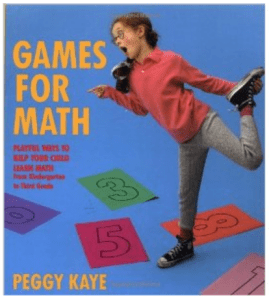
From Peggy Kaye’s classic book Games for Math:

Kaye-Games4Math

“Games put children in exactly the right frame of mind for learning difficult things.

“Children relax when they play — and they concentrate. They don’t mind repeating certain facts or procedures over and over, if repetition is part of the game.

“Children throw themselves into playing games the way they never throw themselves into filling out workbook pages.

“The games solidify the achievements of children who are already good at math, and they shore up children who need shoring up. They teach or reinforce many of the skills that a formal curriculum teaches, plus one skill that formal teaching sometimes leaves out — the skill of having fun with math, of thinking hard and enjoying it.

“If you play these games and your child learns only that hard mental effort can be fun, you will have taught something invaluable.”

Peggy Kaye
Games for Math

Sample Peggy’s Games for Math

 
* * *

This blog is reader-supported.

If you’d like to help fund the blog on an on-going basis, then please join me on Patreon for mathy inspiration, tips, and an ever-growing archive of printable activities.

If you liked this post, and want to show your one-time appreciation, the place to do that is PayPal: paypal.me/DeniseGaskinsMath. If you go that route, please include your email address in the notes section, so I can say thank you.

Which I am going to say right now. Thank you!

“The Value of Math Games” copyright © 2016 by Denise Gaskins.

Number Game Printables

One step closer to getting my long-awaited Multiplication & Fraction Games book out — I finished the printables file! At least, I hope I’ve finished. Sometimes it seems like whack-a-typo never ends…

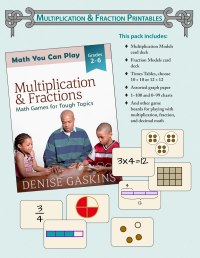
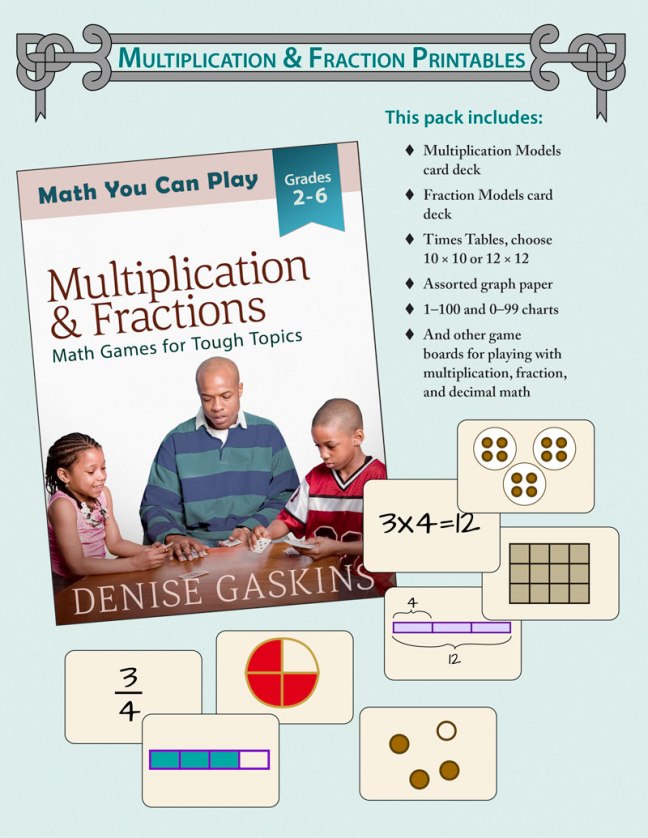
Multiplication & Fraction Printables

Multiplication & Fraction Printables

Click here to download the Multiplication & Fraction Printables, featuring mathematical model cards, hundred charts, and game boards to accompany the upcoming Math You Can Play: Multiplication & Fractions book.

The Multiplication & Fractions ebook will come out sometime in November, and the paperback should follow in time for Christmas. If you’re interested, my newsletter subscribers will get a special introductory sale price whenever the book is published. Join now!

You may also want to check out:

Number Game Printables Pack

Number Game Printables Pack

Click here to download the Number Game Printables Pack, featuring hundred charts, graph paper, and game boards from the first two Math You Can Play books.

Also, 0–99 charts, and bottoms-up versions, too. (See my blog post Math Debates with a Hundred Chart.) And a fun cut-and-fold game board for playing Shut the Box.

Permission to Use These Files

You have permission to copy and use these game boards and worksheets in your own local classroom, home school, math circle, co-op class, etc. But you may not post them on your own website (though you can link to this post, if you like) or sell them. If you’re not sure how copyright works on the Internet, check out Daniel Scocco’s Copyright Law: 12 Dos and Don’ts.

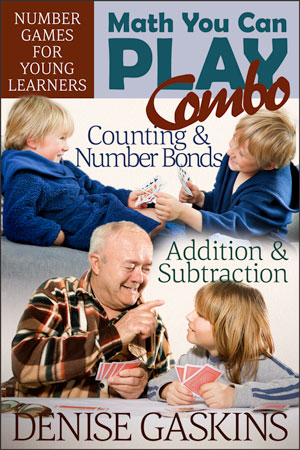
Math You Can Play Combo in Paperback and Ebook

If you’re interested in helping children learn math, I have special offer just for you:

  • Save 20% off the individual ebooks or 35% off the paperback prices when you buy a combined 2-books-in-1 edition featuring the first two books in the Math You Can Play series together.

The 42 kid-tested games are simple to learn, quick to play, and require minimal preparation. Most use common household items such as cards or dice.

Free Online Preview

Amazon-logo the_book_depository_logo Barnes-Noble-logo kobo-logo Scribd_logo Smashwords-logo CreateSpace-logo

“Although the cover says games for young learners, the beauty of this book is that most of the games can easily be scaled up for older kids, teens, and even adults. My youngest is four and my oldest is 14, and I will be pulling games for all of them out of this book!

“I appreciate that most of the games are low floor, high ceiling – easy for a child to access, but can be played at a higher level through strategy or slight alterations to the rules. These are not drills disguised as games, but activities that require problem solving and strategy as well as calculation.”

Kindle customer review

Continue reading Math You Can Play Combo in Paperback and Ebook

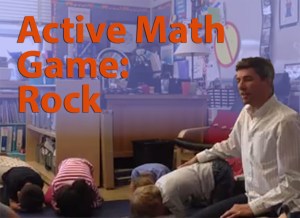
Active Math Game: Rock

Gordon Hamilton of Math Pickle posted Rock – Low unique number game for grades K–2. If you have a set of active kids and a few minutes to spare, give it a try!

How to Play Rock

  • Everyone makes a rock shape with eyes closed.
  • Everyone chooses a number: 0, 1, 2, 3, 4, 5, 6, 7, 8 …
  • Teacher calls out numbers consecutively, starting at 0.
  • When a student hears their number being called they immediately raise a hand. When the teacher tags the hand, they stand up.
  • If more than one hand was raised, those students lose. They become your helpers, tagging raised hands.
  • If only one hand was raised, that child wins the round.

Rock-game

“Each game takes about 45 seconds,” Hamilton says. “This is part of the key to its success. Children who have not learned the art of losing are quickly thrown into another game before they have a chance to get sad.”

The experience of mathematics should be profound and beautiful. Too much of the regular K-12 mathematics experience is trite and true. Children deserve tough, beautiful puzzles.

Gordon Hamilton

What Happens When Grownups Play Rock

What are the best numbers to pick? Patrick Vennebush hosted on online version of the game at his Math Jokes 4 Mathy Folks blog a few years back, though we didn’t have to bend over into rocks‌—‌which is a good thing for some of us older folks.

Vennebush also posted a finger-game version suitable for small groups of all ages, called Low-Sham-Bo:

  • On the count of 1-2-3, each person “throws” out a hand showing any number of fingers from zero to five.
  • The winner is the person who throws the smallest unique number.

You may want to count “Ready, set, go!” for throwing out fingers, so the numbers in the count don’t influence the play.

The official name for this sort of game is Lowest Unique Bid Auction.

 
* * *

This blog is reader-supported.

If you’d like to help fund the blog on an on-going basis, then please join me on Patreon for mathy inspiration, tips, and an ever-growing archive of printable activities.

If you liked this post, and want to show your one-time appreciation, the place to do that is PayPal: paypal.me/DeniseGaskinsMath. If you go that route, please include your email address in the notes section, so I can say thank you.

Which I am going to say right now. Thank you!

“Active Math Game: Rock” copyright © 2015 by Denise Gaskins. .

New Hundred Chart Game: Odd-Even-Prime Race

Counting all the fractional variations, my massive blog post 30+ Things to Do with a Hundred Chart now offers nearly forty ideas for playing around with numbers from preschool to prealgebra.

Here is the newest entry, a variation on #10, the “Race to 100” game:

(11.5) Play “Odd-‌Even-‌Prime Race.″ Roll two dice. If your token is starting on an odd number, move that many spaces forward. From an even number (except 2), move backward — but never lower than the first square. If you are starting on a prime number (including 2), you may choose to either add or multiply the dice and move that many spaces forward. The first person to reach or pass 100 wins the game.
[Hat tip: Ali Adams in a comment on another post.]

And here’s a question for your students:

  • If you’re sitting on a prime number, wouldn’t you always want to multiply the dice to move farther up the board? Doesn’t multiplying always make the number bigger?

 
* * *

This blog is reader-supported.

If you’d like to help fund the blog on an on-going basis, then please join me on Patreon for mathy inspiration, tips, and an ever-growing archive of printable activities.

If you liked this post, and want to show your one-time appreciation, the place to do that is PayPal: paypal.me/DeniseGaskinsMath. If you go that route, please include your email address in the notes section, so I can say thank you.

Which I am going to say right now. Thank you!

“New Hundred Chart Game: Odd-Even-Prime Race” copyright © 2015 by Denise Gaskins. Image at the top of the post copyright © geishaboy500 (CC BY 2.0).

Review Game: Once Through the Deck

Math Concepts: basic facts of addition, multiplication.
Players: one.
Equipment: one deck of math cards (poker- or bridge-style playing cards with the face cards and jokers removed).

The best way to practice the math facts is through the give-and-take of conversation, orally quizzing each other and talking about how you might figure the answers out. But occasionally your child may want a simple, solitaire method for review.

Continue reading Review Game: Once Through the Deck

Math Game: Fan Tan (Sevens)

Math Concepts: sorting by attribute (card suits), counting up, counting down, standard rank of playing cards (aces low).
Players: two or more, best with four to six.
Equipment: one complete deck of cards (including face cards), or a double deck for more than six players. Provide a card holder for young children.

How to Play

Deal out all the cards, even if some players get more than others. The player to the dealer’s left begins by playing a seven of any suit. If that player does not have a seven, then the play passes left to the first player who does.

After that, on your turn you may lay down another seven or play on the cards that are already down. If you cannot play, say, “Pass.”

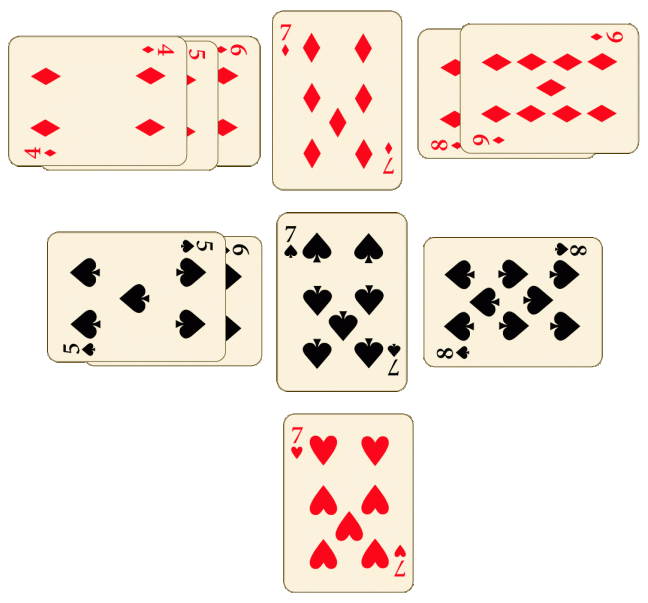
Once a seven is played in any suit, the six and the eight of that suit may be played on either side of it, forming the fan. Then the five through ace can go on the six in counting-down order, and the nine through king can go on the eight, counting up. You can arrange these cards to overlap each other so the cards below are visible, or you can square up the stacks so only the top card is seen.

A Fan Tan game in progress.

Continue reading Math Game: Fan Tan (Sevens)

Math Games with Factors, Multiples, and Prime Numbers

Students can explore prime and non-prime numbers with these free favorite classroom games:

For $15-20 you can buy a downloadable file of the beautiful, colorful, mathematical board game Prime Climb. Or pick up the full Prime Climb game box at Amazon.

Or you can try the following game by retired Canadian education professor Jerry Ameis:

Factor Finding Game

FactorFindingGame

Math Concepts: multiples, factors, composite numbers, and primes.
Players: only two.
Equipment: pair of 6-sided dice, 10 squares each of two different colors construction paper, and the game board (click the image to print it, or copy by hand).

On your turn, roll the dice and make a 2-digit number. Use one of your colored squares to mark a position on the game board. You can only mark one square per turn.

  • If your 2-digit number is prime, cover a PRIME square.
  • If any of the numbers showing are factors of your 2-digit number, cover one of them.
  • BUT if there’s no square available that matches your number, you lose your turn.

The first player to get three squares in a row (horizontal, vertical, or diagonal) wins. Or for a harder challenge, try for four in a row.

 
* * *

This game was featured in the Math Teachers At Play (MTaP) math education blog carnival: MTaP #79. Hat tip: Jimmie Lanley.

This blog is reader-supported.

If you’d like to help fund the blog on an on-going basis, then please join me on Patreon for mathy inspiration, tips, and an ever-growing archive of printable activities.

If you liked this post, and want to show your one-time appreciation, the place to do that is PayPal: paypal.me/DeniseGaskinsMath. If you go that route, please include your email address in the notes section, so I can say thank you.

Which I am going to say right now. Thank you!

“Math Games with Factors, Multiples, and Prime Numbers” copyright © 2015 by Denise Gaskins. Image at the top of the post copyright © Jimmie via flickr (CC BY 2.0).

Math Teachers at Play #85

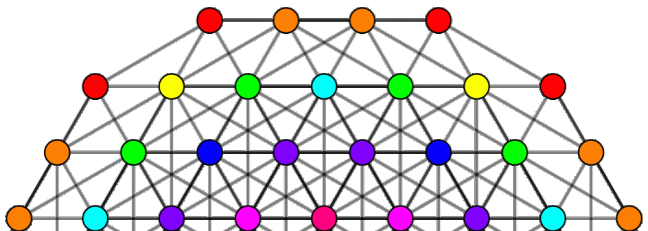
[Feature photo by Tomruen via Wikimedia Commons.]

Do you enjoy math? I hope so! If not, browsing the articles linked in this post just may change your mind.

Welcome to the 85th edition of the Math Teachers At Play math education blog carnival‌—‌a smorgasbord of links to bloggers all around the internet who have great ideas for learning, teaching, and playing around with math from preschool to pre-college.

By tradition, we start the carnival with a short puzzle or activity. But if you would like to jump straight to our featured blog posts, click here to see the Table of Contents.

Let the mathematical fun begin!

Continue reading Math Teachers at Play #85

Math Game: Thirty-One

Math Concepts: addition to thirty-one, thinking ahead.
Players: best for two.
Equipment: one deck of math cards.

How to Play

Lay out the ace to six of each suit in a row, face-up and not overlapping, one suit above another. You will have one column of four aces, a column of four twos, and so on‌—‌six columns in all.

The first player flips a card upside down and says its number value. Then the second player turns down a card, adds it to the first player’s number, and says the sum.

Players alternate, each time turning down one card, mentally adding its value to the running total, and saying the new sum out loud. The player who exactly reaches thirty-one, or who forces the next player to go over that sum, wins the game.

31-Game

Continue reading Math Game: Thirty-One