In 1905, when he was 26 years old, Albert Einstein rocked the scientific world with a series of papers that changed our understanding of the nature of the universe. At MinutePhysics, the celebration continues:
Do the Digits of Pi Encode Shakespeare’s Plays?
Happy Pi Day, from Vi Hart:
Happy Birthday, Einstein (Part 2)
Today would be Albert Einstein’s 133rd birthday. At MinutePhysics, the celebration continues:
More Einstein Videos
Happy Birthday, Einstein!
March 14th is Pi Day, and it’s also Albert Einstein’s birthday. In honor of Einstein, MinutePhysics is posting a series of videos on his “wonder year” of 1905, when he published several papers that eventually earned him the Nobel Prize.
More Einstein Videos
Purple Comet! Math Meet

The 2012 Purple Comet! Math Meet is a free, on-line, team competition for middle and high school students around the world. Every team needs an adult supervisor. Homeschoolers are welcome and should register under the Mixed Team category.
- Contest Rules.
- Quick-start instructions.
- See all the past contests. Lots of practice problems!
Register now. The contest will run Tuesday, April 17, through Thursday, April 26, 2012. That gives your team plenty of time for practice sessions between now and then.
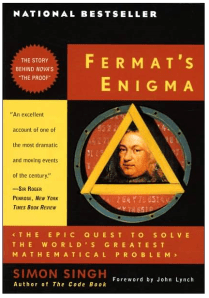
What I’m Reading: Fermat’s Enigma
Homeschooling is much more than just doing school at home — it’s a lifelong lifestyle of learning. And thanks to the modern miracle of inter-library loan, even those of us who live in the middle of nowhere can get just about any book sent directly to our tiny home-town libraries.
As I mentioned in Math Teachers at Play 46, I’m trying to add more living books about math to our homeschool schedule, including my own self-education reading. So, a copy of Fermat’s Enigma: The Epic Quest to Solve the World’s Greatest Mathematical Problem finally showed up at my library, and I am thoroughly enjoying it.
2012 Mathematics Game

photo by Creativity103 via flickr
For our homeschool, January is the time to assess our progress and make a few New Semester’s Resolutions. This year, we resolve to challenge ourselves to more math puzzles. Would you like to join us? Pump up your mental muscles with the 2012 Mathematics Game!
Rules of the Game
Use the digits in the year 2012 to write mathematical expressions for the counting numbers 1 through 100.
- You must use all four digits. You may not use any other numbers.
- You may use +, -, x, ÷, sqrt (square root), ^ (raise to a power), ! (factorial), and parentheses, brackets, or other grouping symbols.
- You may use a decimal point to create numbers such as .2, .01, etc.
- You may create multi-digit numbers such as 10 or 202, but we prefer solutions that avoid them.
Bonus Rules
You may use the overhead-bar (vinculum), dots, or brackets to mark a repeating decimal.You may use multifactorials:
- n!! = a double factorial = the product of all integers from 1 to n that have the same parity (odd or even) as n.
- n!!! = a triple factorial = the product of all integers from 1 to n that are equal to n mod 3
[Note to teachers: Math Forum modified their rules to allow double factorials, but as far as I know, they do not allow repeating decimals or triple factorials.]
Tau Day Limerick

So if working in radians you hate
(How can 

Make your life simpler now
By just switching to τ
= 6.28318…
—Denise Gaskins
Happy Tau Day
6/28 is τ Day.
Tau = τ = one turn around the circle = 
How do mathematicians celebrate τ Day?
Protest! Share anti-π propaganda.
And eat two pies…
2011 Mathematics Game
 [Photo from Wikipedia.]
Two of the most popular New Year’s Resolutions are to spend more time with family and friends, and to get more exercise. The 2011 Mathematics Game is a chance to do both at once.
So grab a partner, slip into your workout clothes, and pump up those mental muscles!
Here are the rules:
Use the digits in the year 2011 to write mathematical expressions for the counting numbers 1 through 100.
- All four digits must be used in each expression. You may not use any other numbers except 2, 0, 1, and 1.
- You may use the arithmetic operations +, -, x, ÷, sqrt (square root), ^ (raise to a power), and ! (factorial). You may also use parentheses, brackets, or other grouping symbols.
- You may use a decimal point to create numbers such as .1, .02, etc.
- Multi-digit numbers such as 20 or 102 may be used, but preference is given to solutions that avoid them.
Bonus Rules
You may use the overhead-bar (vinculum), dots, or brackets to mark a repeating decimal.You may use multifactorials:
- (n!)! = a factorial of a factorial, which is not the same as a multifactorial
- n!! = a double factorial = the product of all integers from 1 to n that have the same parity (odd or even) as n
- n!!! = a triple factorial = the product of all integers from 1 to n that are equal to n mod 3
[Note to teachers: The bonus rules are not part of the Math Forum guidelines. They make a significant difference in the number of possible solutions, however, and they should not be too difficult for high school students or advanced middle schoolers.]
 Denise Gaskins' Let's Play Math