Math That Is Fun: Infinite Primes

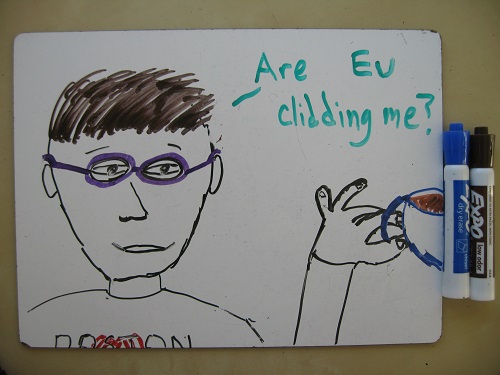
Oh, my! Ben Orlin over at Math with Bad Drawings just published my new favorite math proof ever:

I had a fight with Euclid on the nature of the primes.
It got a little heated – you know how the tension climbs.

It started out most civil, with a honeyed cup of tea;
we traded tales of scholars, like Descartes and Ptolemy.
But as the tea began to cool, our chatter did as well.
We’d had our fill of gossip. We sat silent for a spell.
That’s when Euclid turned to me, and said, “Hear this, my friend:
did you know the primes go on forever, with no end?” …

15-eu-must-be-clidding

Click here to read the whole post at Math with Bad Drawings.

How To Master Quadratic Equations

G'Day Math logo

Feature photo above by Junya Ogura via Flickr (CC BY 2.0).

A couple of weeks ago, James Tanton launched a wonderful resource: a free online course devoted to quadratic equations. (And he promises more topics to come.)

Kitten and I have been working through the lessons, and she loves it!

We’re skimming through pre-algebra in our regular lessons, but she has enjoyed playing around with simple algebra since she was in kindergarten. She has a strong track record of thinking her way through math problems, and earlier this year she invented her own method for solving systems of equations with two unknowns.

I would guess her background is approximately equal to an above-average Algebra 1 student near the end of the first semester.

After few lessons of Tanton’s course, she proved — within the limits of experimental error — that a catenary (the curve formed by a hanging chain) cannot be described by a quadratic equation. Last Friday, she easily solved the following equations:

\left ( x+4 \right )^2 -1=80

and:

w^2 + 90 = 22 w - 31

and (though it took a bit more thought):

4x^2 + 4x + 4 = 172

We’ve spent less than half an hour a day on the course, as a supplement to our AoPS Pre-Algebra textbook. We watch each video together, pausing occasionally so she can try her hand at an equation before listening to Tanton’s explanation. Then (usually the next day) she reads the lesson and does the exercises on her own.

So far, she hasn’t needed the answers in the Companion Guide to Quadratics, but she did use the “Dots on a Circle” activity — and knowing that she has the answers available helps her feel more independent.

Continue reading How To Master Quadratic Equations
Homeschooling High School Math

photo by ddluong via flickr

Feature photo (above) by Sphinx The Geek via flickr.

Most homeschoolers feel at least a small tinge of panic as their students approach high school. “What have we gotten ourselves into?” we wonder. “Can we really do this?” Here are a few tips to make the transition easier.

Before you move forward, it may help to take a look back. How has homeschooling worked for you and your children so far?

If your students hate math, they probably never got a good taste of the “Aha!” factor, that Eureka! thrill of solving a challenging puzzle. The early teen years may be your last chance to convince them that math can be fun, so consider putting aside your textbooks for a few months to:

On the other hand, if you have delayed formal arithmetic, using your children’s elementary years to explore a wide variety of mathematical adventures, now is a good time to take stock of what these experiences have taught your students.

  • How much of what society considers “the basics” have your children picked up along the way?
  • Are there any gaps in their understanding of arithmetic, any concepts you want to add to their mental tool box?

Continue reading Homeschooling High School Math

How to Recognize a Successful Homeschool Math Program

photo by danielrmccarthy
photo by Dan McCarthy (cc-by)

After teaching co-op math classes for several years, I’ve become known as the local math maven. Upon meeting one of my children, fellow homeschoolers often say, “Oh, you’re Denise’s son/daughter? You must be really good at math.”

The kids do their best to smile politely — and not to roll their eyes until the other person has turned away.

I hear similar comments after teaching a math workshop: “Wow, your kids must love math!” But my children are individuals, each with his or her own interests. A couple of them enjoy an occasional geometry or logic puzzle, but they never voluntarily sit down to slog through a math workbook page.

In fact, one daughter expressed the depth of her youthful perfectionist angst by scribbling all over the cover of her Miquon math workbook:

  • “I hate math! Hate, hate, hate-hate-HATE MATH!!!”

Translation: “If I can’t do it flawlessly the first time, then I don’t want to do it at all.”

photo by Jason Bolonski (cc-by)

Continue reading How to Recognize a Successful Homeschool Math Program

2013 Mathematics Game

feature photo above by Alan Klim via flickr

New Year’s Day

Now is the accepted time to make your regular annual good resolutions. Next week you can begin paving hell with them as usual.

Yesterday, everybody smoked his last cigar, took his last drink, and swore his last oath. Today, we are a pious and exemplary community. Thirty days from now, we shall have cast our reformation to the winds and gone to cutting our ancient shortcomings considerably shorter than ever. We shall also reflect pleasantly upon how we did the same old thing last year about this time.

However, go in, community. New Year’s is a harmless annual institution, of no particular use to anybody save as a scapegoat for promiscuous drunks, and friendly calls, and humbug resolutions, and we wish you to enjoy it with a looseness suited to the greatness of the occasion.

— Mark Twain
Letter to Virginia City Territorial Enterprise, Jan. 1863

For many homeschoolers, January is the time to assess our progress and make a few New Semester’s Resolutions. This year, we resolve to challenge ourselves to more math puzzles. Would you like to join us? Pump up your mental muscles with the 2013 Mathematics Game!

Continue reading 2013 Mathematics Game

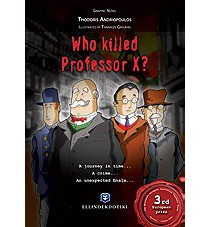
Who Killed Professor X?

What a Fun Book!

professorX

Who Killed Professor X? is a work of fiction based on actual incidents, and its heroes are real people who left their mark on the history of mathematics. The murder takes place in Paris in 1900, and the suspects are the greatest mathematicians of all time. Each suspect’s statement to the police leads to a mathematical problem, the solution of which requires some knowledge of secondary-school mathematics. But you don’t have to solve the puzzles in order to enjoy the book.

Fourteen pages of endnote biographies explain which parts of the mystery are true, which details are fictional, and which are both (true incidents slightly modified for the sake of the story).

My daughter Kitten, voracious as always, devoured it in one sitting — and even though she hasn’t studied high school geometry yet, she was able to work a couple of the problems.

Sample from the Introduction to Mathematical Thinking Class

I’m really looking forward to Keith Devlin’s free Introduction to Mathematical Thinking class, which starts in mid-September. There are more than 30,000 nearly 40,000 students signed up already. Will you join us?

These days, mathematics books tend to be awash with symbols, but mathematical notation no more is mathematics than musical notation is music.

A page of sheet music represents a piece of music: the music itself is what you get when the notes on the page are sung or performed on a musical instrument. It is in its performance that the music comes alive and becomes part of our experience. The music exists not on the printed page but in our minds.

The same is true for mathematics. The symbols on a page are just a representation of the mathematics. When read by a competent performer (in this case, someone trained in mathematics), the symbols on the printed page come alive — the mathematics lives and breathes in the mind of the reader like some abstract symphony.

— Keith Devlin
Introduction to Mathematical Thinking

How to Think like a Mathematician

Would you like to learn how to think like a mathematician? Stanford professor (and NPR “Math Guy”) Keith Devlin is teaching a free online course through Coursera. It starts in just a few weeks. I’ve signed up. Will you join us?

The prerequisite is to be taking or have finished high school math. If (like me) you took it so long ago that you can’t quite remember, don’t worry: The focus of the course is not on long-forgotten mathematical procedures, but on “learning to think in a certain (very powerful) way.”

Mathematical thinking is not the same as doing mathematics — at least not as mathematics is typically presented in our school system. School math typically focuses on learning procedures to solve highly stereotyped problems. Professional mathematicians think a certain way to solve real problems, problems that can arise from the everyday world, or from science, or from within mathematics itself.

The key to success in school math is to learn to think inside-the-box. In contrast, a key feature of mathematical thinking is thinking outside-the-box — a valuable ability in today’s world. This course helps to develop that crucial way of thinking.

— Keith Devlin
Introduction to Mathematical Thinking

Continue reading How to Think like a Mathematician