Math Games for the Holidays

Snowman Drive math party game

Are you looking for fun ways to keep your children busy (and learning!) through the holidays? Here are two printable activity guides you might enjoy:

Snowman Drive
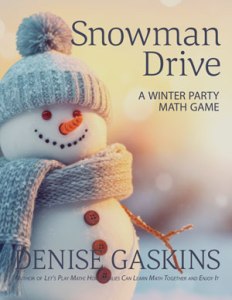
Snowman Drive math game book(My newest game activity.)

Players roll the dice and build their creative snowman (or snowbeast). Will you make a fearless pirate or a dapper aristocrat — or a high-scoring snow spider?

A Snowman Drive is a family-friendly party that can also serve as a fundraiser for your church, homeschool group, or organization. The Drive consists of several rounds of the Snowman Game played on a single worksheet, with prizes for the top-scoring players and overall champion.

This activity book includes game instructions and gameboard pages for single-family or group play.

For ages 5 and up.

* * *
Download a PDF preview file.
* * *
FORMAT: 13-page printable PDF file with your choice of 8.5″×11″ (letter size) or A4 pages.

Buy Now

Christmas Tree Math Games
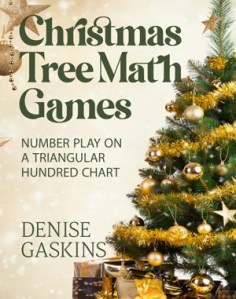
Christmas Tree Math Games book(Number play on a triangular hundred chart.)

Christmas Tree Math Games features 4 easy-to-learn games and 6 additional activities for primary and middle-grade students. All you need is a set of dice and a few colorful markers.

Math games build mental flexibility and strategic reasoning in players of all ages. And even people who hated math in school can enjoy the friendly challenge of a game.

These are NOT the typical memory-and-speed-based math games you’ve probably seen online, but true battles of wit and skill (plus a bit of luck).

Perfect ice-breakers for family gatherings, classroom warmups, or for launching a group game night. You’ll be surprised how much fun thinking hard can be!

Christmas Tree Math Games includes instructions and tips for the teacher, math game pages for handouts or learning centers, plus a variety of dot-grid journaling paper.

For ages 6 and up.

* * *
Download a PDF preview file.
* * *
FORMAT: 30-page printable PDF file with your choice of 8.5″×11″ (letter size) or A4 pages.

Buy Now

 
* * *

Are you looking for more creative ways to play math with your kids? Check out all my books, printable activities, and cool mathy merch at Denise Gaskins’ Playful Math Store. Or join my email newsletter.

This blog is reader-supported. If you’d like to help fund the blog on an on-going basis, then please join me on Patreon for mathy inspiration, tips, and an ever-growing archive of printable activities.

“Math Games for the Holidays” copyright © 2024 by Denise Gaskins. Image at the top of the post copyright © prarinya / Depositphotos.


Charlotte Mason Math: Practical Tips for a Living Math Education

“Young italian woman with two sleeping children on coast’ painting by August Riedel, public domain

Focus on the logic of reasoning.

Correct answers are important, of course, but as children explain their thinking, they will often catch and fix mistakes on their own.

“Two and two make four and cannot by any possibility that the universe affords be made to make five or three. From this point of view, of immutable law, children should approach Mathematics; they should see how impressive is Euclid’s ‘Which is absurd,’ just as absurd as would be the statements of a man who said that his apples always fell upwards, and for the same reason.”

 — Charlotte Mason, Towards a Philosophy of Education

“Most remarks made by children consist of correct ideas badly expressed. A good teacher will be wary of saying ‘No, that’s wrong.’ Rather, he will try to discover the correct idea behind the inadequate expression. This is one of the most important principles in the whole of the art of teaching.”

 — W. W. Sawyer, Vision in Elementary Mathematics

  • Tip: If you’re not sure how to draw out your child’s reasoning, read Christopher Danielson’s wonderful examples and advice on talking math with your kids: Talking Math with Your Kids.

Continue reading Charlotte Mason Math: Practical Tips for a Living Math Education

Charlotte Mason Math: Wrong Answers and Slovenly Teaching

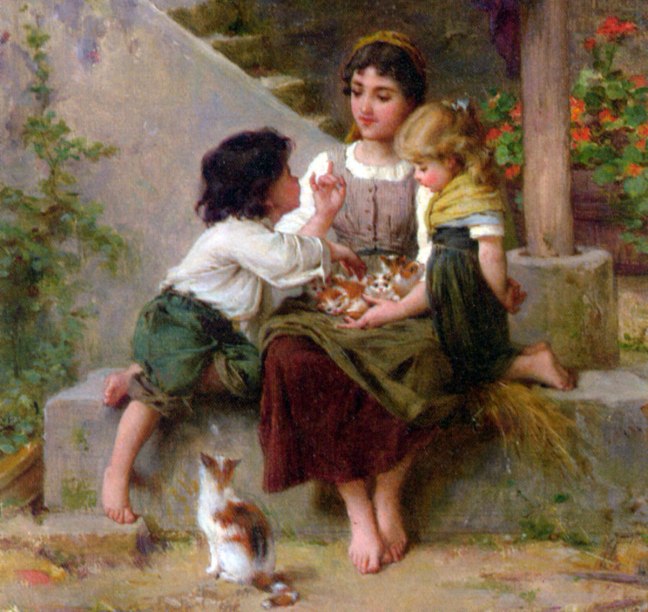
"Playing with the kittens" painting by Emile Munier, public domain

The second place where a surface-level reading of Charlotte Mason’s books can lead to misunderstanding involves the treatment of wrong answers. Mason wrote:

“… quite as bad as these is the habit of allowing that a sum is nearly right, two figures wrong, and so on, and letting the child work it over again. Pronounce a sum wrong, or right — it cannot be something between the two. That which is wrong must remain wrong: the child must not be let run away with the notion that wrong can be mended into right.”

 — Charlotte Mason, Home Education

Does this call to mind images of your own childhood schoolwork? It does for me: laboring over a worksheet or quiz and then taking it to my teacher to be graded. Right was right, and wrong could not be mended. In such a performance-oriented setting, mistakes can take on the flavor of moral failure.

Is this authoritarian approach the way Mason wants us to teach math to our children? Where is the summa corda — the joyful praise — in that?

No. Please, no. Very definitely no.

Mason wanted us to avoid slovenliness in our teaching. In this passage, she warned against several forms this might take.

Continue reading Charlotte Mason Math: Wrong Answers and Slovenly Teaching

Gratis Games and Playful Math News

Get your free copy today!
Do you want to help your children learn math?

Teach them to play.

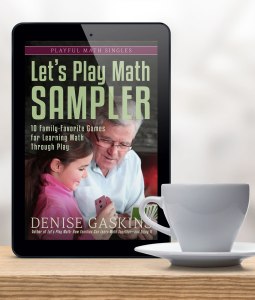
Grab a free copy of my Let’s Play Math Sampler: 10 Family-Favorite Games for Learning Math Through Play, which contains short excerpts from my most popular titles. It’s a great way to get started with playful math. 😍

As a bonus, I’ll add you to my Playful Math News email subscription and send you monthly tips and activity ideas for playing math with your kids.

From time to time, I’ll even throw in a free sample of whatever I’ve been working on — an early draft of something that will eventually show up in one of my books or printable activity guides.

For example, check out this fun freebie I sent last April:

Don’t miss out on all this mathy goodness. Sign up today!

Get the Games Book Now

Charlotte Mason Math: The Trouble with Manipulatives

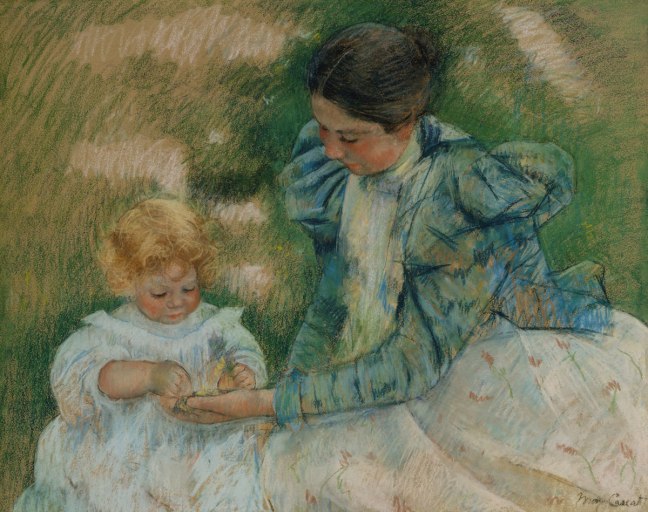
“Mother Playing with Child” painting by Mary Cassatt, public domain

Two passages in Charlotte Mason’s writing about math are in my opinion widely misunderstood. The first relates to the proper use of manipulatives.

Mason believed strongly in the importance of physical objects and oral work (mental math) in early math education. In her priorities, the use of written calculation fell in distant third place.

“A bag of beans, counters, or buttons should be used in all the early arithmetic lessons, and the child should be able to work with these freely, and even to add, subtract, multiply, and divide mentally, without the aid of buttons or beans, before he is set to ‘do sums’ on his slate.”

 — Charlotte Mason, Home Education

Continue reading Charlotte Mason Math: The Trouble with Manipulatives

Charlotte Mason Math: Finding Time for Big Ideas

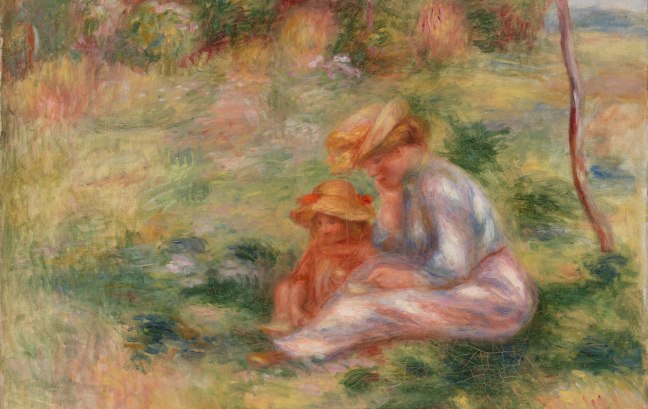
“Woman and Child in the Grass” painting by Renoir

“Teachers have seldom time to give the inspiring ideas, what Coleridge calls, the ‘Captain’ ideas, which should quicken imagination. How living would Geometry become in the light of the discoveries of Euclid as he made them!”

 — Charlotte Mason, Towards a Philosophy of Education

The Captain ideas are the great Truths of a subject, the things that make our minds wake up and pay attention, that energize our thoughts and make us yearn for more.

In math, living ideas are the big principles that tie together many branches of the subject. Things like:

Proportion — where two quantities are connected so they scale up or scale down in tandem. For instance, if we double the number of cars in the driveway, that automatically doubles the number of tires.

Transformation — how we can change things while keeping important attributes the same. Like, if we shrink a square, its area will change, but the angles stay the same.

Continue reading Charlotte Mason Math: Finding Time for Big Ideas

Charlotte Mason Math: How Shall We Teach?

Woman withchildren painting by Dorothy Kate Richmond, public domain

Even in Mason’s day, testing drove much of educational policy, but we must not allow ourselves to fall into the trap of teaching for a test. Just as we do not study history in order to win a trivia contest, so we do not study math merely to produce answers on an exam.

“Arithmetic, Mathematics, are exceedingly easy to examine upon and so long as education is regulated by examinations so long shall we have teaching, directed not to awaken a sense of awe in contemplating a self-existing science, but rather to secure exactness and ingenuity in the treatment of problems.”

 — Charlotte Mason, Towards a Philosophy of Education

Remember Mason’s twin goals of rightness and reason. Even if you use a math book that focuses on memorizing rules and cranking out answers, you and your child can look for the ideas behind the rules: “Why does this work? How can we know for sure?”

Not just because the book says so, but because you search out and discover the innate sense of it. That is the essence of mathematics.

Continue reading Charlotte Mason Math: How Shall We Teach?

Charlotte Mason Math: Our Educational Tools

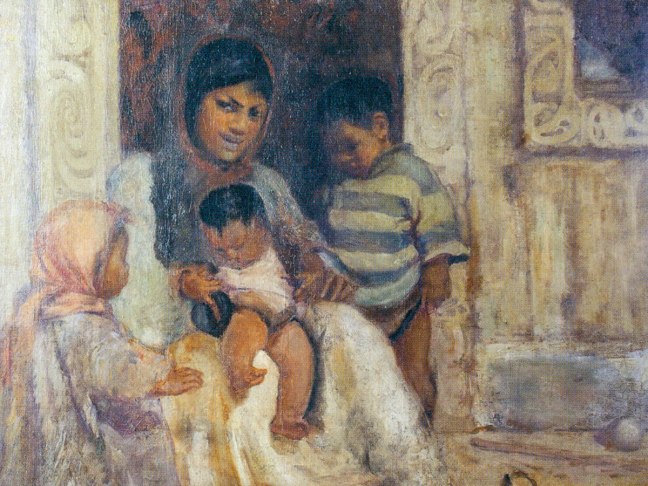
"Woman and Children" painting by Elizabeth Boott Duveneck, public domain

“Therefore, we are limited to three educational instruments––the atmosphere of environment, the discipline of habit, and the presentation of living ideas. The P.N.E.U.* Motto is: Education is an atmosphere, a discipline, and a life.”

— Charlotte Mason, Principle 5

This principle is the key to a Charlotte Mason education. Most of her books consist of drawing out the meaning and implications of this motto.

When we think about applying Mason’s educational principles to math, we must focus on providing the right atmosphere, developing appropriate habits, and presenting living ideas.

What is the mathematical atmosphere of our home or classroom? Is math a natural and welcome part of life? Or does it exist only in schoolbooks and in some nebulous “future” for which our children must prepare?

What about the people in our children’s lives? Do we adults enjoy and use math, or do we dread and avoid it? Is our mathematical worldview positive, eager to learn and grow, or negative, seeing math as a chore to endure?

Continue reading Charlotte Mason Math: Our Educational Tools

Podcast: The Beauty of Math in the Charlotte Mason Paradigm

painting by Dennis Miller Bunker, public domain

I have a new podcast interview, and I think you’ll enjoy it!

Check out Cindy Rollins’s The New Mason Jar (Season 7, Episode 93) on your favorite podcast app, or listen on the website:

Go to the podcast ❱

Here’s a couple of excerpts…

Continue reading Podcast: The Beauty of Math in the Charlotte Mason Paradigm

Charlotte Mason Math: Practice Your Principles

La Fable, painting by Berthe Morisot

In our search for a Charlotte Mason math education, we must take into consideration Mason’s approach to all learning, not just the things she said about math. We must be guided by the core principles of her philosophy, even in math

“We hold that the child’s mind is no mere sac to hold ideas; but is rather, if the figure may be allowed, a spiritual organism, with an appetite for all knowledge. This is its proper diet, with which it is prepared to deal; and which it can digest and assimilate as the body does foodstuffs.”

 — Charlotte Mason, Principle 9

For instance, we must offer our students living ideas (not mere facts) in math, just as we do in literature and history.

Masons “20 Principles” outline the essentials of her educational philosophy. If we truly apply these principles to math, it can radically transform how we teach the subject.

Let’s examine a few of her principles in more detail…

Continue reading Charlotte Mason Math: Practice Your Principles