I love how Richard Rusczyk explains math problems. It’s a new school year, and that means it’s time for new MathCounts Mini videos. Woohoo!
- Download the activity sheet with warm-up and follow-up problems.
I love how Richard Rusczyk explains math problems. It’s a new school year, and that means it’s time for new MathCounts Mini videos. Woohoo!

photo by puuikibeach via flickr
Our homeschool co-op held an end-of-semester assembly. Each class was supposed to demonstrate something they had learned. I planned to set up a static display showing some of our projects, like the fractal pop-up card and the game of Nim, but the students voted to do a skit based on the logic puzzles of Raymond Smullyan.
We had a small class (only four students), but you can easily divide up the lines make room for more players. We created signs from half-sheets of poster board with each native’s line on front and whether she was a knight or knave on the flip side. In the course of a skit, there isn’t enough time to really think through the puzzles, so the audience had to vote based on first impressions — which gave us a fair showing of all opinions on each puzzle.

The 2012 Purple Comet! Math Meet is a free, on-line, team competition for middle and high school students around the world. Every team needs an adult supervisor. Homeschoolers are welcome and should register under the Mixed Team category.
Register now. The contest will run Tuesday, April 17, through Thursday, April 26, 2012. That gives your team plenty of time for practice sessions between now and then.
Sue VanHattum is trying to convince the publishers that this excellent book would reach a wider audience if they made it available at a lower price. What do you think?
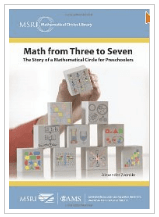
As anyone who has taught or raised young children knows, mathematical education for little kids is a real mystery. What are they capable of? What should they learn first? How hard should they work? Should they even “work” at all? Should we push them, or just let them be?
There are no correct answers to these questions, and Zvonkin deals with them in classic math-circle style: He doesn’t ask and then answer a question, but shows us a problem — be it mathematical or pedagogical — and describes to us what happened. His book is a narrative about what he did, what he tried, what worked, what failed, but most important, what the kids experienced.
This book is not a guidebook. It does not purport to show you how to create precocious high achievers. It is just one person’s story about things he tried with a half-dozen young children. On the other hand, if you are interested in running a math circle, or homeschooling children, you will find this book to be an invaluable, inspiring resource. It’s not a “how to” manual as much as a “this happened” journal. … Just about every page contains a really clever teaching idea, a cool math problem, and an inspiring and funny story.
— Paul Zeitz
Introduction to Math from Three to Seven

photo by Creativity103 via flickr
For our homeschool, January is the time to assess our progress and make a few New Semester’s Resolutions. This year, we resolve to challenge ourselves to more math puzzles. Would you like to join us? Pump up your mental muscles with the 2012 Mathematics Game!
Use the digits in the year 2012 to write mathematical expressions for the counting numbers 1 through 100.
- You must use all four digits. You may not use any other numbers.
- You may use +, -, x, ÷, sqrt (square root), ^ (raise to a power), ! (factorial), and parentheses, brackets, or other grouping symbols.
- You may use a decimal point to create numbers such as .2, .01, etc.
- You may create multi-digit numbers such as 10 or 202, but we prefer solutions that avoid them.
Bonus Rules
You may use the overhead-bar (vinculum), dots, or brackets to mark a repeating decimal.You may use multifactorials:
- n!! = a double factorial = the product of all integers from 1 to n that have the same parity (odd or even) as n.
- n!!! = a triple factorial = the product of all integers from 1 to n that are equal to n mod 3
[Note to teachers: Math Forum modified their rules to allow double factorials, but as far as I know, they do not allow repeating decimals or triple factorials.]
The MathCounts Club Program provides enrichment activities and puzzles for 6th-8th grade math clubs within schools — and homeschool groups may join, too! Participants receive a free Club in a Box Resource Kit, which includes the Club Resource Guide, two game boards to accompany one of the meeting plans, 12 MathCounts pencils, and a MathCounts tote bag for the coach. (Apparently they had good intentions, but they didn’t follow through. My box had no tote.)
A school (or homeschool group) may choose to participate in the Club Program, the competition or both programs. Since these programs can complement each other, any school that registers for the MathCounts competition automatically gets the Club in a Box Resource Kit, too.
For more information, check out these links:
 [Photo from Wikipedia.]
Two of the most popular New Year’s Resolutions are to spend more time with family and friends, and to get more exercise. The 2011 Mathematics Game is a chance to do both at once.
So grab a partner, slip into your workout clothes, and pump up those mental muscles!
Use the digits in the year 2011 to write mathematical expressions for the counting numbers 1 through 100.
- All four digits must be used in each expression. You may not use any other numbers except 2, 0, 1, and 1.
- You may use the arithmetic operations +, -, x, ÷, sqrt (square root), ^ (raise to a power), and ! (factorial). You may also use parentheses, brackets, or other grouping symbols.
- You may use a decimal point to create numbers such as .1, .02, etc.
- Multi-digit numbers such as 20 or 102 may be used, but preference is given to solutions that avoid them.
Bonus Rules
You may use the overhead-bar (vinculum), dots, or brackets to mark a repeating decimal.You may use multifactorials:
- (n!)! = a factorial of a factorial, which is not the same as a multifactorial
- n!! = a double factorial = the product of all integers from 1 to n that have the same parity (odd or even) as n
- n!!! = a triple factorial = the product of all integers from 1 to n that are equal to n mod 3
[Note to teachers: The bonus rules are not part of the Math Forum guidelines. They make a significant difference in the number of possible solutions, however, and they should not be too difficult for high school students or advanced middle schoolers.]
Beautifully done!
Do you know why this proof works? How can we be sure the red and yellow areas don’t change as they slide around?
For my Calculus for Young People students: Beware! We studied a few infinite series that converge to a nice, tame sum — but not all series are so well behaved.
Check out this mind-blowing video from the author of Math Without Words:
[See also: Harmonic Series Quotation and For Niner: A Bit of Calculus Fun.]

[Photo by pfala.]
Thanks to John Cook’s article about factorials in the recent Mathematics and Multimedia Carnival, we’re adding new rules to the 2010 Mathematics Game.
Let’s play with multifactorials!
 Denise Gaskins' Let's Play Math