Hit Me! (A Math Game)

Photo by paparutzi.

Math concepts: addition, subtraction, negative numbers, mental math, absolute value
Number of players: any number
Equipment: math cards (two decks may be needed for a large group)

Set Up

One player (the dealer) shuffles the math cards and deals one card face down for each player, beginning with the player on his left and proceeding in turn around the table. Then he deals one card face up beside each face down card.

Continue reading Hit Me! (A Math Game)

The Function Machine Game

Math concepts: odd numbers, even numbers, greater-than/less-than, rounding off, addition, subtraction, multiplication, division, fractions, negative numbers, prime numbers, square numbers, problem solving, mental math
Number of players: two or more
Equipment: pencil (or pen) and paper for every player

Continue reading The Function Machine Game

Game: Avoid Three, or Tic-Tac-No!

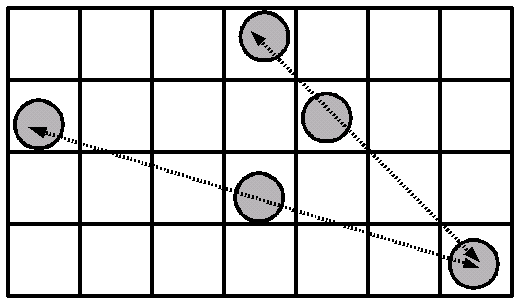
Math concepts: slope, logical strategy
Number of players: 2 or more
Equipment: 4×4 or larger grid, pebbles or other tokens to mark squares

Set Up

Alexandria Jones and her brother Leon played Avoid Three with pebbles on a grid scratched in the sand, but you can also use pencils or markers on graph paper. You need a rectangular playing area at least 4×4 squares large. The bigger your grid, the longer your game.

Continue reading Game: Avoid Three, or Tic-Tac-No!

Substitute Teacher Experiments with Combinatorics


Photo by peigianlong.

Here is a puzzle from Just a Substitute Teacher:

Lesson plan entry: “Hand out worksheet packets and have students staple before starting. They know what to do.”

Sounds simple enough! Four numbered sheets, eight total pages, printed front and back. What could go wrong?

Do you know how many possible combinations four pieces of paper can be arranged for stapling?

Continue reading Substitute Teacher Experiments with Combinatorics

Happy Pi Day II

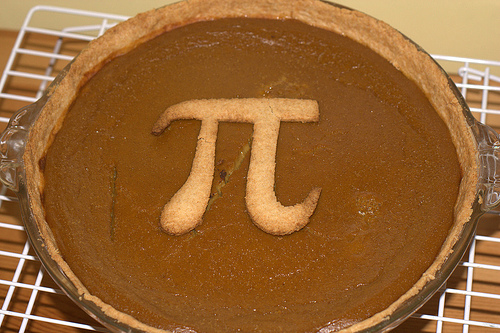
[Feature photo above by pauladamsmith.]

Now there is an ancient Greek letter,
And I think no other is better.
It isn’t too tall,
It might look very small,
But its digits, they go on forever.

— Scott
Mrs. Mitchell’s Virtual School

Time to Celebrate

Are your students doing anything special for \pi Day? After two months with no significant break, we are going stir crazy. We need a day off — and what better way could we spend it than to play math all afternoon?

If you need ideas, here are some great \pi pages:

Continue reading Happy Pi Day II

Euclid’s Game on a Hundred Chart

Math concepts: subtraction within 100, number patterns, mental math
Number of players: 2 or 3
Equipment: printed hundred chart (also called a hundred board), and highlighter or translucent disks to mark numbers — or use this online hundred chart

Set Up

Place the hundred chart and highlighter where all players can reach them.

How to Play

  • Allow the youngest player choice of moving first or second; in future games, allow the loser of the last game to choose.
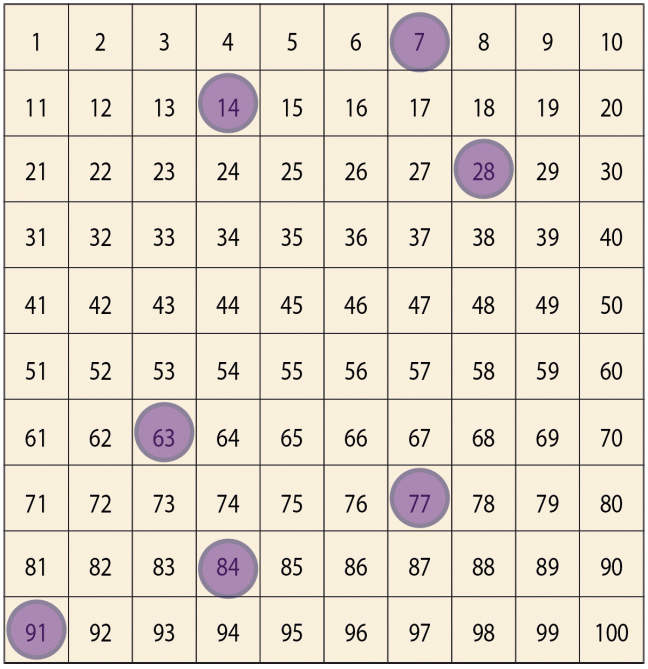
  • The first player chooses a number from 1 to 100 and marks that square on the hundred chart.
  • The second player chooses and marks any other number.
  • On each succeeding turn, the player subtracts any two marked numbers to find and mark a difference that has not yet been taken.
  • Play alternates until no more numbers can be marked.

Continue reading Euclid’s Game on a Hundred Chart

2008 Mathematics Game

Are you ready for a challenge? Join us for the 2008 Mathematics Game. Here are the rules:

Use the digits in the year 2008 and the operations +, -, x, ÷, sqrt (square root), ^ (raise to a power), and ! (factorial) — along with parentheses, brackets, or other grouping symbols — to write expressions for the counting numbers 1 through 100.

  • All four digits must be used in each expression.
  • Only the digits 2, 0, 0, 8 may be used.
  • Multi-digit numbers such as 20, 208, or .02 MAY be used this year.
  • The square function may NOT be used.
  • The integer function may NOT be used.

By definition:
0! = 1
[See Dr. Math’s Why does 0 factorial equal 1?]

For this game we will accept the value:
{0}^{0} = 1
[See the Dr. Math FAQ 0 to the 0 power.]

Continue reading 2008 Mathematics Game

Puzzles for the New Year

by Koshyk via flickr

As we all head back to school, here are some interesting calendar puzzles:

  • 2008 is a leap year. Why do leap years happen? If we didn’t add a leap day every so often, would January eventually come in the summer?
  • Today is Thursday. What day of the week will it be exactly one year from today?
  • January 1, 2008, came on a Tuesday. When will be the next year that begins on Tuesday?
  • My birthday (in March) lands on a Monday this year. When is the next year my birthday will come on a Monday? How about YOUR birthday — when is the next time it will happen on the same day of the week as this year?
  • Can you find a pattern in the way dates move from one day of the week to another, year after year?

Continue reading Puzzles for the New Year