The Christmas Present Quandary

Alexandria Jones hated using store-bought wrapping paper at Christmas. She tried to wrap each present as a hand-crafted work of art.

Last year, she did mini-scenes with plastic figures building cotton snowmen or skating on aluminum-foil ponds — and, for her brother Leonhard’s gift, her favorite creation: toy dinosaurs having a snowball fight. But those 3-D scenes got knocked about under the Christmas tree.

This year, she decided, she would wrap the packages flat. But then, how could she make them special?

Continue reading The Christmas Present Quandary

Game: Hundred Chart Nim

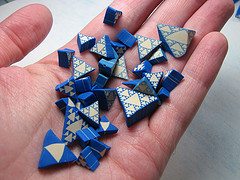
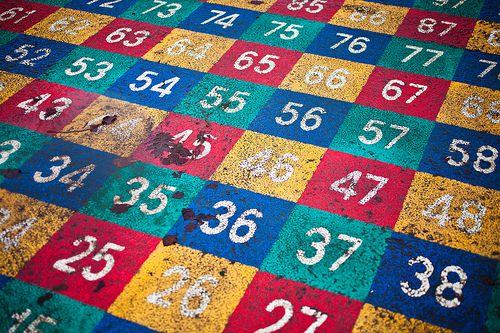
Photo by Håkan Dahlström via flickr.

Math concepts: addition and subtraction within 100, logical strategy
Number of players: 2 or 3
Equipment: printed hundred chart (also called a hundred board) and beans, pennies, or other tokens with which to mark numbers — or use this online hundred chart

Set Up

Place the hundred chart and a small pile of tokens where both players can reach them.

Continue reading Game: Hundred Chart Nim

More Fun with Hexa-Trex

Hexa-trex turtle logo

My elementary Math Club students had fun practicing their math facts and “out of the box” thinking with Hexa-Trex puzzles. The object of Hexa-Trex is to find a path through all the number and operation tiles to make a true equation. The “Easy” puzzles are just the right level for my 4th-5th grade students, although they get stumped whenever the equations require Order of Operations. One girl enjoyed the puzzles enough to take our extra pages home for her dad.

Hexa-Trex puzzles were featured in the October issue of Games magazine, and now you can enjoy Hexa-Trex away from the computer with Bogusia Gierus‘s new book, The First Book of Hexa-Trex Puzzles. If you are thinking ahead to Christmas (can it be that time already?!), and if you have a puzzle lover in the family, this little book would make a fun stocking-stuffer.

How to Solve Math Problems

That’s a Tough One!

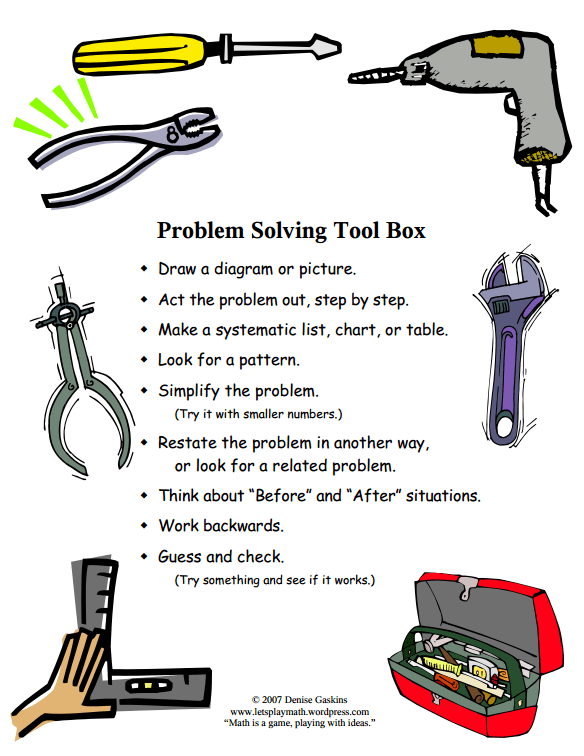
What can you do when you are stumped? Too many students sit and stare at the page, waiting for inspiration to strike — and when the solution doesn’t crack their heads open and step out, fully formed, they complain: “Math is too hard!”

So this year I have given my Math Club students a couple of mini-posters to put up on the wall above their desk, or wherever they do their math homework. The first gives four questions to ask yourself as you think through a math problem, and the second is a list of problem-solving strategies.

Continue reading How to Solve Math Problems

Puzzle: Random Blocks

Red block puzzle

In the first section of George Lenchner’s Creative Problem Solving in School Mathematics, right after his obligatory obeisance to George Polya (see the third quote here), Lechner poses this problem. If you have seen it before, be patient — his point was much more than simply counting blocks.

A wooden cube that measures 3 cm along each edge is painted red. The painted cube is then cut into 1-cm cubes as shown above. How many of the 1-cm cubes do not have red paint on any face?

And then he challenges us as teachers:

Do you have any ideas for extending the problem?
If so, then jot them down.

This is strategically placed at the end of a right-hand page, and I was able to resist turning to read on. I came up with a list of 15 other questions that could have been asked — some of which will be used in future Alexandria Jones stories. Lechner wrote only seven elementary-level problems, and yet his list had at least two questions that I had not considered. How many can you come up with?

Continue reading Puzzle: Random Blocks

Quotations XIII: Mathematics Education Is Much More Complicated than You Expected

Registrations have been rolling in for our homeschool co-op, and the most popular classes are full already. Math doesn’t seem to be a “most popular” class. I can’t imagine why! Still, many of my students from last year are coming back for another go, and I am getting spill-over from the science class waiting list.

Anyway, I have started planning in earnest for our fall session. As usual, I look to those wiser than myself for inspiration…

Many teachers are concerned about the amount of material they must cover in a course. One cynic suggested a formula: since, he said, students on the average remember only about 40% of what you tell them, the thing to do is to cram into each course 250% of what you hope will stick.

Paul Halmos

Continue reading Quotations XIII: Mathematics Education Is Much More Complicated than You Expected

Game: Tens Concentration

Math concepts: addition, number bonds for 10, visual memory
Number of players: any number, mixed ages
Equipment: math cards, one deck

Set Up

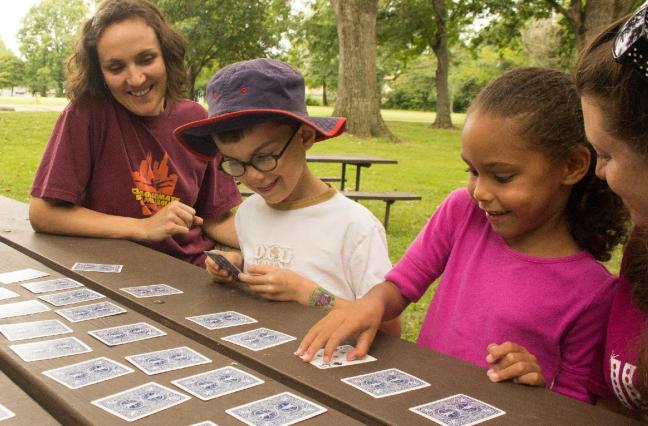
Each player draws a card, and whoever choses the highest number will go first. Then shuffle the cards and lay them all face down on the table, spread out so no card covers any other card. There are 40 cards in a deck, so you can make a neat array with five rows of eight cards each, or you may scatter them at random.

Continue reading Game: Tens Concentration

How To Start a Homeschool Math Club

From a recent e-mail:

“Hello! I am on the board of a homeschool co-op. We have had requests for a math club and wondered if you have any tips for starting one. We service children from K-10th and would need to try to meet the needs of as many ages as possible.”

There are several ways you might organize a homeschool math club, depending on the students you have and on your goals. I think you would have to split the students by age groups — it is very hard to keep that wide of a range of students interested. Then decide whether you want an activity-oriented club or a more academic focus.

When I started my first math club, I raided the math shelves in the children’s section at my library (510-519) for anything that interested me. I figured that if an activity didn’t interest me, I couldn’t make it fun for the kids. Over the years we have done a variety of games, puzzles, craft projects, and more — always looking for something that was NOT like whatever the kids would be doing in their textbooks at home.

Continue reading How To Start a Homeschool Math Club
Puzzle: Patty Paper Trisection

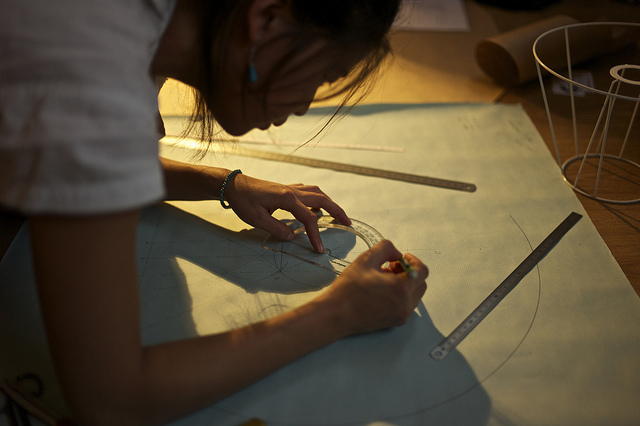
[Feature photo above by Michael Cory via Flickr (CC BY 2.0).]

trisection

One of the great unsolved problems of antiquity was to trisect any angle using only the basic tools of Euclidean geometry: an unmarked straight-edge and a compass. Like the alchemist’s dream of turning lead into gold, this proved to be an impossible task. If you want to trisect an angle, you have to “cheat.” A straight-edge and compass can’t do it. You have to use some sort of crutch, just as an alchemist would have to use a particle accelerator or something.

One “cheat” that works is to fold your paper. I will show you how it works, and your job is to show why.

Continue reading Puzzle: Patty Paper Trisection