Rate Puzzle: How Fast Does She Read?


[Photo by Arwen Abendstern.]

If a girl and a half
can read a book and a half
in a day and a half,
then how many books can one girl read in the month of June?

Kitten reads voraciously, but she decided to skip our library’s summer reading program this year. The Border’s Double-Dog Dare Program was a lot less hassle and had a better prize: a free book! Of course, it didn’t take her all summer to finish 10 books.

How fast does Kitten read?

Continue reading Rate Puzzle: How Fast Does She Read?

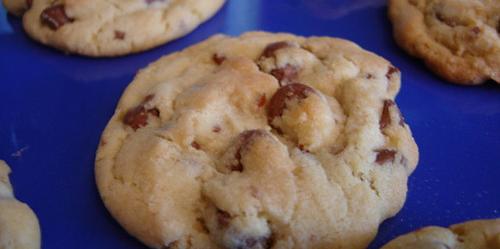
The Cookie Factory Guide to Long Division

[Photo by scubadive67.]

Help! My son was doing fine in math until he started long division, but now he’s completely lost! I always got confused with all those steps myself. How can I explain it to him?

Long division. It’s one of the scariest of the Math Monsters, those tough topics of upper-elementary and middle school mathematics. Of all the topics that come up on homeschool math forums, perhaps only one (“How can I get my child to learn the math facts?”) causes parents more anxiety.

Most of the “helpful advice” I’ve seen focuses on mnemonics (“Dad/Mother/Sister/Brother” to remember the steps: Divide, Multiply, Subtract, Bring down) or drafting (turn your notebook paper sideways and use the lines to keep your columns straight).

I worry that parents are too focused on their child mastering the algorithm, learning to follow the procedure, rather than on truly understanding what is happening in long division.

An algorithm is simply a step-by-step recipe for doing a mathematical calculation. But WHY does the algorithm work? If our students could understand the reason for the steps, they wouldn’t have to work so hard on memory tricks.

Continue reading The Cookie Factory Guide to Long Division

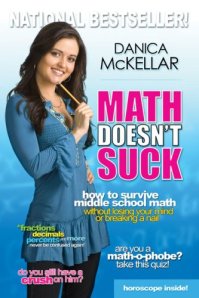
Review: Math Doesn’t Suck

We’ve all heard the saying, Don’t judge a book by its cover, but I did it anyway. Well, not by the cover, exactly — I also flipped through the table of contents and read the short introduction. And I said to myself, “I don’t talk like this. I don’t let my kids talk like this. Why should I want to read a book that talks like this? I’ll leave it to the public school kids, who are surely used to worse.”

Okay, I admit it: I’m a bit of a prude. And it caused me to miss out on a good book. But now Danica McKellar‘s second book is out, and the first one has been released in paperback. A friendly PR lady emailed to offer me a couple of review copies, so I gave Math Doesn’t Suck a second chance.

I’m so glad I did.

Continue reading Review: Math Doesn’t Suck

Subtracting Mixed Numbers: A Cry for Help

Photo by powerbooktrance.

Paraphrased from a homeschool math discussion forum:

“Help me teach fractions! My son can do long subtraction problems that involve borrowing, and he can handle basic fraction math, but problems like 9  -  5 \frac{2}{5} give him a brain freeze. To me, this is an easy problem, but he can’t grasp the concept of borrowing from the whole number. It is even worse when the math book moves on to 10 \frac{1}{4}  -  2 \frac{3}{7} .”

Several homeschooling parents replied to this question, offering advice about various fraction manipulatives that might be used to demonstrate the concept. I am not sure that manipulatives are needed or helpful in this case. The boy seems to have the basic concept of subtraction down, but he gets flustered and is unsure of what to do in the more complicated mixed-number problems.

The mother says, “To me, this is an easy problem” — and that itself is one source of trouble. Too often, we adults (homeschoolers and classroom teachers alike) don’t appreciate how very complicated an operation we are asking our students to perform. A mixed-number calculation like this is an intricate dance that can seem overwhelming to a beginner.

I will go through the calculation one bite at a time, so you can see just how much a student must remember. As you read through the steps, pay attention to your own emotional reaction. Are you starting to feel a bit of brain freeze, too?

Afterward, we’ll discuss how to make the problem simpler…

Continue reading Subtracting Mixed Numbers: A Cry for Help

Word Problems in Russia and America

Andrei Toom calls this an “extended version” of a talk he gave a few years ago at the Swedish Mathematical Society. At 159 pages [2010 updated version is 98 pages], I would call it a book. Whatever you call it, it’s a must-read for math teachers:

Main Thesis: Word problems are very valuable in teaching mathematics not only to master mathematics, but also for general development. Especially valuable are word problems solved with minimal scolarship, without algebra, even sometimes without arithmetics, just by plain common sense. The more naive and ingenuous is solution, the more it provides the child’s contact with abstract reality and independence from authority, the more independent and creative thinker the child becomes.

Continue reading Word Problems in Russia and America

Fraction Models, and a Card Game

Fraction cards

Models give us a way to form and manipulate a mental image of an abstract concept, such as a fraction. There are three basic ways we can imagine a fraction: as partially-filled area or volume, as linear measurement, or as some part of a given set. Teach all three to give your students a well-rounded understanding.

When teaching young students, we use physical models — actual food or cut-up pieces of construction paper. Older students and adults can firm up the foundation of their understanding by drawing many, many pictures. As we move into abstract, numbers-only work, these pictures remain in our minds, an always-ready tool to help us think our way through fraction problems.

Continue reading Fraction Models, and a Card Game

How to Read a Fraction

Fraction notation and operations may be the most abstract math monsters our students meet until they get to algebra. Before we can explain those frustrating fractions, we teachers need to go back to the basics for ourselves. First, let’s get rid of two common misconceptions:

  • A fraction is not two numbers.
    Every fraction is a single number. A fraction can be added to other numbers (or subtracted, multiplied, etc.), and it has to obey the Distributive Law and all the other standard rules for numbers. It takes two digits (plus a bar) to write a fraction, just as it takes two digits to write the number 18 — but, like 18, the fraction is a single number that names a certain amount of whatever we are counting or measuring.
  • A fraction is not something to do.
    A fraction is a number, not a recipe for action. The fraction 3/4 does not mean, “Cut your pizza into 4 pieces, and then keep 3 of them.” The fraction 3/4 simply names a certain amount of stuff, more than a half but not as much as a whole thing. When our students are learning fractions, we do cut up models to help them understand, but the fractions themselves are simply numbers.

Continue reading How to Read a Fraction

How Shall We Teach Fractions?

How did you fare on the Frustrating Fractions Quiz? With so many apparent inconsistencies, we can all see why children (and their teachers) get confused. And yet, fractions are vital to our children’s test scores — and scores are important to college admissions officers. What is a teacher to do? Must we tell our children, “Do it this way, and don’t ask questions”?

Parents and teachers are tempted to wonder if the struggle is worth it. After all, how often do you divide by a fraction in your adult life? If only we could skip the hard stuff…

Continue reading How Shall We Teach Fractions?

Trouble with Percents

Can your students solve this problem?

There are 20% more girls than boys in the senior class.
What percent of the seniors are girls?

This is from a discussion of the semantics of percent problems and why students have trouble with them, going on over at MathNotations. (Follow-up post here.)

Our pre-algebra class just finished a chapter on percents, so I thought Chickenfoot might have a chance at this one. Nope! He leapt without thought to the conclusion that 60% of the class must be girls.

After I explained the significance of the word “than”, he solved the follow-up problem just fine.

How Old Are You, in Nanoseconds?

Conversion factors are special fractions that contain problem-solving information. Why are they called conversion factors? “Conversion” means change, and conversion factors help you change the numbers and units in your problem. “Factors” are things you multiply with. So to use a conversion factor, you will multiply it by something.

For instance, if I am driving an average of 60 mph on the highway, I can use that rate as a conversion factor. I may use the fraction \frac{60 \: miles}{1 \: hour} , or I may flip it over to make \frac{1 \: hour}{60 \: miles} . It all depends on what problem I want to solve.

After driving two hours, I have traveled:

\left(2 \: hours \right) \times \frac{60 \: miles}{1 \: hour} = 120 miles so far.

But if I am planning to go 240 more miles, and I need to know when I will arrive:

\left(240 \: miles \right) \times \frac{1 \: hour}{60 \: miles} = 4 hours to go.

Any rate can be used as a conversion factor. You can recognize them by their form: this per that. Miles per hour, dollars per gallon, cm per meter, and many, many more.

Of course, you will need to use the rate that is relevant to the problem you are trying to solve. If I were trying to figure out how far a tank of gas would take me, it wouldn’t be any help to know that an M1A1 Abrams tank gets 1/3 mile per gallon. I won’t be driving one of those.

Using Conversion Factors Is Like Multiplying by One

If I am driving 65 mph on the interstate highway, then driving for one hour is exactly the same as driving 65 miles, and:

\frac{65 \: miles}{1 \: hour} = the \: same \: thing \: divided \: by \: itself = 1

This may be easier to see if you think of kitchen measurements. Two cups of sour cream are exactly the same as one pint of sour cream, so:

\frac{2 \: cups}{1 \: pint} = \left(2 \: cups \right) \div \left(1 \:pint \right) = 1

If I want to find out how many cups are in 3 pints of sour cream, I can multiply by the conversion factor:

\left(3 \: pints \right) \times \frac{2 \: cups}{1 \: pint} = 6 \: cups

Multiplying by one does not change the original number. In the same way, multiplying by a conversion factor does not change the original amount of stuff. It only changes the units that you measure the stuff in. When I multiplied 3 pints times the conversion factor, I did not change how much sour cream I had, only the way I was measuring it.

Conversion Factors Can Always Be Flipped Over

If there are \frac{60 \: minutes}{1 \: hour} , then there must also be \frac{1 \: hour}{60 \: minutes} .

If I draw house plans at a scale of \frac{4 \: feet}{1 \: inch} , that is the same as saying \frac{1 \: inch}{4 \: feet} .

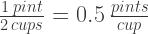
If there are \frac{2\: cups}{1 \: pint} , then there is \frac{1\: pint}{2 \: cups} = 0.5 \: \frac{pints}{cup} .

Or if an airplane is burning fuel at \frac{8\: gallons}{1 \: hour} , then the pilot has only 1/8 hour left to fly for every gallon left in his tank.

This is true for all conversion factors, and it is an important part of what makes them so useful in solving problems. You can choose whichever form of the conversion factor seems most helpful in the problem at hand.

How can you know which form will help you solve the problem? Look at the units you have, and think about the units you need to end up with. In the sour cream measurement above, I started with pints and I wanted to end up with cups. That meant I needed a conversion factor with cups on top (so I would end up with that unit) and pints on bottom (to cancel out).

You Can String Conversion Factors Together

String several conversion factors together to solve more complicated problems. Just as numbers cancel out when the same number is on the top and bottom of a fraction (2/2 = 2 ÷ 2 = 1), so do units cancel out if you have the same unit in the numerator and denominator. In the following example, quarts/quarts = 1.

How many cups of milk are there in a gallon jug?

\left(1\: gallon \right) \times \frac{4\: quarts}{1\: gallon} \times \frac{2\: pints}{1\: quart} \times \frac{2\: cups}{1\: pint} = 16\: cups

As you write out your string of factors, you will want to draw a line through each unit as it cancels out, and then whatever is left will be the units of your answer. Notice that only the units cancel — not the numbers. Even after I canceled out the quarts, the 4 was still part of my calculation.

Let’s Try One More

The true power of conversion factors is their ability to change one piece of information into something that at first glance seems to be unrelated to the number with which you started.

Suppose I drove for 45 minutes at 55 mph in a pickup truck that gets 18 miles to the gallon, and I wanted to know how much gas I used. To find out, I start with a plain number that I know (in this case, the 45 miles) and use conversion factors to cancel out units until I get the units I want for my answer (gallons of gas). How can I change minutes into gallons? I need a string of conversion factors:

\left(45\: min. \right) \times \frac{1\: hour}{60\: min.} \times \frac{55\: miles}{1\: hour} \times \frac{1\: gallon}{18\: miles} = 2.3\: gallons

How Old Are You, Anyway?

If you want to find your exact age in nanoseconds, you need to know the exact moment at which you were born. But for a rough estimate, just knowing your birthday will do. First, find out how many days you have lived:


Days\: I\:have\: lived = \left(my\: age \right) \times \frac{365\: days}{year}

+ \left(number\: of\: leap\: years \right) \times \frac{1\: extra\: day}{leap\: year}

+ \left(days\: since\: my\: last\: birthday,\: inclusive \right)

Once you know how many days you have lived, you can use conversion factors to find out how many nanoseconds that would be. You know how many hours are in a day, minutes in an hour, and seconds in a minute. And just in case you weren’t quite sure:

One\: nanosecond = \frac{1}{1,000,000,000} \: of\: a\: second

Have fun playing around with conversion factors. You will be surprised how many problems these mathematical wonders can solve.


[Note: This article is adapted from my out-of-print book, Master the Math Monsters.]