Celebrating Math with Pi Day

Are your students doing anything special for Pi Day?

Back when we were homeschooling, my kids and I always felt stir-crazy after two months with no significant break. We needed a day off — and what better way could we spend it than to play math all afternoon?

I love any excuse to celebrate math!

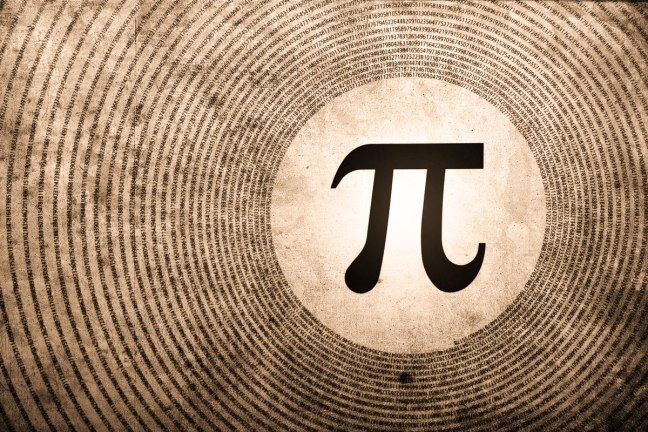
Pi Day is March 14. If you write dates in the month/date format, then 3/14 at 1:59 is about as close as the calendar can get to 3.14159etc.

(Otherwise, you can celebrate Pi Approximation Day on July 22, or 22/7.)

Unfortunately, most of the activities on teacher blogs and Pinterest focus on the pi/pie wordplay or on memorizing the digits. With a bit of digging, however, I found a few puzzles that let us sink our metaphorical teeth into real mathematical meat.

What’s the Big Deal? Why Pi?

In math, symmetry is beautiful, and the most completely symmetric object in the (Euclidean) mathematical plane is the circle. No matter how you turn it, expand it, or shrink it, the circle remains essentially the same.

Every circle you can imagine is the exact image of every other circle there is.

This is not true of other shapes. A rectangle may be short or tall. An ellipse may be fat or slim. A triangle may be squat, or stand upright, or lean off at a drunken angle. But circles are all the same, except for magnification. A circle three inches across is a perfect, point-for-point copy of a circle three miles across, or three millimeters.

What makes a circle so special and beautiful? Any child will tell you, what makes a circle is its roundness. Perfectly smooth and plump, but not too fat.

The definition of a circle is “all the points at a certain distance from the center.” Can you see why this definition forces absolute symmetry, with no pointy sides or bumped-out curves?

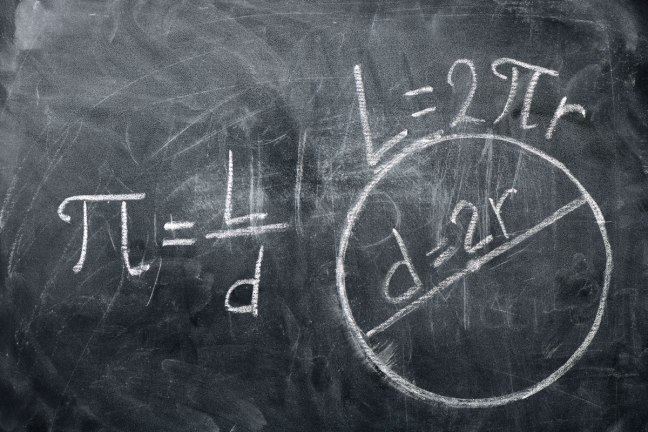
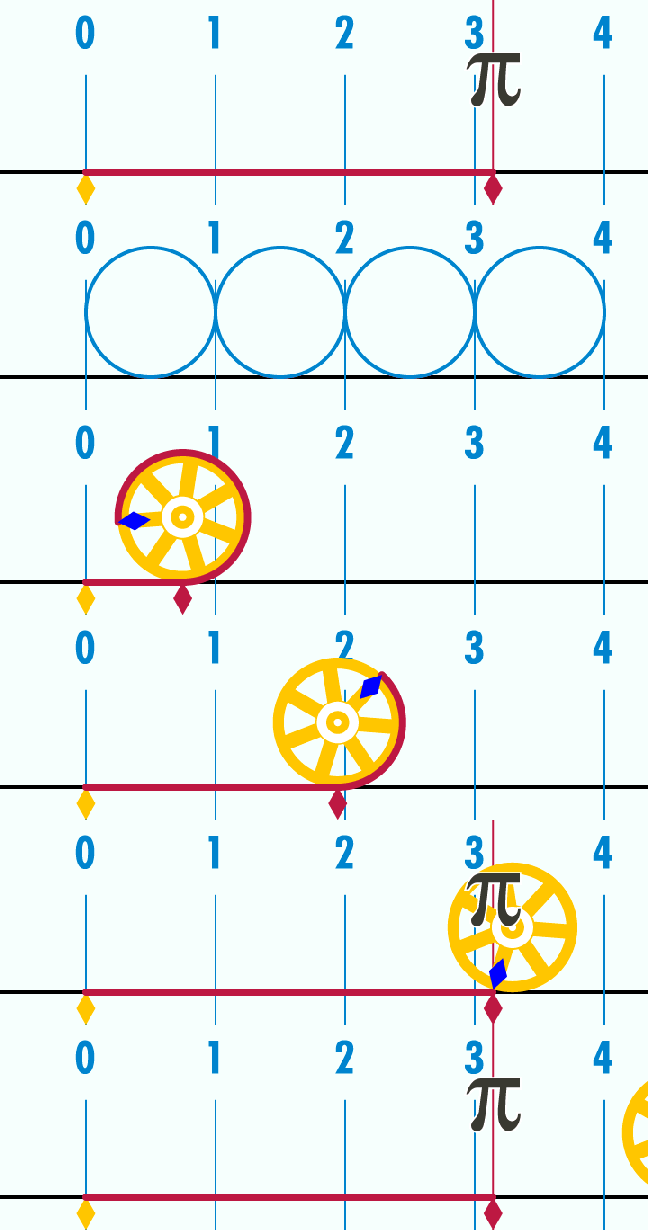
One way to express that perfect roundness in numbers is to compare it to the distance across. How many times would you have to walk back and forth across the middle of the circle to make the same distance as one trip around?

The ratio is the same for every circle, no matter which direction you walk.

That’s pi!

Puzzles with Pi

For all ages:

Sarah Carter created this fun variation on the classic Four 4s puzzle for Pi Day:

Using only the digits 3, 1, 4 once in each calculation, how many numbers can you make?

You can use any math you know: add, subtract, multiply, square roots, factorials, etc. You can concatenate the digits, putting them together to make a two-digit or three-digit number.

For older students:

1. Imagine the Earth as a perfect sphere with a long rope tightly wrapped around the equator. Then increase the length of the rope by 10 feet, and magically lift it off the Earth to float above the equator. Will an ant be able to squeeze under the rope without touching it? What about a cat? A person?

2. If you ride a bicycle over a puddle of water, the wheels will leave wet marks on the road. Obviously, each wheel leaves a periodic pattern. How the two patterns are related? Do they overlap? Does their relative position depend on the length of the puddle? The bicycle? The size of the wheels?

3. Draw a semicircle. Along its diameter draw smaller semicircles (not necessarily the same size) that touch each other. Because there are no spaces in between, the sum of the diameters of the small semicircles must equal the diameter of the large one. What about their perimeter, the sum of their arc lengths?

4. Choose any smallish number N. How can you cut a circular shape into N parts of equal area with lines of equal lengths, using only a straight-edge and compass? Hint: The lines don’t have to be straight.


[Solutions at Alexander Bogomolny’s Pi Page. Scroll down to “Extras.”]

It can be of no practical use to know that Pi is irrational, but if we can know, it surely would be intolerable not to know.

— Edward Titchmarsh

For More Information

Here are a few pi-related links you may find interesting:

Or for pure silliness:

Have fun playing math with your kids!

John Reid, CC BY-SA 3.0 via Wikimedia Commons

Get a Weekly Dose of Playful Math

Our leaves haven’t started to turn yet, but summer’s on the wane, farmers are busy with harvest, and the back-to-school rush has calmed down into a daily routine.

But if you’re like me, you keep tweaking that routine, constantly looking for the perfect balance for your family or classroom. I especially love to discover easy ways to add more playful math to our schedule.

So here’s a collection of sites that offer fresh math resources on a weekly or monthly basis throughout the school year.

Which one will you try?

KenKen Classroom

Every week, they’ll email you a set of free KenKen arithmetic puzzles for all ages. As the challenge level subtly shifts week to week, students develop their math and logical thinking skills without even knowing it.

Subscribe ❯

#MathStratChat

Pose an interesting math problem. How can you figure it out? What else could you do? How many different ways can you find? Which strategy do you like best for this problem?

Follow Pam Harris on your favorite social media site to get a new problem every Wednesday.

Choose a Problem ❯

The Parallel Universe

Dr Simon Singh, author of the No. 1 bestseller Fermat’s Last Theorem and The Simpsons and Their Mathematical Secrets has created a set of weekly maths challenges – just 15-30 minutes of interesting, fun and challenging tidbits of mystery and history, activities and oddities, puzzles and problems.

Help students expand their mathematical horizons beyond the school curriculum and build strong mathematical thinking skills. Stretch your brain every week!

Learn More ❯

Numberless Word Problems

As I mentioned yesterday, my new book includes links to online resources to help you play with word problems. So this week, I’m sharing a few of my favorites.

Visit the Kickstarter

Today we examine a time-tested method to help kids reason about math: Leave out the numbers.

First up, there’s Brian Bushart’s numberless problem bank for young students. Then we’ll look at Farrar Williams’s modern revision of a math teaching classic with problems for upper-elementary and middle school students.

Have fun thinking math with your kids!

Word Problem Bank

Word problems are commonplace in mathematics classrooms, and yet they regularly confound students and lead to frustrated teachers saying things like:

  • “They just add all the numbers! It doesn’t matter what the problem says.”
  • “They don’t stop to think! They just start computing as soon as they’re done reading the problem.”

Brian Bushart offers a collection of ready-to-go slide presentations that walk through the steps of making a word problem make sense.

Visit the Site

Math With No Numbers

Discover Farrar Williams’s book Numberless Math Problems: A Modern Update of S.Y. Gillian’s Classic Problems Without Figures, available in ebook or paperback.

Williams writes: “In order to answer the question, they’ll have to explain it, because the problem doesn’t give you anything to calculate with. The only way to answer is by explaining your process. See how sneaky a numberless problem is? It makes students really think about the process of solving the problem.”

Find Out More

“When students face a word problem, they often revert to pulling all the numbers out and “doing something” to them. They want to add, subtract, multiply, or divide them, without really considering which operation is the right one to perform or why.

    “When you don’t have numbers, it sidesteps that problem.

      “For students who freeze up when they see the numbers, this can be a really good way to get them to think about their process with math.”

      —Farrar Williams, Math With No Numbers

      CREDITS: Feature photo (top) by saeed karimi via Unsplash.com.

      Problem Solving with James Tanton

      At the back of my new Word Problems from Literature book, I’ve included an appendix with links to recommended online resources.

      Buy It Now

      So I thought this week, I’d share some of my favorites with you. First up: Problem Solving Tips from James Tanton.

      You may know Tanton from the popular Exploding Dots and other activities at the Global Math Project website. But he’s been busy for decades sharing the delight and the beauty of the subject. He currently serves as the Mathematician-at-Large for the Mathematical Association of America.

      Read on to discover several of Tanton’s best problem-solving tips for middle school and older students.

      Have fun exploring math with your kids!

      How to Think like a School Math Genius

      In this 4-video series, Tanton presents five key principles for brilliant mathematical thinking, along with loads and loads of examples to explain what he means by each of them. He says it’s “a call for parents and teachers to be mindful of the life thinking we should foster, encourage, promote, embrace and reward — even in a math class!”

      Watch the Videos:

      Two Key — but Ignored —Steps to Solving Any Math Problem

      How many degrees in a Martian circle?
      Every challenge or problem we encounter in mathematics (or life!) elicits a human response. The dryness of textbooks and worksheets in the school world might suggest otherwise, but connecting with one’s emotions is fundamental and vital for success — and of course, joy — in doing mathematics.

      Read the Article

      MAA AMC Curriculum Inspirations

      Essays and videos showing how to approach math puzzles in a way that a) is relevant and connected to the curriculum, and b) revels in deep, joyous, mulling and flailing, reflection, intellectual play and extension, insight, and grand mathematical delight.

      Scroll down and start with the Ten Problem-Solving Strategies.

      Download the Puzzles

      Think Puzzles and Think Cool Math

      Here are some essays illustrating astounding tidbits of mathematical delight. And here are some purely visual puzzles to surprise.

      Explore and Enjoy

      “The true joy in mathematics, the true hook that compels mathematicians to devote their careers to the subject, comes from a sense of boundless wonder induced by the subject.

        “There is transcendental beauty, there are deep and intriguing connections, there are surprises and rewards, and there is play and creativity.

          “Mathematics has very little to do with crunching numbers. Mathematics is a landscape of ideas and wonders.”

          —James Tanton

          CREDITS: Feature photo (top) by Ian Stauffer via Unsplash.com.

          6th Grade Minimalist Math Curriculum

          For details on using a Minimalist Math Curriculum, see my earlier post How To Make Time for Exploration.

          If you’re teaching or homeschooling students in 6th grade, here’s the new minimalist curriculum link:

          As I mentioned in my earlier post, a minimalist curriculum can be a great way to free up time for playing math games and exploring enrichment activities (like these).

          How Will You Celebrate this Epic Twosday?

          Tomorrow is Tuesday 2/22/22 (or 22/2/22, if you prefer). What a wonderfully epic Twosday!

          Here’s a puzzle your family or class may enjoy…

          The “All 2s” Challenge

          Use only the digit 2, and try to use as few of them as you can for each calculation. You may use any math operations you know.

          For example:
          0 = 2 − 2
          8 = 2 + 2 + 2 + 2

          • Can you find a way to make 8 using fewer than four 2s?
          • What other numbers can you make?
          • Can you calculate all the numbers from 1–20? 1–100?

          Putting 2 in Perspective

          You might enjoy practicing your math art skills with this 2-digit challenge from Steve Wyborney.

          How many blocks make the digit 2? How did you count them?

          Advent Math Activity Calendars

          Once again, the delightful Nrich Maths website offers a seasonal selection of activities to encourage your children’s (and your own!) mathematical creativity.

          Click the images below to visit the corresponding December Math Calendar pages.

          For Primary Students

          Here are twenty-four activities for elementary and middle school, one for each day in December during the run-up to Christmas.

          2021 Primary Advent Calendar

          When you get to the Nrich website, click a number to go to that day’s math.

          For Secondary Students

          Here are twenty-four favorite activities for middle and high school, one for each day in December in the run-up to Christmas.

          2021 Secondary Advent Calendar

          When you get to the Nrich website, click a number to go to that day’s math.

          More Holiday Math

          I encourage you also to explore my HUGE holiday math post:

          Or check out these pages for more ideas:

          Have fun playing math with your kids!

          Prealgebra & Geometry Games Now Available

          Publication Day!

          Prealgebra & Geometry: Math Games for Middle School hits the online bookstores today.

          Check Your Favorite Store

          You can prepare your children for high school math by playing with positive and negative integers, number properties, mixed operations, algebraic functions, coordinate geometry, and more. Prealgebra & Geometry features 41 kid-tested games, offering a variety of challenges for students in 4–9th grades and beyond.

          A true understanding of mathematics requires more than the ability to memorize procedures. This book helps your children learn to think mathematically, giving them a strong foundation for future learning.

          And don’t worry if you’ve forgotten all the math you learned in school. I’ve included plenty of definitions and explanations throughout the book. It’s like having a painless math refresher course as you play.

          Continue reading Prealgebra & Geometry Games Now Available

          FAQ: Playful Math for Older Students

          My students are so busy that time-consuming math projects are a luxury. How is it possible for older kids to play with mathematics?

          Too often, the modern American school math curriculum is a relentless treadmill driving students toward calculus. (Does this happen in other countries, too?)

          But that’s definitely not the only way to learn. For most students, it’s not the best way, either.

          Here are a few ideas to get your older children playing with math…

          Continue reading FAQ: Playful Math for Older Students

          The Gerrymander Math Project

          With a big election on the horizon, now is a great time to talk about the math of politics.

          Does “One person, one vote” make a fair democracy?

          Or does it give the majority license to trample a minority?

          How can planners arrange voting districts to give everyone the best representation? And is that really what politicians would do, if they had the choice?

          Try the Gerrymander Project with your students to investigate these questions and spark real-world mathematical discussion.

          First, Create a Map

          [Or buy a copy of my printable activity guide, The Gerrymander Project: Math in the World of Politics, which includes a prepared city map with more detailed instructions, answers, and journaling prompts. My publisher has extended the 10% discount code TBLTOP10 through to Election Day, 3 November 2020.]

          • Print a blank hundred chart or outline a 10×10 square on grid paper. This represents your city. Give it a name.
          • Pull out your colored pencils. Choose one color for your city’s Majority Party and another for the Minority Party.
          • Color 10 squares in a neutral color for non-voting areas. These might be malls or parks or the downtown business district — your choice.
          • Color the remaining 90 blocks in a random distribution so that 60% are the Majority color and 40% the Minority. How will you choose which squares to make which colors? Can you think of a way to use dice or playing cards to make your choices random, yet still get the right proportion?

          Slip your finished map into a clear page protector, so you can mark on it with dry-erase markers. Or make several copies, so you can write on them without destroying the original.

          Then Gerrymander Your City

          “Gerrymandering” is the American political tradition of adjusting the voting district boundaries to favor one’s own party at the expense of one’s opponents.

          The city has hired you to mark out 10 new voting districts of 9 squares each (not counting the neutral squares, which can go in any district). The squares in each district must touch side-to-side, not just meet at a corner.

          So now you get to play “political hack.”

          First, see how fair you can make the map:

          • What happens if you ignore the party colors and make your districts as compact as possible, so the people living nearest to each other vote together? Will the Majority Party always win?
          • Can you give all your voters a proportional representation? Both parties should win the number of districts that most closely matches their percentage of the voting population.

          Next, try your hand at gerrymandering, but make sure all the squares in each district stay connected. Can you create ten voting districts that will guarantee:

          • A come-from-behind triumph for the Minority Party? They need to carry at least six districts to wrest control of the City Council from their opponents.
          • The greatest possible margin of victory for the Majority Party? Can you keep the Minority from winning any districts at all?

          Share Your Thoughts

          I’d love to hear your students’ reaction to this project. Please share in the comments section below.

          For myself, the more I play with this project, the more I admire the work done by the framers of the U.S. Constitution. Our Electoral College divides the country into “districts” based on state boundaries, giving each a vote roughly proportional to its population — but in a way that slightly strengthens the Minority Party. The system may not be perfect, but it’s done an amazing job through the centuries of maintaining a balance of power, making sure that neither major political party can destroy the other.

          Which is NOT to say that our country always protects the rights of true minorities. Clearly, that’s an ongoing struggle.

          But overall, the political parties stay relatively balanced, making for a stable government. After more than two centuries, we still have, as Ben Franklin said, “a republic, if you can keep it.”

           
          * * *

          This blog is reader-supported.

          If you’d like to help fund the blog on an on-going basis, then please head to my Patreon page.

          If you liked this post, and want to show your one-time appreciation, the place to do that is PayPal: paypal.me/DeniseGaskinsMath. If you go that route, please include your email address in the notes section, so I can say thank you.

          Which I am going to say right now. Thank you!

          “The Gerrymander Math Project” copyright © 2020 by Denise Gaskins.