Vi Hart repents with an update to her last video: “Take that, mathematics!”
0.999… = 1 via Vi Hart
And For Balance
Mind Blown Yet?
Do the Digits of Pi Encode Shakespeare’s Plays?
Happy Pi Day, from Vi Hart:
Purple Comet! Math Meet

The 2012 Purple Comet! Math Meet is a free, on-line, team competition for middle and high school students around the world. Every team needs an adult supervisor. Homeschoolers are welcome and should register under the Mixed Team category.
- Contest Rules.
- Quick-start instructions.
- See all the past contests. Lots of practice problems!
Register now. The contest will run Tuesday, April 17, through Thursday, April 26, 2012. That gives your team plenty of time for practice sessions between now and then.
2012 Mathematics Game

photo by Creativity103 via flickr
For our homeschool, January is the time to assess our progress and make a few New Semester’s Resolutions. This year, we resolve to challenge ourselves to more math puzzles. Would you like to join us? Pump up your mental muscles with the 2012 Mathematics Game!
Rules of the Game
Use the digits in the year 2012 to write mathematical expressions for the counting numbers 1 through 100.
- You must use all four digits. You may not use any other numbers.
- You may use +, -, x, ÷, sqrt (square root), ^ (raise to a power), ! (factorial), and parentheses, brackets, or other grouping symbols.
- You may use a decimal point to create numbers such as .2, .01, etc.
- You may create multi-digit numbers such as 10 or 202, but we prefer solutions that avoid them.
Bonus Rules
You may use the overhead-bar (vinculum), dots, or brackets to mark a repeating decimal.You may use multifactorials:
- n!! = a double factorial = the product of all integers from 1 to n that have the same parity (odd or even) as n.
- n!!! = a triple factorial = the product of all integers from 1 to n that are equal to n mod 3
[Note to teachers: Math Forum modified their rules to allow double factorials, but as far as I know, they do not allow repeating decimals or triple factorials.]
What to Do with a Hundred Chart #27
 [Photo by geishaboy500.]
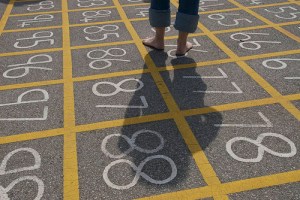
It began with a humble list of 7 things to do with a hundred chart in one of my out-of-print books about teaching home school math. Over the years I added a few new ideas, and online friends contributed still more, so the list grew to its current length of 26. Recently, thanks to several fans at pinterest, it has become the most popular post on my blog:
Now I am working several hours a day revising my old math books, in preparation for publishing new, much-expanded editions. And as I typed in all the new things to do with a hundred chart, I thought of one more to add to the list:
(27) How many numbers are there from 11 to 25? Are you sure? What does it mean to count from one number to another? When you count, do you include the first number, or the last one, or both, or neither? Talk about inclusive and exclusive counting, and then make up counting puzzles for each other.
Share Your Ideas
Can you think of anything else we might do with a hundred chart? Add your ideas in the Comments section below, and I’ll add the best ones to our master list.
More Than One Way to Solve It, Again

We continue with our counting lessons — and once again, Kitten proves that she doesn’t think the same way I do. In fact, her solution is so elegant that I think she could have a future as a mathematician. After all, every aspiring novelist needs a day job, right?
If only I could get her to give up the idea that she hates math…
Permutations with Complications
How many of the possible distinct arrangements of 1-6 have 1 to the left of 2?
How to Understand Fraction Division
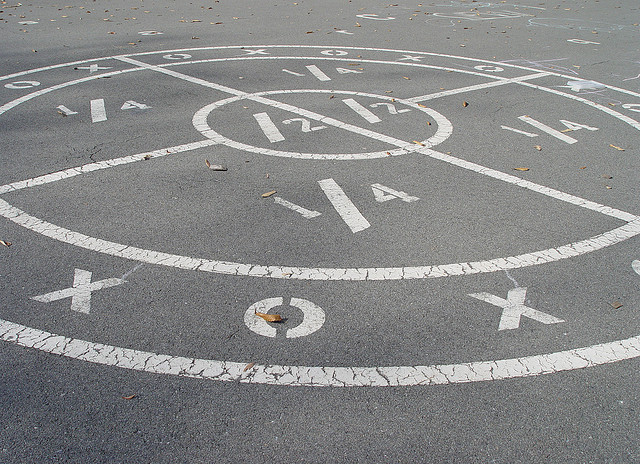
photo by Scott Robinson via flickr
A comment on my post Fraction Division — A Poem deserves a longer answer than I was able to type in the comment reply box. Whitecorp wrote:
Incidentally, this reminds me of a scene from a Japanese anime, where a young girl gets her elder sister to explain why 1/2 divided by 1/4 equals 2. The elder girl replies without skipping a heartbeat: you simply invert the 1/4 to become 4/1 and hence 1/2 times 4 equals 2.
The young one isn’t convinced, and asks how on earth it is possible to divide something by a quarter — she reasons you can cut a pie into 4 pieces, but how do you cut a pie into one quarter pieces? The elder one was at a loss, and simply told her to “accept it” and move on.
How would you explain the above in a manner which makes sense?
Sign Up for the MathCounts Club Program
The MathCounts Club Program provides enrichment activities and puzzles for 6th-8th grade math clubs within schools — and homeschool groups may join, too! Participants receive a free Club in a Box Resource Kit, which includes the Club Resource Guide, two game boards to accompany one of the meeting plans, 12 MathCounts pencils, and a MathCounts tote bag for the coach. (Apparently they had good intentions, but they didn’t follow through. My box had no tote.)
A school (or homeschool group) may choose to participate in the Club Program, the competition or both programs. Since these programs can complement each other, any school that registers for the MathCounts competition automatically gets the Club in a Box Resource Kit, too.
For more information, check out these links:
- Sample “Game and Puzzle Month” meeting plan
- Sample Silver Level Challenge problem set
- 2011-2012 MathCounts School Handbook
- MathCounts Problems of the Week
- Updated Eligibility Guidelines for Homeschools and Virtual Schools (competition program)
- Register online
More Than One Way to Solve It

Photo by Eirik Newth via flickr.
In a lazy, I-don’t-want-to-do-school mood, Princess Kitten was ready to stop after three math problems. We had gotten two of them correct, but the last one was counting the ways to paint a cube in black and white, and we forgot to count the solid-color options.
For my perfectionist daughter, one mistake was excuse enough to quit. She leaned her head against me as we sat together on the couch and said, “We’re done. Done, done, done.” If she could, she would have started purring — one of the most manipulative noises known to humankind. I’m a soft touch. Who can work on math when there’s a kitten to cuddle?

Still, I managed to squeeze in one more puzzle. I picked up my whiteboard marker and started writing:
DONE
DOEN
DNOE
DENO
DNEO
ONED
ODNE
 Denise Gaskins' Let's Play Math