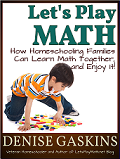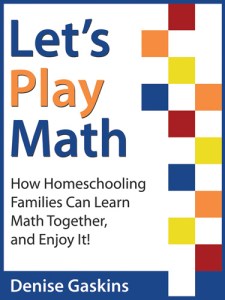
Introducing the “Let’s Play Math!” Book, Beta Version

This blog originally grew out of my Homeschool Math Manuals series published in the 1990s, and when I typed a post, I often added new tips, activities, or examples. Now the stories are coming full circle: I’ve entered the enriched blog-post versions back into the book manuscript, fixed all the typos I could find, deleted obsolete references, and added a list of my favorite “living” math books and internet links.

But no writer can accurately judge her own work. A professional editor is helpful, but he or she can’t see the book with a real homeschooler’s eye. Most writers look for beta-readers among their friends or acquaintances. As we live in a rural area, my supply of potential victims helpers is limited. So I decided to try an ebook experiment: Use Amazon.com to find readers willing to pay the price of a Caramel Macchiato for a pre-publication beta version of my book.

All of the books in the Math Ebooks Beta Series are designed to supplement your current math program — to help you teach math with ANY curriculum. If you would like to help me improve the books, please grab a notepad and jot down your thoughts as you read:

  • Let’s Play Math:
    How Homeschooling Families Can Learn Math Together, and Enjoy It!

    Discover new ways to explore math as a family adventure, playing with ideas. True mathematical thinking involves the same creative reasoning that children use to solve puzzles. Introduce your children to the “Aha!” factor, the thrill of solving a challenging puzzle, and build thinking skills with toys, games, and library books. Find out how to choose math manipulatives, or make your own, and learn how to tackle story problems with confidence. Let’s Play Math will give you a wealth of motivating, hands-on ideas for teaching home school math.

Edited to Add a Clarification

If you are interested in my book but don’t have time to take notes and send me comments, that’s OK. Feel free to take advantage of the beta price anyway — there’s absolutely no obligation.

I hope you and your children enjoy the adventure of learning math together!
Mathematicians Love to Play

Mathematicians love to play with ideas. They experiment with puzzles. They tinker with the connections between shapes and numbers, patterns and logic, growth and change. To a mathematician, the fun of the game is in experimenting, in trying new things and discovering what will happen. Many modern strategy games were invented primarily for the fun puzzle of analyzing who would win.

Continue reading Mathematicians Love to Play

Mathematicians Ask Questions

Wise mathematicians are never satisfied with merely finding the answer to a problem. If they decide to put effort into solving a math puzzle, then they are determined to milk every drop of knowledge they can get from that problem. When mathematicians find an answer, they always go back and think about the problem again.

  • Is there another way to look at it?
  • Can we make our solution simpler or more elegant?
  • Does this problem relate to any other mathematical idea?
  • Can we expand our solution and find a general principle?

Continue reading Mathematicians Ask Questions

How Can I Teach Math If I Don’t Understand It?

Our childhood struggles with schoolwork gave most of us a warped view of mathematics. We learned to manipulate numbers and symbols according to what seemed like arbitrary rules. We may have understood a bit here and a bit there, but we never saw how the framework fit together. We stumbled from one class to the next, packing more and more information into our strained memory, until the whole structure threatened to collapse. Finally we crashed in a blaze of confusion, some of us in high school algebra, others in college calculus.

Continue reading How Can I Teach Math If I Don’t Understand It?

Book Update, and Self-Publishing Info

photo by Darwin Bell via flickr

As you may know, I’ve been working hard on my Let’s Play Math! books, and I’m still hoping to get at least couple of them out this summer. (Though if I keep thinking of more sections to add, I may never get them done!) I’m also finishing up the editing on my daughter’s novel and plan to release it soon.

One of the most useful resources I’ve found for self-publishing information is Joel Friedlander’s blog, The Book Designer. The last time I published my books, a dozen years ago, I made nearly every one of the mistakes he mentions in Amateur Hour Books and 5 Book Design Mistakes to Avoid.

Continue reading Book Update, and Self-Publishing Info

Tell Me a (Math) Story

[Feature photo above by Keoni Cabral via Flickr (CC BY 2.0).]

My favorite playful math lessons rely on adult/child conversation — a proven method for increasing a child’s reasoning skills. What better way could there be to do math than snuggled up on a couch with your little one, or side by side at the sink while your middle-school student helps you wash the dishes, or passing the time on a car ride into town?

As soon as your little ones can count past five, start giving them simple, oral story problems to solve: “If you have a cookie and I give you two more cookies, how many cookies will you have then?”

The fastest way to a young child’s mind is through the taste buds. Children can easily visualize their favorite foods, so we use mainly edible stories at first. Then we expand our range, adding stories about other familiar things: toys, pets, trains.

Continue reading Tell Me a (Math) Story

Update: My Math Books

photo by goXunuReviews via Flickr

Are you a homeschooler? Are you happy with your current curriculum, or would you like to break out of the textbook mold and explore math through “living” books and activities? Whether you hope to replace your math program or just to supplement it, I can show you ways to turn math into a learning adventure for the whole family. Your children will build a stronger foundation of understanding when you teach math as a game, playing with ideas.

Nearly a year ago, I wrote:

This blog originally grew out of my books, and now it’s coming full circle: New, expanded editions of my long-out-of-print books are ripening on the vine, growing out of the blog. To bring them to harvest, I’m going to need your help.

It has taken much longer than I had hoped to whip the manuscripts into form. My new goal is to publish ebook editions, since I will be able to sell them for about half what the original books cost twelve years ago. I’m hoping that I can finish at least a couple of the ebooks by mid-summer.

Continue reading Update: My Math Books

Used Book Price Shock

Someone mentioned one of my old books on the Living Math forum, which made me curious how the used copies were doing at Amazon.com. These are simple little books, 100 loose pages comb-bound together. I have seen ridiculous prices before, but this one takes the cake.

Thankfully, there are a few used book dealers with more sense, or at least with more reasonable computer-automated pricing routines.

I am still at work revising (and greatly expanding) the old books so I can publish new editions. If you haven’t voted yet in my “What Do You Want from a Math Book?” survey, I’d love to hear your opinion!

Quotations XXVI: On Teaching Math

photo by chrisrobinson1945 via flickr

As I continue to polish the manuscript for my math games book, I’ve been looking for short quotations to put at the beginning of each chapter. I’ve gathered a lot of math quotations over the years, from my own reading and from quote-collection websites. But there’s a problem with using most of these in a book, since to do it right I would have to dig up the original source of each quote and then write a letter to the publisher for permission to use it. And pay a fee that, depending on the publisher’s sense of self-importance, can run into the hundreds of dollars. Bother!

So I went digging around my rss reader to see what sort of inspiration I could find. Bloggers love to be quoted, right? And most of them are happy to give permission via email, which makes my job ever so much easier.

Here are some of the gems I’m considering. I’d love to hear your favorite quotes from math bloggers, too — or favorite passages from your own blog. Please comment!

It’s amazing that this vision of math as “getting to the right answer on your first try” even exists. I have to make, unmake, remake so many mistakes to get where I’m going. I think all mathematicians work that way.

Somehow, a big part of the experience of math is trouble. Frustration is the status quo. But when you get something—the thrill!

Dan Finkel
Good Mistakes, Constant Mistakes

Continue reading Quotations XXVI: On Teaching Math

Working on My Let’s Play Math! Books

Workplace stress caused by an unsuitable work ...
Image via Wikipedia

This blog originally grew out of my books, and now it’s coming full circle: New, expanded editions of my long-out-of-print books are ripening on the vine, growing out of the blog. To bring them to harvest, I’m going to need your help.

The Books

I’m working on the games books first because I think they will be the most helpful supplements to any math program.

  • Let’s Play Math! Number Games for All Ages
    This book will include games like Tens Concentration and Hit Me, as well as tips for teaching negative numbers, the times table, and more. Never before published, because it was planned as the fifth book in my earlier how-to-teach-homeschool-math series, but my self-publishing experiment ended after book four.
  • Others to be announced, if I ever get the first two done…

Continue reading Working on My Let’s Play Math! Books