How To Master Quadratic Equations

G'Day Math logo

Feature photo above by Junya Ogura via Flickr (CC BY 2.0).

A couple of weeks ago, James Tanton launched a wonderful resource: a free online course devoted to quadratic equations. (And he promises more topics to come.)

Kitten and I have been working through the lessons, and she loves it!

We’re skimming through pre-algebra in our regular lessons, but she has enjoyed playing around with simple algebra since she was in kindergarten. She has a strong track record of thinking her way through math problems, and earlier this year she invented her own method for solving systems of equations with two unknowns.

I would guess her background is approximately equal to an above-average Algebra 1 student near the end of the first semester.

After few lessons of Tanton’s course, she proved — within the limits of experimental error — that a catenary (the curve formed by a hanging chain) cannot be described by a quadratic equation. Last Friday, she easily solved the following equations:

\left ( x+4 \right )^2 -1=80

and:

w^2 + 90 = 22 w - 31

and (though it took a bit more thought):

4x^2 + 4x + 4 = 172

We’ve spent less than half an hour a day on the course, as a supplement to our AoPS Pre-Algebra textbook. We watch each video together, pausing occasionally so she can try her hand at an equation before listening to Tanton’s explanation. Then (usually the next day) she reads the lesson and does the exercises on her own.

So far, she hasn’t needed the answers in the Companion Guide to Quadratics, but she did use the “Dots on a Circle” activity — and knowing that she has the answers available helps her feel more independent.

Continue reading How To Master Quadratic Equations

Logic Puzzle: Imbalance Problems

Kitten and I have been slogging through the decimals chapter in AoPS Pre-Algebra. She hates arithmetic, so I tried skipping ahead to the algebra puzzle in the exercises, but she refused to be taken in: a decimal problem with an x in it is still a decimal problem.

So I let her off early and pointed her toward these logical “algebra” puzzles instead:

Puzzle by Paul Salomon

Continue reading Logic Puzzle: Imbalance Problems

Reviews for my Daughter’s Book

I cleaned up the clutter on my other blog, and so I decided to make a page about my daughter’s book, which meant taking the time to pull out excerpts from her reviews. And since I hadn’t posted anything about her on this blog for a couple of months, I thought I’d brag a bit to you all, too.

Reviews of Banished

Banished is a captivating fantasy story with a well-thought-out plot that would be a credit to any writer. But it is especially remarkable coming from a thirteen-year-old student who has been homeschooled all her life.

Teresa Gaskins actually wrote this book as a project for the National Novel Writing Month program. One noteworthy thing about the book is that there is no sexuality or bad language (the euphemistic interjection “Blasted” is used once), so, other than those who object to the presence of any kind of magic in books, parents can let their kids read the novel with no reservations.

However, be forewarned. When you reach the final page and find the words, “Not the End…,” you will cry, “Oh! No!” The story does not resolve itself at the end and then pick up in a sequel. Rather, the plot is left hanging at the end and will continue in another book. I for one feel as if I simply can’t wait to read the next installment to find out what happens to Chris and his friends. It’s that good!

— Wayne at Home School Book Review

Continue reading Reviews for my Daughter’s Book

5 Stars at Home School Book Review

Wayne at Home School Book Review just posted a very kind review of my daughter’s book:

Banished is a captivating fantasy story with a well-thought-out plot that would be a credit to any writer. But it is especially remarkable coming from a thirteen-year-old student who has been homeschooled all her life.

However, be forewarned. When you reach the final page and find the words, “Not the End…,” you will cry, “Oh! No!”

I for one feel as if I simply can’t wait to read the next installment to find out what happens to Chris and his friends. It’s that good!

New Fantasy Fiction Book by 13yo Homeschooler

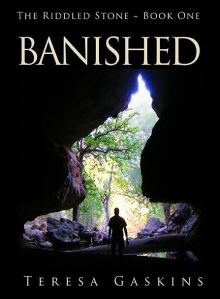
My 13-year-old daughter just released her first book on Kindle:

  • Banished (The Riddled Stone, Book One)
    Falsely accused of stealing a magic artifact, Chris is forced to leave home, never to return. As he and three friends travel toward the border, however, they are warned of great danger approaching the land. They set out to solve an ancient riddle — but will they be able to save the kingdom, or will the quest cost them their lives?

[Update 7/6/12: The paperback book is now “In Stock” at Amazon (yay!).]

Teresa (also known as Princess Kitten) has done the NaNoWriMo Youth Program as part of her language studies for the past three years and has written many stories on her blog, but this is the first time we’ve followed through and published one of her books.

Of course I’m biased, but I think she did a pretty good job, as first books go. It’s clearly the beginning of a series, so she sets up more plot threads than she resolves — but I did convince her not to wait for this year’s NaNoWriMo to start Book Two. (I want to find out what happens next!)

Anyway, if you or your kids enjoy fantasy fiction and are interested in reading something written by a teenage homeschooler, please check out her book. She would love to get some reviews!

PUFM 1.1 Counting

Photo by Iain Watson via flickr. In this Homeschooling Math with Profound Understanding (PUFM) Series, we are studying Elementary Mathematics for Teachers and applying its lessons to home education.

Many things in mathematics need to be understood relationally — that is, in relationship to other concepts. But some things just need to be memorized. How do you know which is which? A homeschooling friend pointed out that one thing children definitely need to memorize is the counting sequence from 1-100 and beyond. While there are some patterns that make counting easier, one does just have to memorize which “nonsense sounds” we have attached to each number.

Another sort-of counting that young students should master is subitizing — recognizing at a glance how many items are in a small group. Children do this instinctively, but we can help them develop the skill by playing subitizing games.

[Aside: In writing this blog post, I ran into some nostalgia. Back when we first did these PUFM lessons, my daughter Kitten was only a toddler. I wrote, “I’ve tried to do lots of counting with my youngest, who hasn’t quite gotten beyond, ‘…eleven, twelve, firteen, firteen, nineteen, seven,…’ The numbers tend to start appearing randomly after she gets past 10.” Ah, memories.]

Continue reading PUFM 1.1 Counting

More Than One Way to Solve It, Again

photo by Annie Pilon via flickr

We continue with our counting lessons — and once again, Kitten proves that she doesn’t think the same way I do. In fact, her solution is so elegant that I think she could have a future as a mathematician. After all, every aspiring novelist needs a day job, right?

If only I could get her to give up the idea that she hates math…

Permutations with Complications

How many of the possible distinct arrangements of 1-6 have 1 to the left of 2?

Competition Math for Middle School, by J. Batterson

Continue reading More Than One Way to Solve It, Again

More Than One Way to Solve It

More-Than-One-Way

Photo by Eirik Newth via flickr.

In a lazy, I-don’t-want-to-do-school mood, Princess Kitten was ready to stop after three math problems. We had gotten two of them correct, but the last one was counting the ways to paint a cube in black and white, and we forgot to count the solid-color options.

For my perfectionist daughter, one mistake was excuse enough to quit. She leaned her head against me as we sat together on the couch and said, “We’re done. Done, done, done.” If she could, she would have started purring — one of the most manipulative noises known to humankind. I’m a soft touch. Who can work on math when there’s a kitten to cuddle?

by tanjila ahmed via flickr

Still, I managed to squeeze in one more puzzle. I picked up my whiteboard marker and started writing:

DONE
DOEN
DNOE
DENO
DNEO
ONED
ODNE

Continue reading More Than One Way to Solve It

The (Mathematical) Trouble with Pizza

Photo by George Parrilla via flickr.

Kitten complained that some math programs keep repeating the same kind of problems over and over, with bigger numbers: “They don’t get any harder, they just get longer. It’s boring!”

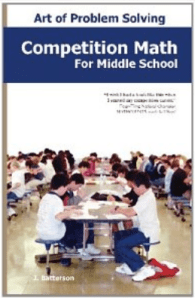
So we pulled out the Counting lessons in Competition Math for Middle School. [Highly recommended book!] Kitten doesn’t like to compete, but she enjoys learning new ideas, and Batterson’s book gives her plenty of those, well organized and clearly explained.

Today’s topic was the Fundamental Counting Principle. It was review, easy-peasy. The problems were too simple, until…

Pizzas at Mario’s come in three sizes, and you have your choice of 10 toppings to add to the pizza. You may order a pizza with any number of toppings (up to 10), including zero. How many choices of pizza are there at Mario’s?

[The book said 9 toppings, but I was skimming/paraphrasing aloud and misread.]

  • Can you figure out the answer?

Continue reading The (Mathematical) Trouble with Pizza

Summer Slowdown

It happens this way every summer: I think that when school’s out, I’ll have time to catch up on things. But school is never out, because we’re homeschoolers — and something else always comes up to make us even more busy than normal. This year, an emergency forced dh to move his engineering office from town to home. It’s great to have him close at hand, but spring cleaning has turned into a total house reorganization to make room.

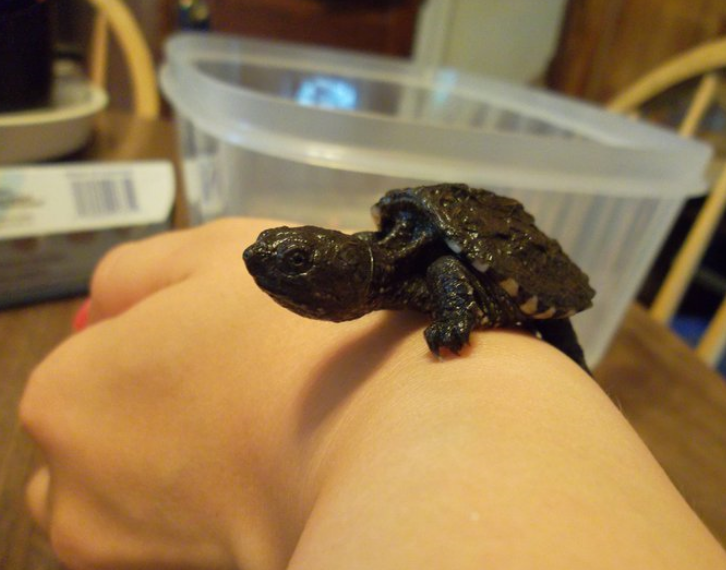
Niner's baby snapping turtle sitting on her wrist
And then Niner and Kitten adopted a couple of new pets. Here’s a picture of Niner’s new snapping turtle. The old one is getting so big he eats feeder fish by the dozen, but she plans to release him back into the creek as soon as the spring floods go down. Kitten rescued two baby birds (normally the dogs take care of wind-blown fledglings), so we have to find room for yet another cage in our menagerie.

In the meantime, this month’s Math Teachers at Play carnival is coming home to my blog, so I’d better get to work on that. If you would like to share a blog post about learning, teaching, or just playing around with math, I’d love to have you send it in. Just click here and fill out the handy automatic submission form.

Update, July 2011: Niner wrote a blog post on the turtles, with photos. Kitten had one of her babies die (sad!) but the other grew up enough to be released into the woods across the creek.