Writing to Learn Math: People learn math by playing with ideas. A math journal can be like a science lab book.
Do you want your children to develop the ability to reason creatively and figure out things on their own?
Help kids practice slowing down and taking the time to fully comprehend a math topic or problem-solving situation with these classic tools of learning: Notice. Wonder. Create.
Writing to Learn Math: Problem-solving cares less about whether an answer is right and more about whether a solution makes sense.
Do you want your children to develop the ability to reason creatively and figure out things on their own?
Help kids practice slowing down and taking the time to fully comprehend a math topic or problem-solving situation with these classic tools of learning: Notice. Wonder. Create.
We were getting ready for the annual homeschool co-op speech contest, and a friend emailed me for help.
“Can you help us figure out how to figure out this problem?
“This is related to C’s speech. I think we have all the information we need, but I’m not sure:
“The average household income in the United States is $60,000/year. And a man’s annual income is $56 billion.
“Is there a way to figure out what this man’s value of a million dollars would be, compared to the person who earns $60,000/year? In other words, I would like to say—$1,000,000 to us is like 10 cents to Bill Gates.”
We found out later that her son’s numbers weren’t exactly right. He hadn’t understood the difference between income and net worth, so he made Gates sound richer than reality.
But the basic math principles never change, and it’s fun to play with big numbers.
“I love your image of math as a nature walk. My children are ready to start their homeschooling journey, and I want to put them on the right track from the beginning. How can I help them think about math and problem-solving without using a textbook?”
The most difficult part of teaching our children real math is to change our own way of thinking about the subject you’ve already taken that step, so it looks like your family’s learning journey is off to a great start.
There’s a well-known quote attributed to tennis champion Arthur Ashe (and to President Theodore Roosevelt, and probably others):
“Start where you are, use what you have, do what you can.”
How does this apply to learning math?
Many homeschoolers fear that their students have fallen behind grade level in math and worry about how to catch up.
We have an educational myth that math is a steady progression of topics arranged by ever-increasing complexity with regular signposts like mile markers that identify what students must learn at each stage along the way.
For example, first-grade students can add one-or two-digit numbers, but three-digit numbers are beyond them. Second-grade students can add three- or four-digit numbers, but never wander off into millions and billions. And so forth.
So I thought this week, I’d share some of my favorites with you. First up: Problem Solving Tips from James Tanton.
You may know Tanton from the popular Exploding Dots and other activities at the Global Math Project website. But he’s been busy for decades sharing the delight and the beauty of the subject. He currently serves as the Mathematician-at-Large for the Mathematical Association of America.
Read on to discover several of Tanton’s best problem-solving tips for middle school and older students.
Have fun exploring math with your kids!
How to Think like a School Math Genius
In this 4-video series, Tanton presents five key principles for brilliant mathematical thinking, along with loads and loads of examples to explain what he means by each of them. He says it’s “a call for parents and teachers to be mindful of the life thinking we should foster, encourage, promote, embrace and reward — even in a math class!”
Two Key — but Ignored —Steps to Solving Any Math Problem
How many degrees in a Martian circle?Every challenge or problem we encounter in mathematics (or life!) elicits a human response. The dryness of textbooks and worksheets in the school world might suggest otherwise, but connecting with one’s emotions is fundamental and vital for success — and of course, joy — in doing mathematics.
Essays and videos showing how to approach math puzzles in a way that a) is relevant and connected to the curriculum, and b) revels in deep, joyous, mulling and flailing, reflection, intellectual play and extension, insight, and grand mathematical delight.
Scroll down and start with the Ten Problem-Solving Strategies.
“The true joy in mathematics, the true hook that compels mathematicians to devote their careers to the subject, comes from a sense of boundless wonder induced by the subject.
“There is transcendental beauty, there are deep and intriguing connections, there are surprises and rewards, and there is play and creativity.
“Mathematics has very little to do with crunching numbers. Mathematics is a landscape of ideas and wonders.”
—James Tanton
CREDITS: Feature photo (top) by Ian Stauffer via Unsplash.com.
As queen of the house, Cimorene insists on being involved in anything that happens in her domain. This includes promoting the Playful Math Journaling Kickstarter.
So she created a cat math journaling prompt to help your children experience the fun of playing around with math.
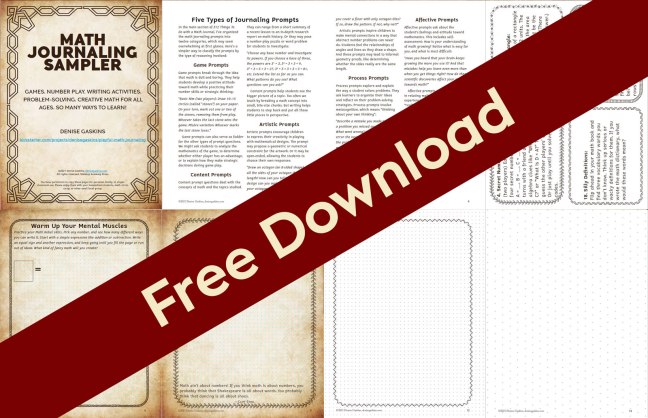
But first, she encourages you to visit the Kickstarter page and download the free 16-page printable Math Journaling Sampler file. Your kids will love solving Cimorene’s puzzle on one of the parchment-style pages!
[The free download will always be there, even after the Kickstarter project ends.] Visit the Kickstarter
Here is Cimorene’s Puzzle
“The Princess of Cats has a luxuriously soft tail about 12 inches (30 cm) long. Her tail is three times the length of her noble head. Her beautiful, furry body is as long as head and tail together. How long is the Princess from her delicate nose to the tip of her majestic tail?”
So, how does math journaling work? What do children do with a problem like this?
They may want to make a list of the things they know from the story. Perhaps they will draw a picture of the cat and label the proportions. Each will take their own approach to figure it out.
And then the best part of any math journal prompt is when kids make their own math.
Can they write a new puzzle about their own pet?
Or about their favorite animal?
Encourage your children to share their math creations with their friends and family.
Cimorene would love to read it, too! If you share your story in the comments section below, I will be sure to show it to her.
Are you looking for new ways to explore math with your kids?
Would you like an easy, no-prep resource for creative problem-solving, number play, math art, word problems, mini-essays, math poetry, geometry investigations, research projects, and much more?
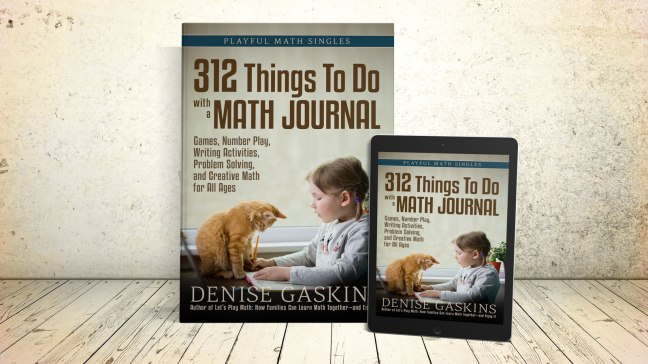
I’ve just launched a Kickstarter project for people to preorder my new book, 312 Things To Do with a Math Journal. It just might transform your child’s experience of math.
In a math journal, children explore their own ideas about numbers, shapes, and patterns through drawing or writing in response to a question. Journaling teaches them to see with mathematical eyes. Not just to remember what we adults tell them, but to create their own math.
Scroll down the Kickstarter project page to download the free 16-page printable “Math Journaling Sampler” file. It includes one of my all-time favorite math activities.
If you like what you see, I’d love to have your support. The more people we can get to share the project in the early days, the more likely Kickstarter will join in and promote it to new readers.
Puck is concerned that some people don’t understand the idea behind the Math Rebel journals. He decided to create a journaling prompt so your children can experience the joy of creative reasoning (and save cats from their mortal enemy!)
Journaling is a great way to help children learn to see with mathematical eyes. Not just to remember what we tell them, but to create their own math.
Many people know it’s important for students to do hands-on experiments in science. But Puck realized that most adults don’t know how to do a math experiment.





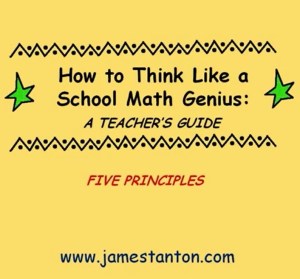 In this 4-video series, Tanton presents five key principles for brilliant mathematical thinking, along with loads and loads of examples to explain what he means by each of them. He says it’s “a call for parents and teachers to be mindful of the life thinking we should foster, encourage, promote, embrace and reward — even in a math class!”
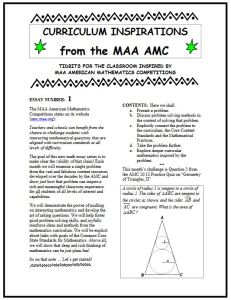 Essays and videos showing how to approach math puzzles in a way that a) is relevant and connected to the curriculum, and b) revels in deep, joyous, mulling and flailing, reflection, intellectual play and extension, insight, and grand mathematical delight.
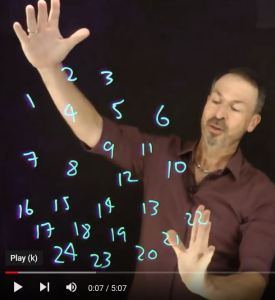 Here are some essays illustrating astounding tidbits of mathematical delight. And here are some purely visual puzzles to surprise.

 Denise Gaskins' Let's Play Math