I love how Richard Rusczyk explains math problems. It’s a new school year, and that means it’s time for new MathCounts Mini videos. Woohoo!
- Download the activity sheet with warm-up and follow-up problems.
I love how Richard Rusczyk explains math problems. It’s a new school year, and that means it’s time for new MathCounts Mini videos. Woohoo!
Would you like to learn how to think like a mathematician? Stanford professor (and NPR “Math Guy”) Keith Devlin is teaching a free online course through Coursera. It starts in just a few weeks. I’ve signed up. Will you join us?
The prerequisite is to be taking or have finished high school math. If (like me) you took it so long ago that you can’t quite remember, don’t worry: The focus of the course is not on long-forgotten mathematical procedures, but on “learning to think in a certain (very powerful) way.”
Mathematical thinking is not the same as doing mathematics — at least not as mathematics is typically presented in our school system. School math typically focuses on learning procedures to solve highly stereotyped problems. Professional mathematicians think a certain way to solve real problems, problems that can arise from the everyday world, or from science, or from within mathematics itself.
The key to success in school math is to learn to think inside-the-box. In contrast, a key feature of mathematical thinking is thinking outside-the-box — a valuable ability in today’s world. This course helps to develop that crucial way of thinking.
— Keith Devlin
Introduction to Mathematical Thinking
I love logic puzzles! Nrich Maths offers four fun Olympics Logic puzzles. And be sure to check out the rest of their Nrich Olympics Math as well.

Medals Count
Given the following clues, can you work out the number of gold, silver and bronze medals that France, Italy and Japan got in this international sports competition?
- Japan has 1 more gold medal, but 3 fewer silver medals, than Italy.
- France has the most bronze medals (18), but fewest gold medals (7).
- Each country has at least 6 medals of each type.
- Italy has 27 medals in total.
- Italy has 2 more bronze medals than gold medals.
- The three countries have 38 bronze medals in total.
- France has twice as many silver medals as Italy has gold medals.
Yet more fun from Rosie at Education Unboxed. I found these while looking for videos to use in my PUFM Subtraction post. Rosie says:
This is seriously embarrassing and I debated whether to put this video online or not because this is NOT my normal personality, but my girls made up this game and will play it for over an hour and ask for it repeatedly… so I figured someone out there might be able to use it with their kids, too.
If you know me, please don’t ever ask me to do this in public. I will refuse.
Princess in the Dungeon, Part 1 – Fractions with Cuisenaire Rods
A fun exploration for upper elementary or middle school students, from Numberphile:

We continue with our counting lessons — and once again, Kitten proves that she doesn’t think the same way I do. In fact, her solution is so elegant that I think she could have a future as a mathematician. After all, every aspiring novelist needs a day job, right?
If only I could get her to give up the idea that she hates math…
How many of the possible distinct arrangements of 1-6 have 1 to the left of 2?

Photo by Eirik Newth via flickr.
In a lazy, I-don’t-want-to-do-school mood, Princess Kitten was ready to stop after three math problems. We had gotten two of them correct, but the last one was counting the ways to paint a cube in black and white, and we forgot to count the solid-color options.
For my perfectionist daughter, one mistake was excuse enough to quit. She leaned her head against me as we sat together on the couch and said, “We’re done. Done, done, done.” If she could, she would have started purring — one of the most manipulative noises known to humankind. I’m a soft touch. Who can work on math when there’s a kitten to cuddle?

Still, I managed to squeeze in one more puzzle. I picked up my whiteboard marker and started writing:
DONE
DOEN
DNOE
DENO
DNEO
ONED
ODNE
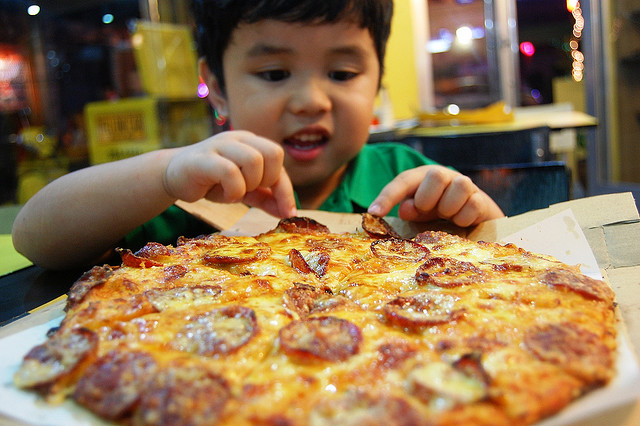
Photo by George Parrilla via flickr.
Kitten complained that some math programs keep repeating the same kind of problems over and over, with bigger numbers: “They don’t get any harder, they just get longer. It’s boring!”
So we pulled out the Counting lessons in Competition Math for Middle School. [Highly recommended book!] Kitten doesn’t like to compete, but she enjoys learning new ideas, and Batterson’s book gives her plenty of those, well organized and clearly explained.
Today’s topic was the Fundamental Counting Principle. It was review, easy-peasy. The problems were too simple, until…
Pizzas at Mario’s come in three sizes, and you have your choice of 10 toppings to add to the pizza. You may order a pizza with any number of toppings (up to 10), including zero. How many choices of pizza are there at Mario’s?
[The book said 9 toppings, but I was skimming/paraphrasing aloud and misread.]
When a kid is feeling bad about being stuck with a problem, or just very anxious, I sometimes ask him to make as many mistakes as he can, and as outrageous as he can. Laughter happens (which is valuable by itself, and not only for the mood — deep breathing brings oxygen to the brain). Then the kid starts making mistakes. In the process, features of the problem become much clearer, and in many cases a way to a solution presents itself.
— Maria Droujkova
Natural Math discussion of math club activities
While I was collecting entries for the Math Teachers at Play #35 blog carnival, I ran across this post by Dave Lanovaz:
 Denise Gaskins' Let's Play Math