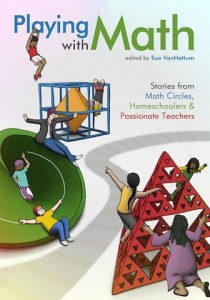
Playing With Math — the Book

body_Book_cover_for_upload

Update: The crowdfunding campaign is now closed and the book is in the final stages. It should be headed to the printer soon. Check the Playing With Math homepage for publication and ordering information.


There are only a few days left to reserve your copy of Playing With Math: Stories from Math Circles, Homeschoolers, and Passionate Teachers. I don’t have time to finish the review I hoped to write, so instead I’ll share some of my favorite quotes from the book:

What do mathematicians do? We play with math. What are little kids doing when they’re thinking about numbers, shapes, and patterns? They’re playing with math. You may not believe it yet, but you can have fun playing with math, too.

— Sue VanHattum, editor

We had a discussion at the end of the club on how we are all confused now, but pleasantly so, and how important it is to rejoice in confusion and to be comfortable with it. Adults often strive very hard to get rid of any and all possible traces of confusion for kids, making things dreadfully boring.

— Maria Droujkova, after a math circle exploration of infinity

All it talkes to do mathematics is opportunity, a frustrating problem, and a bit of stubbornness.

— Ellen Kaplan, math circle leader

Our own school experiences can make it hard for us to teach without being tempted to “help them master” a concept that they may or may not be ready to master. What we never learned in school was the concept of playing around with math, allowing ideas to “percolate,” so to speak, before mastery occurs, and that process may take time.

— Julie Brennan, homeschooler

Continue reading Playing With Math — the Book

Quotable: Math Connections

ConnectedGearsJoBoaler

It turns out that the people who do well in math are those who make connections and see math as a connected subject. The people who don’t do well are people who see math as a lot of isolated methods.

— Jo Boaler
Math Connections

If you or your children struggle with math, Boaler’s non-profit YouCubed.org may help you recover your joy in learning.

Reblog: Calculus Tidbits

[Feature photo above by Olga Lednichenko via Flickr (CC BY 2.0).]

This week I have a series of quotes about calculus from my first two years of blogging. The posts were so short that I won’t bother to link you back to them, but math humor keeps well over the years, and W. W. Sawyer is (as always) insightful.

I hope you enjoy this “Throw-back Thursday” blast from the Let’s Play Math! blog archives:


Finding the Limit

Eldest daughter had her first calculus lesson last night: finding the limit as delta-t approached zero. The teacher found the speed of a car at a given point by using the distance function, calculating the average speed over shorter and shorter time intervals. Dd summarized the lesson for me:

“If you want to divide by zero, you have to sneak up on it from behind.”


Harmonic Series Quotation

This kicked off my week with a laugh:

Today I said to the calculus students, “I know, you’re looking at this series and you don’t see what I’m warning you about. You look and it and you think, ‘I trust this series. I would take candy from this series. I would get in a car with this series.’ But I’m going to warn you, this series is out to get you. Always remember: The harmonic series diverges. Never forget it.”

—Rudbeckia Hirta
Learning Curves Blog: The Harmonic Series
quoting Alexandre Borovik


So You Think You Know Calculus?

Rudbeckia Hirta has a great idea for a new TV blockbuster:


Common Sense and Calculus

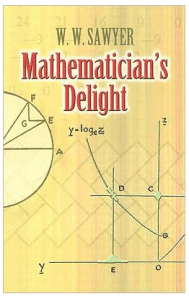
Sawyer-MathDelight

And here’s a quick quote from W. W. Sawyer’s Mathematician’s Delight:

If you cannot see what the exact speed is, begin to ask questions. Silly ones are the best to begin with. Is the speed a million miles an hour? Or one inch a century? Somewhere between these limits. Good. We now know something about the speed. Begin to bring the limits in, and see how close together they can be brought.

Study your own methods of thought. How do you know that the speed is less than a million miles an hour? What method, in fact, are you unconsciously using to estimate speed? Can this method be applied to get closer estimates?

You know what speed is. You would not believe a man who claimed to walk at 5 miles an hour, but took 3 hours to walk 6 miles. You have only to apply the same common sense to stones rolling down hillsides, and the calculus is at your command.

Quotable: Math as a Second Language

Wenninger 94photo by fdecomite via flickr (CC BY 2.0)

I sat in class three days ago and thought to myself, “They need a class called ‘Math as a second language’ or MSL for short.”

It is easy to understand what a median is, or what attributes a kite has, or why is a rectangle a square but a square not a rectangle… for a minute or a day.

It is easy to temporarily memorize a fact. But without true understanding of the concept those “definitions” fade. If the foundation of truly understanding is not there to begin with then there is little hope for any true scaffolding and even less chance of any true learning.

Duncan
Comment on Christopher Danielson’s Geometry and language

Quotable: Focus on Being Silent

Children Reading Pratham Books and Akshara[Photo by Pratham Books via Flickr (CC BY 2.0).]

I discovered this gem in my blog reading today. One of the secrets of great teaching:

Audrey seemed, for once, at a loss for words. She was thinking about the question.

I try to stay focused on being silent after I ask young children questions, even semi-serious accidental ones. Unlike most adults, they actually take time to think about their answers and that often means waiting for a response, at least if you want an honest answer.

If you’re only looking for the “right” answer, it’s fairly easy to gently badger a child into it, but I’m not interested in doing that.

Thomas Hobson
Thank You For Teaching Me

Learn Math by Asking Questions

The best way for children to build mathematical fluency is through conversation. For more ideas on discussion-based math, check out these posts:

And be sure to follow Christopher Danielson’s Talking Math with Your Kids blog!

 
* * *

This blog is reader-supported.

If you’d like to help fund the blog on an on-going basis, then please join me on Patreon for mathy inspiration, tips, and an ever-growing archive of printable activities.

If you liked this post, and want to show your one-time appreciation, the place to do that is PayPal: paypal.me/DeniseGaskinsMath. If you go that route, please include your email address in the notes section, so I can say thank you.

Which I am going to say right now. Thank you!

“Quotable: Focus on Being Silent” copyright © 2013 by Denise Gaskins. Image at the top of the post copyright © Pratham Books via Flickr (CC BY 2.0).