Hobbit Math: Elementary Problem Solving 5th Grade

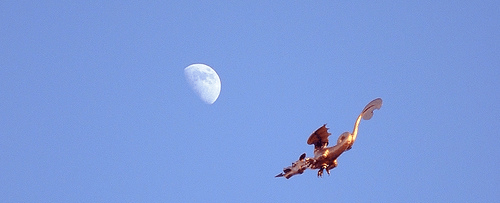
[Photo by OliBac. Visit OliBac’s photostream for more.]

The elementary grades 1-4 laid the foundations, the basics of arithmetic: addition, subtraction, multiplication, division, and fractions. In grade 5, students are expected to master most aspects of fraction math and begin working with the rest of the Math Monsters: decimals, ratios, and percents (all of which are specialized fractions).

Word problems grow ever more complex as well, and learning to explain (justify) multi-step solutions becomes a first step toward writing proofs.

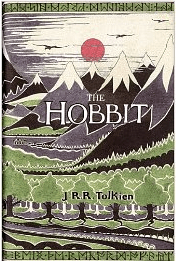
This installment of my elementary problem solving series is based on the Singapore Primary Mathematics, Level 5A. For your reading pleasure, I have translated the problems into the world of J.R.R. Tolkien’s classic, The Hobbit.

UPDATE: Problems have been genericized to avoid copyright issues.

Continue reading Hobbit Math: Elementary Problem Solving 5th Grade

Can You Read the Flu Map?

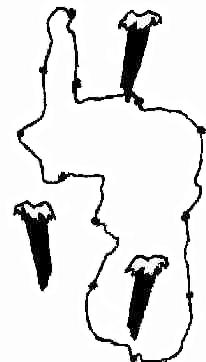
swine-flu-map-with-circles
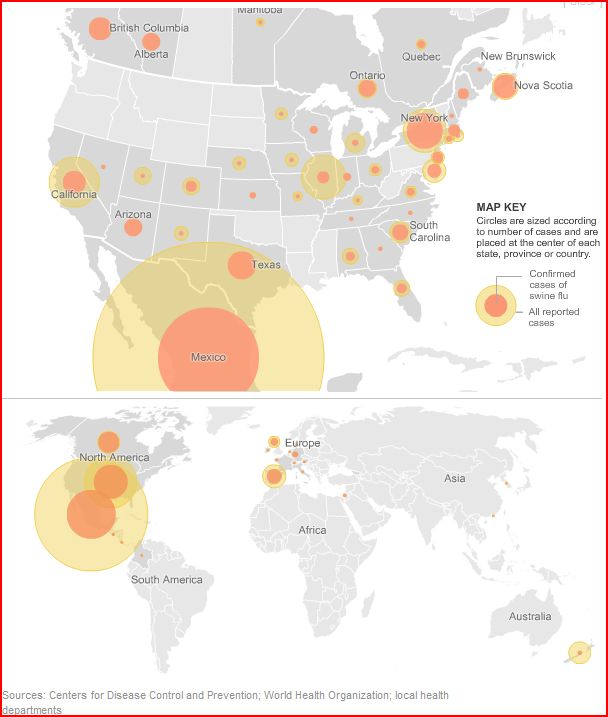
[Map as of early afternoon on May 4th, found at the NY Times.]

Compare the dark circles (confirmed cases) for Mexico, New York and Nova Scotia in the top part, or Mexico and the U.S. in the lower part of the map. It’s easy to see which has more cases of the flu — but how many more? Which would you guess is the closest estimate:

Mexico : New York : Nova Scotia

  • = 7:3:2 or 20:5:3 or 16:2:1?

U.S. : Mexico

  • = 1:2 or 2:5 or 3:7?

Continue reading Can You Read the Flu Map?

Review: Math Doesn’t Suck

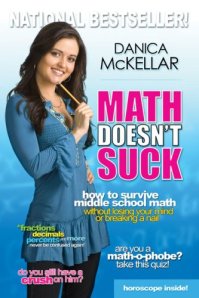
We’ve all heard the saying, Don’t judge a book by its cover, but I did it anyway. Well, not by the cover, exactly — I also flipped through the table of contents and read the short introduction. And I said to myself, “I don’t talk like this. I don’t let my kids talk like this. Why should I want to read a book that talks like this? I’ll leave it to the public school kids, who are surely used to worse.”

Okay, I admit it: I’m a bit of a prude. And it caused me to miss out on a good book. But now Danica McKellar‘s second book is out, and the first one has been released in paperback. A friendly PR lady emailed to offer me a couple of review copies, so I gave Math Doesn’t Suck a second chance.

I’m so glad I did.

Continue reading Review: Math Doesn’t Suck

An Ancient Mathematical Crisis

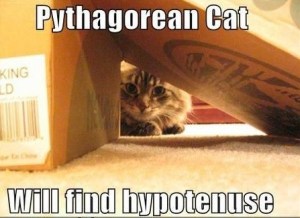
PythagoreanCat

[When Alexandria Jones and her family visited an excavation in southern Italy, they learned several tidbits about the ancient school of mathematics and philosophy founded by Pythagoras. Here is Alex’s favorite story.]

It hit the Pythagorean Brotherhood like an earthquake, a crisis of faith which shook the foundations of their universe. Some say Pythagoras himself made the dread discovery, others blame Hippasus of Metapontum.

Something certainly did happen with Hippasus. The Brotherhood sent him into exile for insubordination, or for breaking the rule of secrecy — or was it for proving the unthinkable? According to legend, Hippasus drowned at sea, but was it a mere shipwreck or the wrath of the gods? Some say the irate Pythagoreans threw him overboard…

Continue reading An Ancient Mathematical Crisis

The Golden Christmas Tree

Last time, Alexandria Jones and her family were on their way to Uncle William’s tree farm to find the perfect Christmas tree, and Dr. Jones taught us about the Golden Section:

The \; Golden \; Section \; ratio

|———————A———————|————B————|

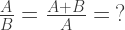
A \; is \; to \; B \; as \; \left(A + B \right) \; is \; to \; A, \; or . . .

\frac{A}{B}   =  \frac{A + B}{A}  = \: ?

I gave you three algebra puzzles to solve. Did you try them?

  • What is the exact value of the Golden Section ratio?
  • If a 7-foot tree will fit in the Jones family’s living room, allowing for the tree stand and for a star on top, how wide will the tree be?
  • Approximately how much surface area will Alex and Leon have to fill with lights and ornaments?

Math Adventurer’s Rule: Figure It Out for yourself

Whenever I give a problem in an Alexandria Jones story, I will try to post the answer soon afterward. But don’t peek! If I tell you the answer, you miss out on the fun of solving the puzzle. So if you have not worked these problems yet, go back to the original post. Figure them out for yourself — and then check the answers just to prove that you got them right.

Continue reading The Golden Christmas Tree

A-Hunting They Will Go

Alexandria Jones and her family piled into the car for a drive in the country. This year, they were determined to find an absolutely perfect Christmas tree at Uncle William Jones’s tree farm.

“I want the tallest tree in Uncle Will’s field,” Alex said.

“Hold it,” said her mother. “I refuse to cut a hole in the roof.”

“But, Mom!” Leon whined. “The Peterkin Papers…”

“Too bad. Our ceiling will stay a comfortable 8 feet high.”

Continue reading A-Hunting They Will Go

Reading to Learn Math

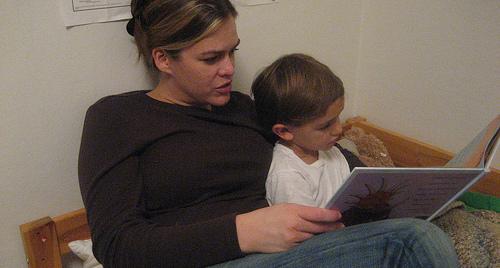
[Photo by Betsssssy.]

Do you ever take your kids’ math tests? It helps me remember what it is like to be a student. I push myself to work quickly, trying to finish in about 1/3 the allotted time, to mimic the pressure students feel. And whenever I do this, I find myself prone to the same stupid mistakes that students make.

Even teachers are human.

In this case, it was a multi-step word problem, a barrage of information to stumble through. In the middle of it all sat this statement:

…and there were 3/4 as many dragons as gryphons…

My eyes saw the words, but my mind heard it this way:

…and 3/4 of them were dragons…

What do you think — did I get the answer right? Of course not! Every little word in a math problem is important, and misreading even the smallest word can lead a student astray. My mental glitch encompassed several words, and my final tally of mythological creatures was correspondingly screwy.

But here is the more important question: Can you explain the difference between these two statements?

Continue reading Reading to Learn Math

Trouble with Percents

Can your students solve this problem?

There are 20% more girls than boys in the senior class.
What percent of the seniors are girls?

This is from a discussion of the semantics of percent problems and why students have trouble with them, going on over at MathNotations. (Follow-up post here.)

Our pre-algebra class just finished a chapter on percents, so I thought Chickenfoot might have a chance at this one. Nope! He leapt without thought to the conclusion that 60% of the class must be girls.

After I explained the significance of the word “than”, he solved the follow-up problem just fine.

How Old Are You, in Nanoseconds?

Conversion factors are special fractions that contain problem-solving information. Why are they called conversion factors? “Conversion” means change, and conversion factors help you change the numbers and units in your problem. “Factors” are things you multiply with. So to use a conversion factor, you will multiply it by something.

For instance, if I am driving an average of 60 mph on the highway, I can use that rate as a conversion factor. I may use the fraction \frac{60 \: miles}{1 \: hour} , or I may flip it over to make \frac{1 \: hour}{60 \: miles} . It all depends on what problem I want to solve.

After driving two hours, I have traveled:

\left(2 \: hours \right) \times \frac{60 \: miles}{1 \: hour} = 120 miles so far.

But if I am planning to go 240 more miles, and I need to know when I will arrive:

\left(240 \: miles \right) \times \frac{1 \: hour}{60 \: miles} = 4 hours to go.

Any rate can be used as a conversion factor. You can recognize them by their form: this per that. Miles per hour, dollars per gallon, cm per meter, and many, many more.

Of course, you will need to use the rate that is relevant to the problem you are trying to solve. If I were trying to figure out how far a tank of gas would take me, it wouldn’t be any help to know that an M1A1 Abrams tank gets 1/3 mile per gallon. I won’t be driving one of those.

Using Conversion Factors Is Like Multiplying by One

If I am driving 65 mph on the interstate highway, then driving for one hour is exactly the same as driving 65 miles, and:

\frac{65 \: miles}{1 \: hour} = the \: same \: thing \: divided \: by \: itself = 1

This may be easier to see if you think of kitchen measurements. Two cups of sour cream are exactly the same as one pint of sour cream, so:

\frac{2 \: cups}{1 \: pint} = \left(2 \: cups \right) \div \left(1 \:pint \right) = 1

If I want to find out how many cups are in 3 pints of sour cream, I can multiply by the conversion factor:

\left(3 \: pints \right) \times \frac{2 \: cups}{1 \: pint} = 6 \: cups

Multiplying by one does not change the original number. In the same way, multiplying by a conversion factor does not change the original amount of stuff. It only changes the units that you measure the stuff in. When I multiplied 3 pints times the conversion factor, I did not change how much sour cream I had, only the way I was measuring it.

Conversion Factors Can Always Be Flipped Over

If there are \frac{60 \: minutes}{1 \: hour} , then there must also be \frac{1 \: hour}{60 \: minutes} .

If I draw house plans at a scale of \frac{4 \: feet}{1 \: inch} , that is the same as saying \frac{1 \: inch}{4 \: feet} .

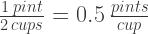
If there are \frac{2\: cups}{1 \: pint} , then there is \frac{1\: pint}{2 \: cups} = 0.5 \: \frac{pints}{cup} .

Or if an airplane is burning fuel at \frac{8\: gallons}{1 \: hour} , then the pilot has only 1/8 hour left to fly for every gallon left in his tank.

This is true for all conversion factors, and it is an important part of what makes them so useful in solving problems. You can choose whichever form of the conversion factor seems most helpful in the problem at hand.

How can you know which form will help you solve the problem? Look at the units you have, and think about the units you need to end up with. In the sour cream measurement above, I started with pints and I wanted to end up with cups. That meant I needed a conversion factor with cups on top (so I would end up with that unit) and pints on bottom (to cancel out).

You Can String Conversion Factors Together

String several conversion factors together to solve more complicated problems. Just as numbers cancel out when the same number is on the top and bottom of a fraction (2/2 = 2 ÷ 2 = 1), so do units cancel out if you have the same unit in the numerator and denominator. In the following example, quarts/quarts = 1.

How many cups of milk are there in a gallon jug?

\left(1\: gallon \right) \times \frac{4\: quarts}{1\: gallon} \times \frac{2\: pints}{1\: quart} \times \frac{2\: cups}{1\: pint} = 16\: cups

As you write out your string of factors, you will want to draw a line through each unit as it cancels out, and then whatever is left will be the units of your answer. Notice that only the units cancel — not the numbers. Even after I canceled out the quarts, the 4 was still part of my calculation.

Let’s Try One More

The true power of conversion factors is their ability to change one piece of information into something that at first glance seems to be unrelated to the number with which you started.

Suppose I drove for 45 minutes at 55 mph in a pickup truck that gets 18 miles to the gallon, and I wanted to know how much gas I used. To find out, I start with a plain number that I know (in this case, the 45 miles) and use conversion factors to cancel out units until I get the units I want for my answer (gallons of gas). How can I change minutes into gallons? I need a string of conversion factors:

\left(45\: min. \right) \times \frac{1\: hour}{60\: min.} \times \frac{55\: miles}{1\: hour} \times \frac{1\: gallon}{18\: miles} = 2.3\: gallons

How Old Are You, Anyway?

If you want to find your exact age in nanoseconds, you need to know the exact moment at which you were born. But for a rough estimate, just knowing your birthday will do. First, find out how many days you have lived:


Days\: I\:have\: lived = \left(my\: age \right) \times \frac{365\: days}{year}

+ \left(number\: of\: leap\: years \right) \times \frac{1\: extra\: day}{leap\: year}

+ \left(days\: since\: my\: last\: birthday,\: inclusive \right)

Once you know how many days you have lived, you can use conversion factors to find out how many nanoseconds that would be. You know how many hours are in a day, minutes in an hour, and seconds in a minute. And just in case you weren’t quite sure:

One\: nanosecond = \frac{1}{1,000,000,000} \: of\: a\: second

Have fun playing around with conversion factors. You will be surprised how many problems these mathematical wonders can solve.


[Note: This article is adapted from my out-of-print book, Master the Math Monsters.]
Answers and Other Tidbits: The Pharaoh’s Treasure

[Read the story of the pharaoh’s treasure here: Part 1, Part 2, and Part 3.]

I confess: I lied — or rather, I helped to propagate a legend. Scholars tell us that the Egyptian rope stretchers did not use a 3-4-5 triangle for right-angled corners. They say it is a myth, like the corny old story of George Washington and the cherry tree, which bounces from one storyteller to the next — as I got it from a book I bought as a library discard.

None of the Egyptian papyri that have been found show any indication that the Egyptians knew of the Pythagorean Theorem, one of the great theorems of mathematics, which is the basis for the 3-4-5 triangle. Unless a real archaeologist finds a rope like Alexandria Jones discovered in my story, or a papyrus describing how to use one, we must assume the 3-4-5 rope triangle is an unfounded rumor.

Continue reading Answers and Other Tidbits: The Pharaoh’s Treasure