Musings: Math is Communication

Young boy writing math expressions

The question came up on a homeschool math forum:

“My first grader and I were playing with equivalent expressions. We were trying to see how many ways we could write the value ‘3.’

    “He wrote down 10 – 2 × 3 + 1.

      “When I tried to explain the problem with his calculation, he got frustrated and didn’t want to do math.

        “How can I help him understand order of operations?”

        [If you think this sounds like too complex of a math expression for a first grader, you may want to read my blog post about math manipulatives and big ideas.]

        Order of operations doesn’t matter in this instance. What matters is communication.

        The mother didn’t know how to read what her son wrote.

        He could help her understand by putting parentheses around the part he wanted her to read first.

        He doesn’t need to know abstract rules for arbitrary calculations, or all the different ways we might possibly misunderstand each other. He just needs to know how to say what is in his mind.

        Continue reading Musings: Math is Communication

        Mental Math: Advanced Subtraction

        mother and daughter talking about math homework

        As our children grow and develop their math skills, the mental math strategies grow with them.

        The basics of mental math don’t change:

        • Use friendly numbers.
        • Estimate and adjust the answer.

        But we have new ways to help children do math in their heads as the numbers get bigger and the problems more challenging.

        For example, how might kids figure out a multi-digit subtraction like 67 − 38?

        First, we need to adjust our mindset…

        Continue reading Mental Math: Advanced Subtraction

        Mental Math: Early Subtraction

        mother and child doing math homework

        By doing mental math, we help our children use the basic principles of arithmetic to simplify problems so they can think about number relationships, mastering the basic structures of how numbers work.

        And the more our children practice these structures in mental math, the better prepared they will be to recognize the same principles in algebra.

        The basic idea of subtraction is finding the difference between two quantities: comparing a larger amount to a smaller one, figuring out what’s left when you remove a part, or finding the distance between two measurements (or two points on the number line).

        When you work with young children learning subtraction, remember our two key mental-math strategies.

        • Use friendly numbers.

        For early subtraction with numbers less than 20, the most important friendly numbers are 5 and 10, the pairs of numbers that make 10, and the doubles.

        • Estimate, then adjust.

        When children apply their creative minds to reasoning about math, they can use friendly numbers to get close to an answer, and then tweak the result as needed.

        Continue reading Mental Math: Early Subtraction
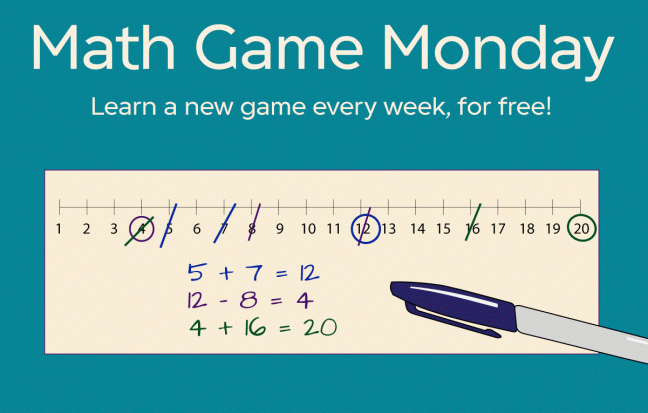
        If Not Methods: Reasoning About Subtraction

        Father and son reasoning about subtraction

        We’ve been examining the fact that, while there may be only one right answer to a math problem, but there’s never only one right way to get that answer.

        What matters in math is the journey. How do your children make sense of the problem and reason their way to that answer?

        As always, real math is not about the answers but the thinking.

        But if we don’t want to give our children a method, how can we teach? What if we pose a problem and the child doesn’t know how to solve it?

        What if our children get stumped on a subtraction calculation like 431 – 86?

        Continue reading If Not Methods: Reasoning About Subtraction

        Math Musings: Lies My Teacher Told Me

        I mentioned last time that the common phrase “Multiplication is repeated addition” is a mathematical lie we tell our children. And it’s not the only one.

        Did you ever say, “Subtraction means take-away”? Or how about “Division is sharing”? I know I have, but both of those statements are also mathematical lies.

        One of the reasons I like Cuisenaire rods so much is that they can help us avoid lying to our children about math.

        Continue reading Math Musings: Lies My Teacher Told Me

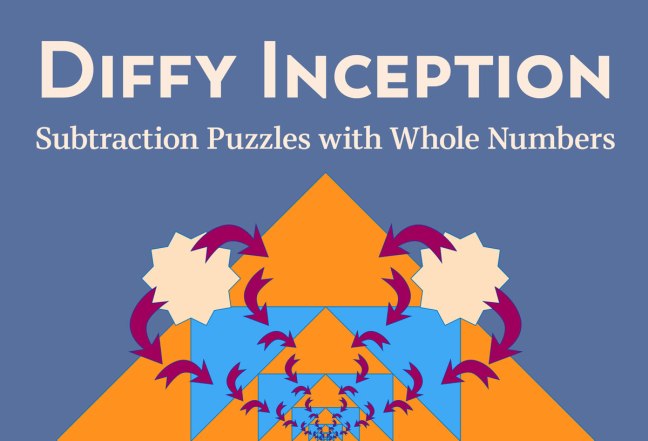
        New Printable Puzzle Books: Diffy Inception

        The best way to practice math is to play with it—to use the patterns and connections between math concepts in your pursuit of something fun or beautiful.

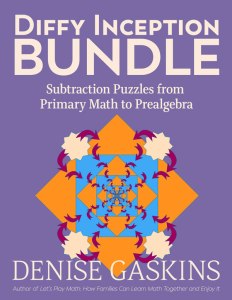
        Diffy Inception puzzles have their own symmetric beauty, but mostly they are just plain fun. Students can practice subtraction and look for patterns in the difference layers.

        I just published four new activity books to our online store:

        Notes to the teacher include puzzle instructions, game variations, journaling prompts, and more. Plus answers for all puzzles.

        Available with 8 1/2 by 11 (letter size) or A4 pages.

        My publishing company runs this online store, so you can find all my playful math books there — including an exclusive pre-publication ebook edition of my newest title, Prealgebra & Geometry: Math Games for Middle School. Click here to browse the Tabletop Academy Press store.

        PUFM 1.4 Subtraction

        Photo by Martin Thomas via flickr. In this Homeschooling Math with Profound Understanding (PUFM) Series, we are studying Elementary Mathematics for Teachers and applying its lessons to home education.

        When adding, we combine two addends to get a sum. For subtraction we are given the sum and one addend and must find the “missing addend”.

        — Thomas H. Parker & Scott J. Baldridge
        Elementary Mathematics for Teachers

        Notice that subtraction is not defined independently of addition. It must be taught along with addition, as an inverse (or mirror-image) operation. The basic question of subtraction is, “What would I have to add to this number, to get that number?”

        Inverse operations are a very fundamental idea in mathematics. The inverse of any math operation is whatever will get you back to where you started. In order to fully understand a math operation, you must understand its inverse.

        Continue reading PUFM 1.4 Subtraction

        Game: Target Number (or 24)

        [Photo by stevendepolo via Flickr (CC BY 2.0).]

        Math concepts: addition, subtraction, multiplication, division, powers and roots, factorial, mental math, multi-step thinking
        Number of players: any number
        Equipment: deck of math cards, pencils and scratch paper, timer (optional)

        Set Up

        All players must agree on a Target Number for the game. Try to choose a number that has several factors, which means there will be a variety of ways to make it. Traditionally, I start my math club students with a target of 24.

        Shuffle the deck, and deal four cards face down to each player. (For larger target numbers, such as 48 or 100, deal five or six cards to each player.) The players must leave the cards face down until everyone is ready. Set the remainder of the deck to one side.

        Continue reading Game: Target Number (or 24)

        Do Your Students Understand Division?

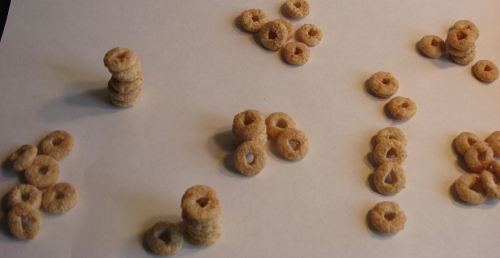
        Cheerios by sixes
        [I couldn’t find a good picture illustrating “division.” Niner came to my rescue and took this photo of her breakfast.]

        I found an interesting question at Mathematics Education Research Blog. In the spirit of Liping Ma’s Knowing and Teaching Elementary Mathematics, Finnish researchers gave this problem to high school students and pre-service teachers:

        We know that:
        498 \div 6 = 83
        How could you use this relationship (without using long-division) to discover the answer to:
        491\div6=?
        [No calculators allowed!]

        The Finnish researchers concluded that “division seems not to be fully understood.” No surprise there!

        Check out the pdf report for detailed analysis.

        Continue reading Do Your Students Understand Division?

        Contig Game: Master Your Math Facts

        [Photo by Photo Mojo via Flickr (CC BY 2.0).]

        Yahtzee and other board games provide a modicum of math fact practice. But for intensive, thought-provoking math drill, I can’t think of any game that would beat Contig.

        Math concepts: addition, subtraction, multiplication, division, order of operations, mental math
        Number of players: 2 – 4
        Equipment: Contig game board, three 6-sided dice, pencil and scratch paper for keeping score, and bingo chips or wide-tip markers to mark game squares

        Set Up

        Place the game board and dice between players, and give each player a marker or pile of chips. (Markers do not need to be different colors.) Write the players’ names at the top of the scratch paper to make a score sheet.

        Continue reading Contig Game: Master Your Math Facts