“One factor that has remained constant through all the twists and turns of the history of physical science is the decisive importance of the mathematical imagination.”
—Freeman Dyson
In the previous episode, Alexandria Jones discovered a mysterious treasure: three wooden sticks, like tent pegs, and a long loop of rope with 12 evenly spaced knots. Her father explained that it was an ancient Egyptian surveyor’s tool, used to mark right angles.
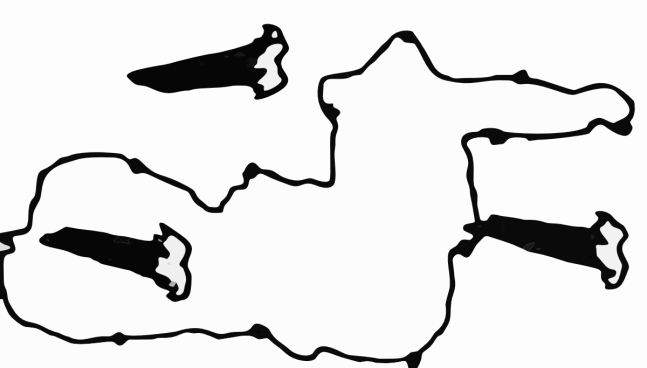
Back at the camp, Fibonacci Jones stacked multi-layer sandwiches while Alexandria poured milk and set the table for supper.
“Geometry,” Fibonacci said.
“What?”
“Geo means earth, and metry means to measure. So geometry means to measure the earth. That is what the Egyptian rope stretches did.”
Alex thought for a moment. “So in the beginning, math was just surveying?”
“And taxes…”
Measuring the Land
Professor Jones sliced a sandwich diagonally into two triangles. “Every farmer in Egypt had to pay a property tax to the Pharaoh each year, based on the size of his land, so the rope stretchers spent most of their time measuring farm land. The scribes could easily calculate the area of a rectangular plot of land.”
Area = length × width
He waved the knife as he talked, drawing imaginary diagrams in the air.
“Dad, would you please put the knife down?” Alex said. “You’re making Rammy nervous.”
“Oh, yes, of course. And since a right triangle made exactly half of a rectangle, the area of a right triangle was simple, too.”
“I know that one,” Alex said. “Area = ½ (base × height), where the base and height are the two legs of the triangle—the two sides that form the right angle. But what if the farmer’s property had some really weird shape?”
Her father began to lay the pieces of sandwiches on the tabletop in an asymmetrical design. “The Egyptians discovered that they could divide any piece of property with straight borders into right triangles.”
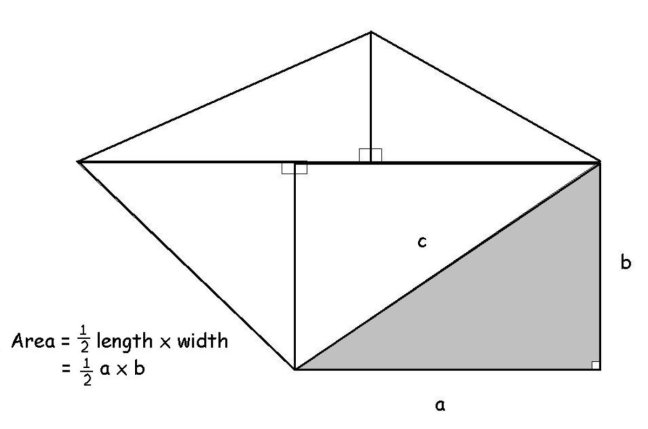
“They could cut any property into triangles?”
“If it had straight sides.” Fibonacci picked up the last sandwich and took a big bite.
Alex grabbed a sandwich half and held it up, tracing its edges with her finger. “Then when they measured the sides of each triangle, they could calculate its area. What a neat system!”
Her father nodded. “Adding the areas of all the triangles together gave them the area of the entire property—”
“And the proper amount for the farmer’s taxes!” Alex laughed.
Try It for Yourself
Of course, Egyptian rope stretchers, like modern surveyors, laid out land in rectangles whenever possible. But some properties came out with irregular shapes no matter what the rope stretchers did, and the fact that the Nile flooded every year made their work particularly difficult.
On a blank sheet of paper, draw a few large polygons: closed shapes made of straight line segments. Start with relatively simple shapes, using only four or five lines, then work your way up to a complex shape that fills half the page. Use a ruler to keep your lines straight.
Try to divide your shape into right triangles. If you don’t have a drafting triangle, you can use the corner of a sheet of paper to help you draw right angles. The more complicated your original shape, the more lines you will need to cut it up, but try to find the fewest lines you can. Like everyone else, Egyptian rope stretchers tried to make their work as easy as possible.
Finally, try this challenge from my old newsletter:
Can you find the area of this farmer’s property, so that he will know how much of his crop to send to Pharaoh for taxes?
A Puzzle for Older Students
Given the equation for the area of a rectangle:
Area (rectangle) = length × width
Show that Alexandria Jones’s equation for the area of a right triangle is true, where the base and height are the two legs that meet at the right angle:
Area (right triangle) = ½ base × height
Then can you show how that area formula applies to any triangle, and why it’s true even for wildly slanty ones?
You don’t have to do a formal proof or write it in the two-column format often taught in geometry class. But make sure your explanations contain enough information that a reader can follow your reasoning.
The toughest part of any geometry proof is to make sure your logic will stand up to scrutiny. How do you know that everything you said is true?
HINT: You may find the following tips from Euclid useful.
Or not, depending on how you approach the problem. Even when there’s only one right answer (the formula you’re trying to prove), there are always many ways to get there. But these are some of the principles I find helpful in thinking about triangles.
And I also like to use Cavalieri’s principle, which says you can imagine any geometric shape sliced into thin pieces like a deck of cards or a stack of pennies. Then even when the stack is pushed slantwise into different shapes, it will always have the same area or volume.
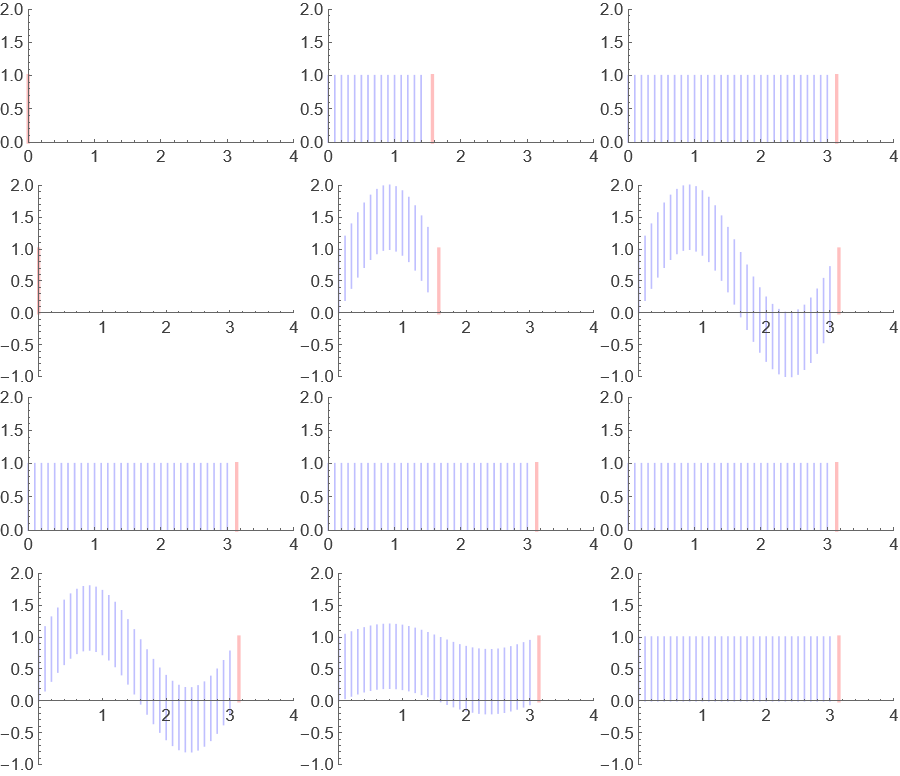
Myin36, CC BY-SA 4.0, via Wikimedia Commons
How might that relate to triangles?
CHALLENGE: Can you show where geometry’s other area formulas come from? Try to prove the area of a parallelogram or trapezoid, or to approximate the area of a circle.
I Lied to You!
I confess: I lied—or rather, I helped to propagate a math-history legend.
Scholars tell us that the Egyptian rope stretchers did not use a 3-4-5 triangle for right-angled corners. They say it is a myth, like the corny old story of George Washington and the cherry tree, which bounces from one storyteller to the next—as I got it from a book I bought as a library discard.
None of the Egyptian papyri that have been found show any indication that the Egyptians knew of the Pythagorean Theorem, one of the great theorems of mathematics, which is the basis for the 3-4-5 triangle. Unless a real archaeologist finds a rope like Alexandria Jones discovered in my story, or a papyrus describing how to use one, we must assume the Pharaoh’s 3-4-5 rope triangle is an unfounded rumor.
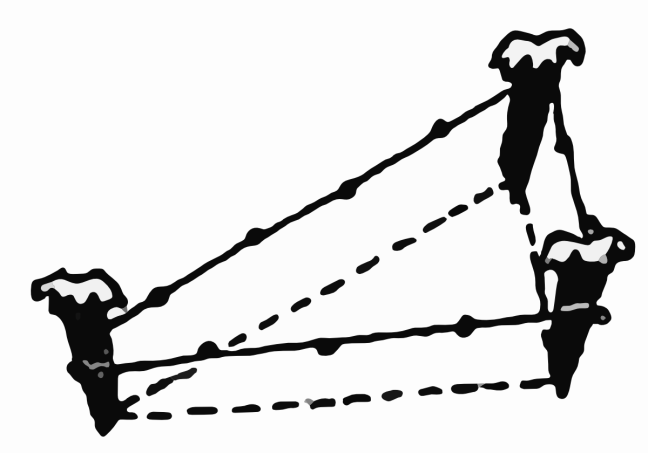
Then why did I tell the story like that?
Unlike Egyptian surveyors, students today do need to know the Pythagorean Theorem and to be familiar with at least a few specific examples. As you go through your high school and college math classes, you will find 3-4-5 (and 5-12-13, 7-24-25, 8-15-17, and more) triangles popping up in all sorts of problems.
I hope that reading about and working with “the Pharaoh’s treasure” will help you remember a few of these useful math facts.
Any multiples of 3-4-5 form similar triangles, which means that sides of 6-8-10 or 9-12-15 also make right angles.
Can you see why this is true?
The Egyptian surveyor could tie an extra knot in the middle of each space of his rope without changing the overall shape of the triangle. That would double the number of spaces on each side, turning 3-4-5 into 6-8-10. This is true for any triangles:
If the sides are proportional, the triangles must be similar.
Another Way to Form Right Angles
But if they did not use the 3-4-5 rope triangle, how did the Egyptian surveyors measure right angles? They still used their knotted ropes, and they used another important fact of geometry:
If you cut an isosceles triangle in half, you get two right triangles.
An isosceles triangle is one in which two of the sides are equal. Here is one way the Egyptian rope-stretchers might have used an isosceles triangle to make a right angle:
- Get four pegs and three ropes. Two of the ropes should have an odd number of knots, evenly spaced. (The reason for an odd number is to make it easy to find the center.) One of the knotted ropes must be much longer than the other.
- Peg the shorter knotted rope along the line of your wall or the edge of the farmer’s property, with the center knot where you want the right angle to be and one knot exactly at each peg. This will form the base, or bottom line, of your isosceles triangle.
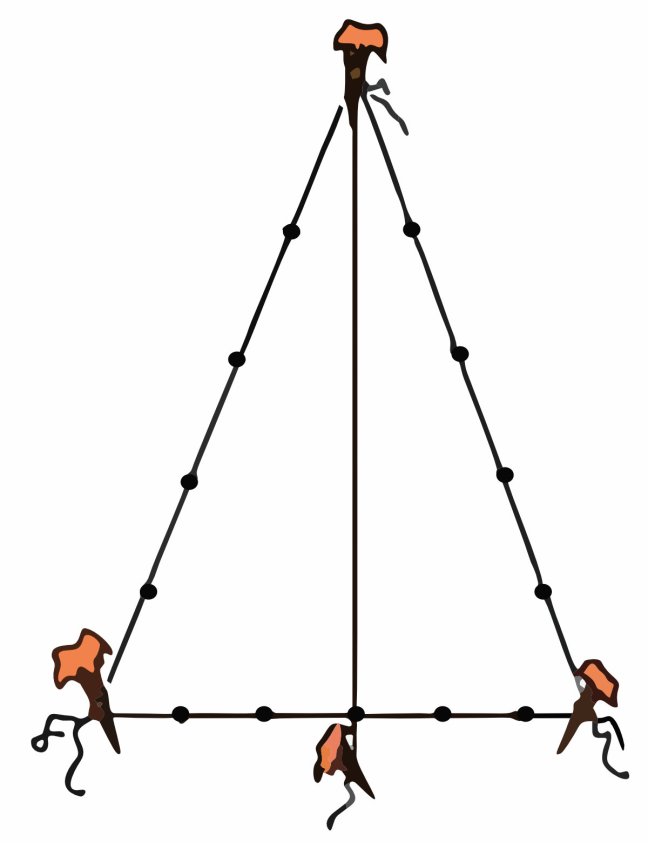
- Tie the longer knotted rope to the same pegs, so that it also has one knot at each peg. Stretch it tight to form a triangle, and put the third peg at the exact center knot to hold it in place.
- Tie the third rope to this last peg and stretch it out until it passes the center knot of the first rope. Use your last peg to hold it in place. This rope will be the altitude of your triangle, and it will form a right angle with the first rope.
If you made a “rope” loop out of string, as described in The Secret of the Pharaoh’s Treasure, Part 1, you can use it this way:
- Make the base of your isosceles triangle with either 3 or 5 knots, putting the center knot where you want the right angle and one knot exactly at each corner pin.
- Then pin the center of the rest of the string as far away as it will stretch, making two equal sides for your triangle.
- Stretch an extra piece of string from this top corner down past the center of the base, which will form your right angle.
“The Pharaoh’s Treasure, Part 2” copyright © 2026 by Denise Gaskins. Image at the top of the blog copyright © Adrian Dascal / Unsplash.
Are you looking for more creative ways to play math with your kids? Check out all my books, printable activities, and cool mathy merch at Denise Gaskins’ Playful Math Store. Or join my email newsletter.
This blog is reader-supported. If you’d like to help fund the blog on an ongoing basis, then please join me on Patreon (or choose the paid level on Substack) for mathy inspiration, tips, and an ever-growing archive of printable activities.



 Denise Gaskins' Let's Play Math