Introduction to the Science of Counting

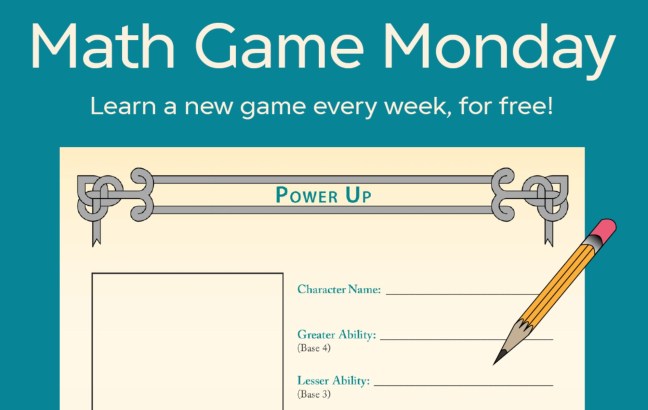
fantasy elf archer

One of my favorite rabbit-trails to explore in middle school math is the science of counting and probability.

It’s a great topic because the calculations are relatively easy, mostly multiplication and division. But there’s a lot of thinking that goes into figuring out just what calculations we need to do.

Counting is not only for little kids! It’s part of discrete mathematics, which means the study of things that are not continuous—things that come in discrete chunks—and it’s important in game design, computer programing, and cryptography.

Prealgebra and Geometry games book

This post is a section of my Prealgebra & Geometry Games book where my daughter and I explore the fundamental counting principle, the key to solving many counting and probability puzzles.

Continue reading Introduction to the Science of Counting

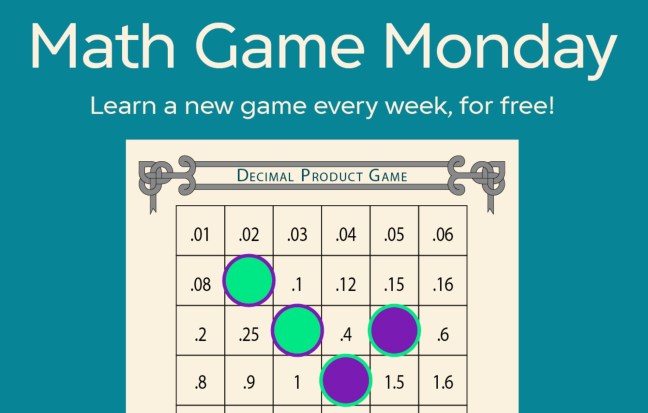
Math Game Monday: Decimal Product Game

Learn a new math game every week, for free

This game builds understanding of decimals, and also of the inverse relationship between multiplication and division.

Many parents remember struggling to learn math. We hope to provide a better experience for our children. And one of the best ways for children to enjoy learning is through hands-on play.

So what are you waiting for? Let’s play some math!

Decimal Product Game

Math Concepts: multiplying decimals, decimal place value.

Players: two players or two teams.

Equipment: printed game board, colored markers or a set of matching tokens for each player, two paperclips or other small tokens to mark the factors.

Continue reading Math Game Monday: Decimal Product Game

Probability Puzzles with Obsolete Coins

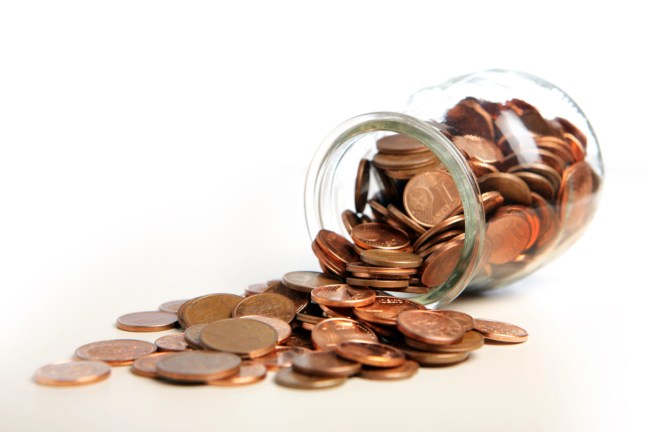
jar of coins

I love math puzzles, and Henry Ernest Dudeney is the foremost puzzlemeister of all time.

Whenever I need a diversion from the pressing day-to-day busyness of life, I like to crack open one of his books. And get humbled. He stumps me as often as not, but I enjoy the challenge.

Today, I’ve got two of his somewhat-easier puzzles from Amusements in Mathematics, dealing with the probability of obsolete coins tossed or pulled from a bag.

Okay, so the penny isn’t obsolete quite yet, even though the US government quit making them. But the “penny” in these puzzles is the old British pence, which went out of date seemingly ages ago, along with all the other non-decimal coins that made old math puzzles so confusing.

Probability puzzles are great for middle school students because the arithmetic itself is simple. The challenge is in figuring out exactly what calculation to do.

Have fun playing math with your kids!

Continue reading Probability Puzzles with Obsolete Coins

Conversion Factors: How Old Are You in Nanoseconds?

birthday cupcake with sparkler

Homeschool Memories

[Based on a problem I made up for my co-op students, once upon a time…]

Conversion factors are special fractions that contain problem-solving information. Why are they called conversion factors?

  • “Conversion” means change, and conversion factors help you change the numbers and units in your problem.
  • “Factors” are things you multiply with. So to use a conversion factor, you will multiply it by something.

For instance, if I am driving an average of 60 mph on the highway, I can use that rate as a conversion factor. I may use the fraction:

Or I may flip it over to make:

It all depends on what problem I want to solve.

After driving two hours, how far have I gone?

But if I am planning to go 240 more miles, how much longer will it take?

Any rate can be used as a conversion factor. You can recognize them by their form: this per that. Miles per hour, dollars per gallon, cm per meter, and many, many more.

Of course, you will need to use the rate that is relevant to the problem you are trying to solve. If I were trying to figure out how far a tank of gas would take me, it wouldn’t be any help to know that an M1A1 Abrams tank would get about 1/3 mile per gallon. I won’t be driving one of those.

Continue reading Conversion Factors: How Old Are You in Nanoseconds?

Column Jumping: An Investigation

man jumping on rock columns

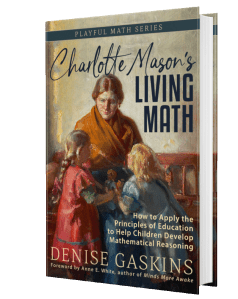
Charlotte Mason's Living Math ebook editionIn my new book, Charlotte Mason’s Living Math, I encourage families to explore the world of math by asking big, open-ended questions.

[Now available exclusively in my Playful Math Store! Ebook only at the moment, but print editions are coming soon.]

Here’s an example of such a question, an excerpt from my earlier book, 70+ Things To Do with a Hundred Chart: Number, Shape, and Logic Activities from Preschool to Middle School.

Have fun exploring math with your kids!

Continue reading Column Jumping: An Investigation

Tasty Treats from the Moscow Puzzles

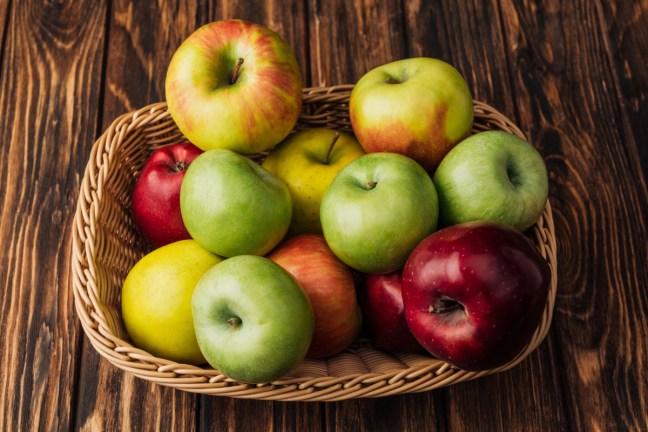
basket of apples

“Problems stressing deduction rather than calculation have a special appeal and value. They teach you to analyze, and to seek unorthodox ways of solving a problem.”

—Boris Kordemsky

Today I’m sharing a few treats from The Moscow Puzzles by Boris Kordemsky, which mixes classic brainteasers and original stumpers.

Recreational math expert Martin Gardner called Kordemsky’s book “the outstanding puzzle collection in the history of Russian mathematics.”

Have fun playing logic with your kids!

Continue reading Tasty Treats from the Moscow Puzzles

Rescuing Cool Math for Older Kids

mother and teen daughter do homework together

Do you have math dreams for your children?

Here are some dreams shared the authors of Avoid Hard Work!

For our children, we dream that mathematics…

  • … makes sense.
  • … is more than just arithmetic.
  • … is joyous.
  • … makes them strong.
  • … is meaningful.
  • … is creative.
  • … is full of fascinating questions.
  • … opens up many paths to solutions.
  • … is friendly.
  • … solves big problems and makes the world better.
  • … is a powerful tool they can master.
  • … is beautiful.
  • … lets them learn in their own ways.
  • … is connected to their lives.
  • … asks “why” and not just “how.”
  • … opens the world.

Continue reading Rescuing Cool Math for Older Kids

Math Prompt: True-False-True

girl writing in a notebook, sitting on couch with her corgi

Book, Charlotte Mason's Living MathOne of the stretch goals for my Charlotte Mason’s Living Math Kickstarter campaign is to add a math journaling prompt to the end of each chapter. So, I’ve been playing around with ideas to get readers writing.

Since the book’s all about how to build mathematical reasoning, I’m looking for ways to prompt creative thinking and flexibility in math calculations.

Check Out the Kickstarter

I found some fun ideas in Guy Gattegno and Martin Hoffman’s Handbook of Activities for the Teaching of Mathematics (which you can download here), including the following riff off a puzzle created by Lewis Carroll.

Continue reading Math Prompt: True-False-True

Mental Math: Advanced Multiplication, Part 2

Father and son celebrate a mental math answer

The methods in last week’s Advanced Multiplication post only work for certain numbers, but we have another, more powerful multiplication tool: We can always use a ratio table to make sense of any multiplication.

Ratios are the beginning of proportional thinking. We can systematically alter the numbers in a ratio to reach any quantity required by our problem.

Students begin working with ratios in story problems that help them visualize and make sense of a proportional relationship.

Continue reading Mental Math: Advanced Multiplication, Part 2

Homeschool Memories: Bill Gates Proportions II

Woman on a shopping spree to buy books

Once upon a time, when my kids and I were young…

Later the same year, not too long after our discussion of the Bill Gates proportions, I stumbled on some more data. I discovered that the median American family’s net worth was $93,100 in 2004, most of that being home equity.

This gave me another chance to play around with proportions. And since I was preparing a workshop for our regional homeschooling conference, I wrote a sample problem:

The median American family has a net worth of about $100 thousand. Bill Gates has a net worth of $56 billion. If Average Jane Homeschooler spends $100 in the vendor hall, what would be the equivalent expense for Gates?

In the last post, I explained that a proportion sets two ratios equal to each other, like equivalent fractions. Each ratio must compare similar thing to similar thing in the same order.

In this case, we are interested in the ratio “Expense compared to Net Worth.”

Continue reading Homeschool Memories: Bill Gates Proportions II