Do you enjoy math? I hope so! If not, browsing this post just may change your mind.
Welcome to the 106th edition of the Math Teachers At Play math education blog carnival — a smorgasbord of links to bloggers all around the internet who have great ideas for learning, teaching, and playing around with math from preschool to pre-college. Let the mathematical fun begin!
By tradition, we start the carnival with a puzzle in honor of our 106th edition. But if you would like to jump straight to our featured blog posts, click here to see the Table of Contents.
Try This Puzzle
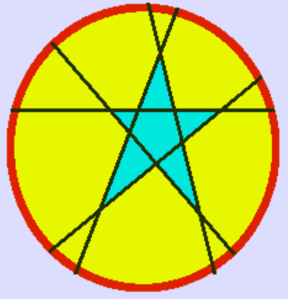
If you slice a pizza with a lightsaber, you’ll make straight cuts all the way across. Slice it once, and you get two pieces.
If you slice it five times, you’ll get a maximum of sixteen pieces. (And if you’re lucky you might get a star!)
How many times would you have to slice the pizza to get 106 pieces?
I love my new paperback math journal series. The books are sturdy, inexpensive, and fit nicely in my purse.
But as with any paperback book, these have one problem. How do I use them without cracking the spine?
When we exercise, we need to warm up our bodies with a bit of stretching to prevent injury. In the same way, we need to warm up a new book to protect it. The process is called “breaking it in.”
It only takes a few minutes to break in a paperback book:
Step by Step
Never force the book but help it limber up gradually, and it will serve you well.
Because my journals are working books, I take the breaking-in process a bit further than shown in the video:
(1) Set the book on its back and follow the process above. Press down each cover, but not completely flat — let it bend at the fold line, about 1 cm from the actual spine. Then press a couple pages at a time, alternating front and back, down flat on each cover.
(2) Flip through the pages of the book forward and backward to limber them up.
(3) Repeat the steps of the video. This time, gently lean the main part of the book away from the part you are pressing down. Aim for a 130–140 degree angle.
(4) Flip through the pages again. For paperbacks, you can even roll the whole book back and forth a bit — gently curving the cover and pages almost as if you’re trying to fold the book in half — to encourage flexibility.
(5) Optional: Repeat the breaking-in process one more time. This time, fold each section back as close to 180 degrees as it will go.
And you’re done!
The pages will still curve in at the fold line, where they connect to the spine of the book. You want that because it makes the book strong. But now they’ll also open up to provide a nice, wide area for writing or math doodling.
Doodling gives our minds a chance to relax, wander, and come back to our work refreshed. And though it goes against intuition, doodling can help us remember more of what we learn.
Math doodles let us experiment with geometric shapes and symmetries. We can feel our way into math ideas gradually, through informal play. Through doodles, our students will explore a wide range of mathematical structures and relationships.
Our own school experiences can make it hard for us to teach. What we never learned in school was the concept of playing around with math, allowing ideas to “percolate,” so to speak, before mastery occurs, and that process may take time.
—Julie Brennan
I like to doodle on dotty grid paper, like the pages in my math journals, but there’s No Purchase Necessary! You can design your own printable dot page at Incompetech’s PDF generator.
Patterns in Shape and Angle
To make a faceted mathematical gemstone, start with any shape you like. Then build other shapes around it. What do you notice? Does your pattern grow outward from its center? Or flow around the corner of your page? How is each layer similar, and how is it different?
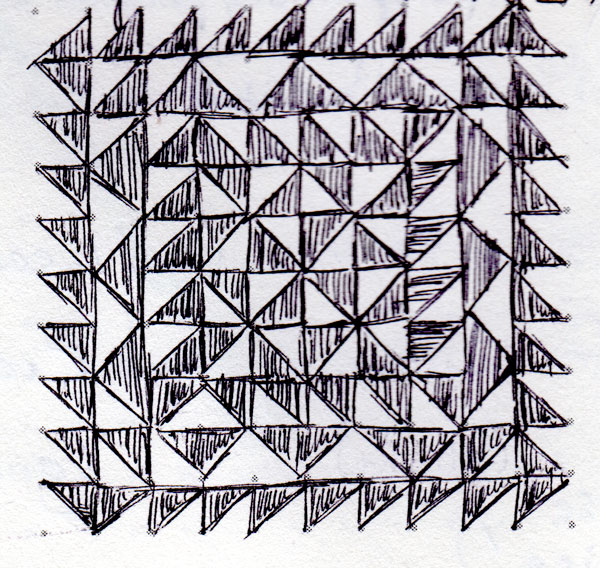
Arbitrary constraints can lead to mathematically interesting doodles. For instance, create a design out of 45-45-90 triangles by coloring exactly half of every grid square. How many variations can you find?
Symmetry Challenge
Play a symmetry puzzle game. Draw a line of symmetry and fill in part of the design. Then trade with a partner to finish each other’s doodles.
Make more complex symmetry puzzles with additional reflection lines.
Math Doodle Links
Who can talk about mathematical doodling without mentioning Vi Hart? If you’ve never seen her “Doodling in Math Class” video series, you’re in for a treat!
Or experiment with the more flexible rules in John’s “Knot Fun” lesson.
And my latest obsession: the “ultimate” tutorial series on Celtic Knotwork, which explores the link between knots and their underlying graphs.
Finally, check out my Math Doodling board at Pinterest.
My favorite knot doodle so far.Inspirations: A Recreational Mathematics JournalReflections: A Math Teacher’s JournalExplorations: A Math Student’s JournalContemplations: A Homeschooler’s Journal
My newest book project began with a few simple coloring pages for my homeschool co-op kids. You may recall when I collected those into a downloadable coloring book last December. Well, I kept tinkering with the designs into January. And then it was time to buy a new planner…
The problem is, I’m not a naturally organized person. I like making lists and plans, but sticking to them is tougher. And I’ve never found a planner or organizational system that I could follow for longer than two weeks at a go. That is until I heard of bullet journaling.
But journaling requires a journal — a notebook of some sort. And I couldn’t find any that I liked. Either the pages were too narrow and felt cramped, or the thing didn’t fit even in my oversized purse. Or the fancy, hardcover binding made it heavy to lug around. Or there weren’t enough pages to last more than a few weeks. Or the lines were too dark, or too widely spaced.
Never quite what I wanted.
So I decided to make my own.
I started with dot-grid pages for flexible layouts and for doodling. I scattered some of my favorite math and education quotations through each book. And then I added several of my most flexible geometric coloring pages (loosely based on Islamic tessellation designs).
And I had so much fun I couldn’t stop with just one. So let me introduce my Dot Grid Notebook with Coloring Pages series:
Inspirations: A Recreational Mathematics JournalReflections: A Math Teacher’s JournalExplorations: A Math Student’s JournalContemplations: A Homeschooler’s Journal
With 170 roomy pages, each book gives you plenty of space to record memories, plan projects, and keep track of tasks. The dot grid makes it easy to draw graphs or diagrams. Take notes, jot down ideas, copy your favorite quotations, or doodle to your heart’s content.
Light gray dots at 5 mm spacing provide guidance for flexible page layouts.
11 geometric coloring pages allow a multitude of artistic possibilities.
31 favorite quotes offer a vision for creative math education.
6 × 9 inch (about 15 × 23 cm) pages are wider than many journals, yet still fit comfortably into a large purse or bag.
Paperback binding makes the journal sturdy but lightweight. Carry it anywhere!
The ebook edition features all 124 quotations (31 from each journal) about mathematics, education, and problem solving. Read through for your own pleasure, post them by your workspace, or use them as writing prompts for yourself or your students. [Yes, all of the ebooks are the same.]
But, what can you DO with all those nice, dotty pages?
Of course, you can use them for bullet journaling. That’s why I originally created the books, because I couldn’t find planners that fit my personal style. My bullet journal is basically an anthology of To-Do lists, bound together so they don’t get lost in the clutter. It’s the only planner system I’ve been able to stick with for more than two weeks at a go.
Or you could use the dotty pages for a commonplace book. That’s my favorite kind of journaling. Like a magpie, I collect shiny tidbits from books, websites, conversations overheard, and more. Passages. Definitions. Poems. Recipes. Proverbs. Things I’m wondering about. Cute kid sayings. It all goes into the mix.
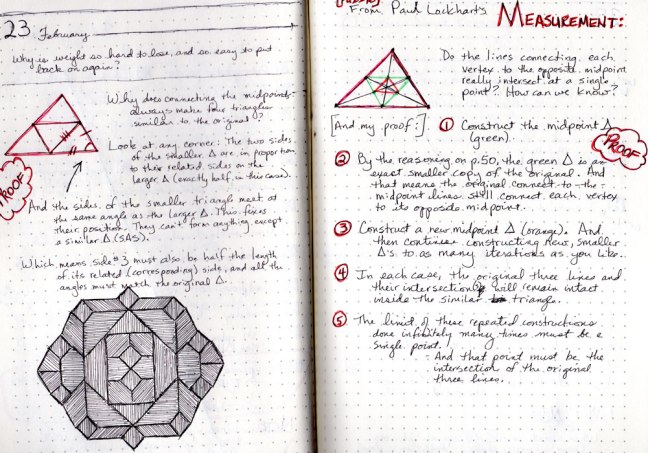
And math puzzles, of course! Below, I’m playing my way through Paul Lockhart’s Measurement. I use the cloud-like labels in the outer margins of each page for keywords that identify what I’m writing, because someday I’ll need to skim back and find an old note.
But where dot grid pages really excel is at doodling — I’m sure you noticed the faceted design filling the lower half of my journal page above and the gem almost overrunning my February calendar. So watch for tomorrow’s blog post featuring a variety of ways to create your own mathematical doodles.
Best wishes, and happy mathing!
P.S.: Do you have a blog? If you’d like to feature a Dot Grid Journal review and giveaway, I’ll provide the prize. Leave a comment below, and we’ll work out the details.
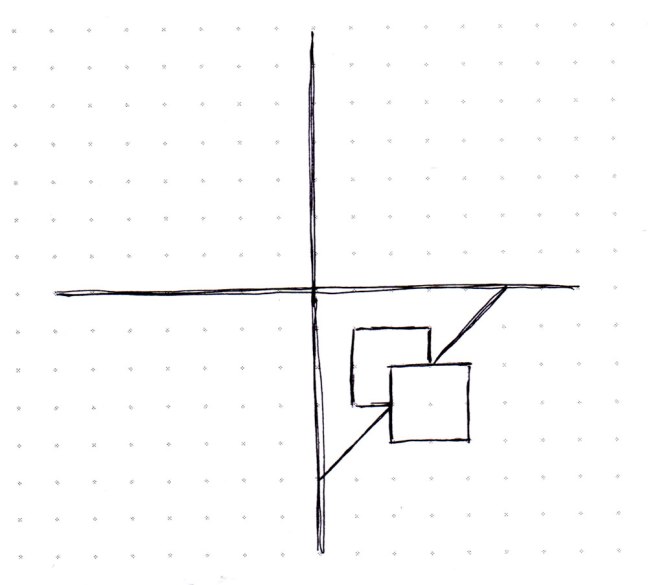
“There’s something striking about the economy of the counselor’s construction. He drew a single line, and that totally changed one’s vision of the geometry involved.
“Very often, there’s a simple introduction of something that’s not logically within the framework of the question — and it can be very simple — and it utterly changes your view of what the question really is about.”
“Spring cleaning has made my desk look worse than before. Nobody feels like studying. The kids would rather be outside, and their mom would rather take a nap. If I line everyone up on the curb in the morning, do you think the yellow bus will take them?”
Homeschool burnout — it’s a perennial problem. If you’re suffering from lethargy and can’t face another day of school work, here are some ideas that kept me going long enough to graduate almost-five kids (my “baby” finishes homeschooling this spring!):
(1) Re-read the homeschooling books on your shelves, or get some new ones from the library. Write down your favorite quotes as you read. Try to read about one a month, to help get your enthusiasm back. And then read at least one new homeschooling book per year to help you stay inspired.
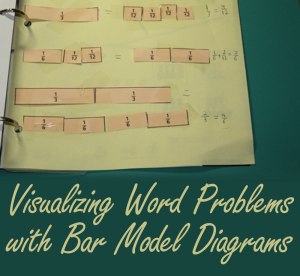
A friend emailed me, frustrated with her child’s math lesson on bar diagrams: “Why do they have to make it so complicated? Why can’t we just solve the blasted problem?”
I told her bar models themselves are not the goal. The real question for parents and teachers is:
What can you do when your child is stumped by a math word problem?
To solve word problems, students must be able to read and understand what is written. They need to visualize this information in a way that will help them translate it into a mathematical expression.
Bar model diagrams are one very useful tool to aid this visualization. These pictures model the word problem in a way that makes the solution appear almost like magic.
It is a trick well worth learning, no matter which math program you use.
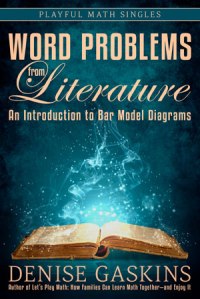
I’ve started working on a book about bar model diagrams, and I’d love to hear your input. Have you tried using them? Do they help your children? What questions do you have?
Update: My New Book
You can help prevent math anxiety by giving your children the mental tools they need to conquer the toughest story problems.
Check out the new carnival of playful math for all ages at Mrs. E Teaches Math. Each month’s carnival brings you a great new collection of puzzles, math conversations, crafts, teaching tips, and all sorts of mathy fun.
Pure mathematics, applied math, and more — all summarized in a single map! Watch the video by physicist and award-winning science writer Dominic Walliman:
Walliman says, “To err is to human, and I human a lot. I always try my best to be as correct as possible, but unfortunately I make mistakes…”
If you’d like to help fund the blog on an on-going basis, then please head to my Patreon page.
If you liked this post, and want to show your one-time appreciation, the place to do that is PayPal: paypal.me/DeniseGaskinsMath. If you go that route, please include your email address in the notes section, so I can say thank you.
I want to tell you a story. Everyone likes a story, right? But at the heart of my story lies a confession that I am afraid will shock many readers.
People assume that because I teach math, blog about math, give advice about math on internet forums, and present workshops about teaching math — because I do all this, I must be good at math.
 Do you enjoy math? I hope so! If not, browsing this post just may change your mind.
 If you slice a pizza with a lightsaber, you’ll make straight cuts all the way across. Slice it once, and you get two pieces.











 People assume that because I teach math, blog about math, give advice about math on internet forums, and present workshops about teaching math — because I do all this, I must be good at math.
  Denise Gaskins' Let's Play Math
.jpg)