Clearly, I won’t need my desk chair today…
Day of Rest
Clearly, I won’t need my desk chair today…
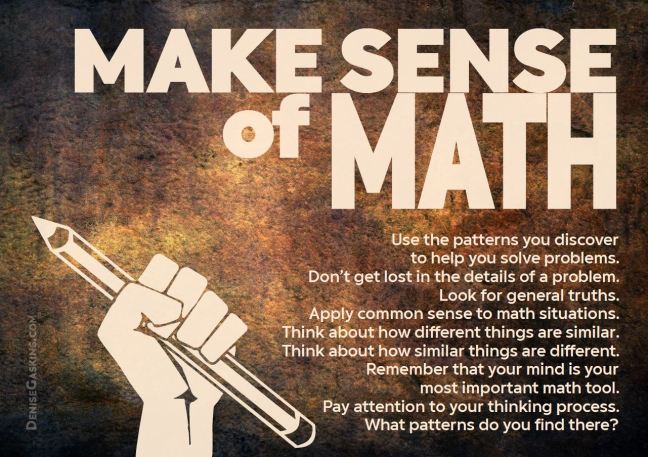
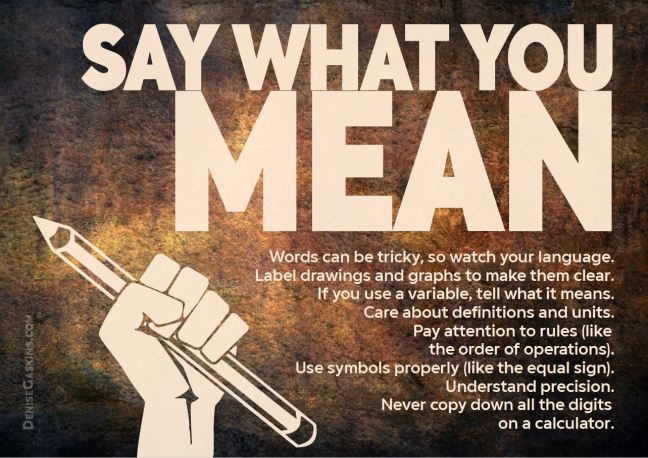
Have you read the Standards for Mathematical Practice? Good idea in theory, but horribly dull and stilted. Like math standards in general, the SMPs sound as if they were written by committee. (Duh!)
I’ve seen several attempts to rewrite the SMPs into student-friendly language. Many of those seem too over-simplified, almost babyish.
Probably I’m just too critical.
Anyway, I decided to try my hand at the project. Here’s the first installment…
Download the poster, if you like:
What do you think? Would this resonate with your students?
What changes do you suggest?
You can find the whole SMP series (eventually) under the tag: Posters.
I had so much fun making these posters that I decided to put them into a printable activity guide. It includes the full-color poster shown above and a text-only version, with both also in black-and-white if you need to conserve printer ink.
Here’s the product description…
Join the Math Rebellion: Creative Problem-Solving Tips for Adventurous Students
Take your stand against boring, routine homework.
Fight for truth, justice, and the unexpected answer.
Join the Math Rebellion will show you how to turn any math worksheet into a celebration of intellectual freedom and creative problem-solving.
This 42-page printable activity guide features a series of Math Tips Posters (in color or ink-saving black-and-white) that transform the Standards for Mathematical Practice to resonate with upper-elementary and older students.
Available with 8 1/2 x 11 (letter size) or A4 pages.
“Mathematics, besides being beautiful and useful, is fun. I hope [my book] brings mathematical joy to many.”
—Bernardo Recamán, The Bogotá Puzzles

Dover Publications occasionally posts free samples from some of their wonderful collection of books. This month’s sampler includes several puzzles from The Bogotá Puzzles by Bernardo Recamán.
Inspired by such illustrious collections as The Canterbury Puzzles, The Moscow Puzzles, and The Tokyo Puzzles. Colombian mathematician and professor Bernardo Recamán assembled these 80 brainteasers, word problems, sudoku-style challenges, and other math-based diversions while living and working in Bogotá.
Enjoy!
If you’d like to receive future Dover Sampler emails, you can sign up here.
THE FINE PRINT: I am an Amazon affiliate. If you follow the book link above and buy something, I’ll earn a small commission (at no cost to you).
Here’s a classic bit of Halloween math from the Playful Math Archive, featuring Thomas Woolley and James Grime:

Here’s another round of books for the Math You Can Play Kickstarter. Almost finished.
If you backed the Kickstarter, thank you!
You should have already received the following:
And most of you should have already received your paperbacks in the mail. The packages above are for those who ordered the 9-book paperback set. Hopefully, they’ll get to you sometime next week.
If you did NOT receive the emails mentioned above, please let me know!!
We’ve had some trouble with things getting lost in the tangles of the internet. You can contact me through Kickstarter or use the About/Contact page on this blog to send me a message.
And if you are one of the two people who bought paperbacks but still haven’t filled out the survey, please do that soon. I can’t mail out your book package until I get an address.
Patrick Vennebush shared this puzzle from his new book, One-Hundred Problems Involving the Number 100:
It’s easy to cover a hundred chart with 100 small squares: 10 rows of 10 squares = 100.
It’s easy to cover a hundred chart with one big square: one 10×10 square = 100.
But can you cover the chart with 20 squares? Or with 57 squares? The squares do NOT have to be all the same size.
If we only consider squares with whole-number sides, so they exactly fit on the grid, then:
- What numbers of squares work to cover the chart?
- What numbers don’t work — and can you prove it?
Click to read the original puzzle along with some teaching tips at Patrick’s blog:
If you’d like some printable hundred charts for coloring in squares, download my free Hundred Charts Galore! file.
And discover more ways to play with these printables in my classic blog post: 30+ Things to Do with a Hundred Chart.
Welcome to the 142nd edition of the Playful Math Education Blog Carnival — a smorgasbord of delectable tidbits of mathy fun. It’s like a free online magazine devoted to learning, teaching, and playing around with math from preschool to high school.
Bookmark this post, so you can take your time browsing.
Seriously, plan on coming back to this post several times. There’s so much playful math to enjoy!
By tradition, we start the carnival with a puzzle/activity in honor of our 142nd edition. But if you’d rather jump straight to our featured blog posts, click here to see the Table of Contents.
According to the OEIS Wiki, 142 is “the number of planar graphs with six vertices.”
What does that mean?
And how can our students play with it?
A planar graph is a set of vertices connected (or not) by edges. Each edge links two vertices, and the edges cannot intersect each other. The graph doesn’t have to be fully connected, and individual vertices may float free.
Children can model planar graphs with three-dimensional constructions using small balls of playdough (vertices) connected by toothpicks (edges).
Let’s start with something smaller than 142. If you roll four balls of playdough, how many different ways can you connect them? The picture shows five possibilities. How many more can you find?
Sort your planar graphs into categories. How are they similar? How are they different?
A wise mathematician once said, “Learning is having new questions to ask.” How many different questions can you think of to ask about planar graphs?
Play the Planarity game to untangle connected planar graphs (or check your phone store for a similar app).
Or play Sprouts, a pencil-and-paper planar-graph game.
For deeper study, elementary and middle-school students will enjoy Joel David Hamkins’s Graph coloring & chromatic numbers and Graph theory for kids. Older students can dive into Oscar Levin’s Discrete Mathematics: An Open Introduction. Here’s the section on planar graphs.
While searching for posts to add to the Playful Math Carnival, I stumbled on a new-to-me math holiday.
Hamilton Day celebrates mathematical discovery — that “Aha!” moment when your eyes are opened and you see something new.
Or something new-to-you. That’s worth celebrating, too.
Irish mathematician William R. Hamilton was struggling with a tough math problem in October, 1843. It had him stumped. Then on the 16th, as he walked along Dublin’s Royal Canal with his wife, inspiration struck.
He suddenly realized he could look at the problem from a new direction, and that would make everything fall into place.
“And here there dawned on me the notion that we must admit, in some sense, a fourth dimension of space for the purpose of calculating with triples … An electric circuit seemed to close, and a spark flashed forth.”
—Sir William Rowan Hamilton
In one of the most famous acts of vandalism in math history, Hamilton pulled out a knife and scratched his new equation into the stone of the Broome Bridge: i² = j² = k² = ijk = -1.
“Who would not rather have the fame of Archimedes than that of his conqueror Marcellus?”
—Sir William Rowan Hamilton
quoted in H. Eves, Mathematical Circles Revisited
“So there’s much to celebrate on Hamilton Day. Beyond its utility, we can appreciate mathematics as a human endeavor, with struggles and setbacks and triumphs. We can highlight the opportunity math affords for daring, creativity, and out-of-the-box thinking.
“Hamilton Day could, in other words, pivot away from Pi Day’s gluttony and memorization, neither of which is part of mathematics, toward the intellectual freedom and drama that are.”
— Katharine Merow
Celebrate Hamilton Day, a Better Mathematical Holiday
I’ve penciled Hamilton Day (October 16) into my calendar for next year.
How about you?
I’d love to hear your ideas for celebrating math! Please share in the comments section below.

* * *
This blog is reader-supported.
If you’d like to help fund the blog on an on-going basis, then please join me on Patreon for mathy inspiration, tips, and an ever-growing archive of printable activities.
If you liked this post, and want to show your one-time appreciation, the place to do that is PayPal: paypal.me/DeniseGaskinsMath. If you go that route, please include your email address in the notes section, so I can say thank you.
Which I am going to say right now. Thank you!
“Happy Hamilton Day (Belated)” copyright © 2020 by Denise Gaskins.
Commemorative plaque photo (top) by Cone83, CC BY-SA 4.0. Hamilton portrait by Unknown artist and “Death of Archimedes” by Thomas Degeorge, public domain. All via Wikimedia Commons.
I couldn’t quite figure out how to fit it into the Playful Math Carnival, but this post made me laugh:
“In football, a tie counts as a half-win (and a half-loss). But half-wins are sometimes worth more than half a win, sometimes they’re worth less than half a win, and sometimes they’re worth exactly half a win. Let me ‘splain…”
—Patrick Vennebush
When a Half Is More Than a Half (and When It Ain’t)
* * *
This blog is reader-supported.
If you’d like to help fund the blog on an on-going basis, then please head to my Patreon page.
If you liked this post, and want to show your one-time appreciation, the place to do that is PayPal: paypal.me/DeniseGaskinsMath. If you go that route, please include your email address in the notes section, so I can say thank you.
Which I am going to say right now. Thank you!
“Football as a Game of Fractions” copyright © 2020 by Denise Gaskins. Image at the top of the post copyright © Dave Adamson via Unsplash.com.
Every time I put together a Playful Math Education Blog Carnival, it becomes my favorite blog post of all time.
At least until the next edition.
I’m always delighted by the posts I discover. There’s so much richness in the math blogging community. This month’s carnival is no different.
I think you’re going to love it!
The Paul Klee painting above is from the carnival. Isn’t it beautiful?
In the carnival post, I use the image to complement a math activity about graphs.
But I think it’s also a wonderful reminder of how connections (between individual bloggers or between math topics in a carnival) make a richer whole than any of us could create on our own.
We need volunteers! Classroom teachers, homeschoolers, unschoolers, or anyone who likes to play around with math (even if the only person you “teach” is yourself) — if you would like to take a turn hosting the Playful Math Carnival, please speak up!
CREDITS: “Geöffneter Berg” by Paul Klee, 1914 via John Golden’s (Mathhombre) Miscellanea.