“It’s done? Yay! Now we can have Math Club again!”
— from a 3rd-grade boy who didn’t appreciate me taking a year off to finish and format the book
Blog
New Picture Book: Tessalation!
When I run a math circle or co-op class, I love starting with a picture book. This new beauty from Emily Grosvenor will be perfect.
You could say that Tessalation is a book about tessellations (repeating tiled patterns), but it is really a children’s picture book about discovering order in a chaotic world.
— Emily Grosvenor
Seeing Math in the World
In taking a playful approach to mathematics, I hope to open children’s eyes to math in their world. Schooly math lessons have led many of my math group kids to think a “pattern” has to be a strictly repeating (and rather boring) series of shapes or colors.
But in the real world, patterns are so important that American mathematician Lynn Arthur Steen defined mathematics as the science of patterns.
“As biology is the science of life and physics the science of energy and matter, so mathematics is the science of patterns,” Steen wrote. “We live in an environment steeped in patterns — patterns of numbers and space, of science and art, of computation and imagination. Patterns permeate the learning of mathematics, beginning when children learn the rhythm of counting and continuing through times tables all the way to fractals and binomial coefficients.”
Tessa Truman-Ling’s delight in patterns is contagious. And it will provide a wonderful jumping-off point for a variety of math activities.
Visit Grosvenor’s Kickstarter page to find out more about her lovely book:
Further Exploration
- Tessalation! coloring pages
- What are Tessellations?
- Tessellations in the world around us
- Other types of patterns to explore
- Make your own tessellating pattern
- Tessellation handout for grades 6-8
March 2016 Math Calendars
Once again, a few of my favorite bloggers have come through with math calendars for our students to puzzle over. Check them out:
- Elementary Math Calendars from Bethany at Math Geek Mama
- Algebra and Geometry Calendars from Chris at Partially Derivative
- High School Review Calendar from Mel at JustMaths
Things to Do with a Math Calendar
At home:
Post the calendar on your refrigerator. Use each math puzzle as a daily review “mini-quiz” for your children (or yourself).
In the classroom:
Post today’s calculation on the board as a warm-up puzzle. Encourage your students to make up “Today is…” puzzles of their own.
As a puzzle:
Cut the calendar squares apart and trim off the dates. Then challenge your students to arrange them in ascending (or descending) order.
Make up problems to fill a new calendar for next month.
And if you do, please share!
Playful Math Carnival #95 via Life Through A Mathematician’s Eyes
Check out the new playful math education carnival at Life Through A Mathematician’s Eyes. Parabolas, fractions, numbers square puzzles, edible math manipulatives, and all sorts of mathy fun:
Excitement!! The MTaP Math Educational Blog Carnival is at its 95 issue and I am extremely excited to host it. Moreover, February is one of my favorite months so I am extra excited for the opportunity.
First thing, let us think a little about the interesting properties of the number 95…
Review and Giveaway
There’s still time to enter the book giveaway at Our Home on the Range blog:
Here on the Range, I’m determined to establish an environment where math is not just numbers and answers. I firmly believe my children can learn all the math they want, when they’re ready, as long as they don’t convince themselves they can’t learn it, they don’t like it, or that it’s too hard. To reach this goal, math must be a regular part of our lives in a way that encourages conversation and exploration.
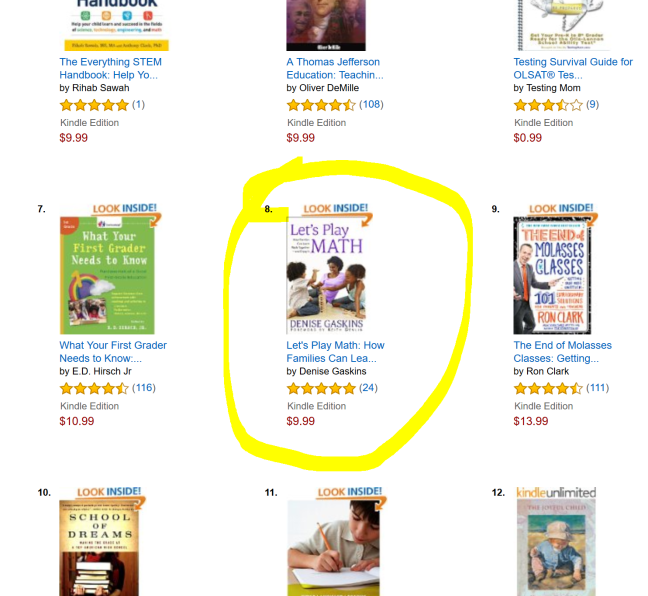
- Let’s Play Math could be the very introduction a young family needs as they contemplate the first few years of homeschooling. First Son’s early years may have been completely different if I had read this book when he was five.
- It could be a fantastic book for a family with a child that’s struggling (in homeschool or otherwise) with math. A few years ago, when First Son first showed signs of a potentially life-long hatred of all things numerical, reading this book may have helped me adapt the curriculum we were then using to meet his needs and enrich him. (We ended up switching and I’m happy with that, but I could have avoided quite a bit of angst.)
- This book would be perfect for a parent who has always struggled with inadequacies in math or for someone like me, who always did just fine in math but never understood the claims of math’s beauty or fascination. I find myself excited to explore some of the resources the author has gathered together for my own growth and new challenges.
—Kansas Mom
Let’s Play Math Back Cover Blurbs
Advance review comments for Let’s Play Math: How Families Can Learn Math Together—and Enjoy It:
Want to help your kids with math? Don’t help with the homework. Get them to engage with math by doing things together — many of which don’t even look like math. Let’s Play Math is charming, intelligent, and practical; full of family fun and sound advice.
—Ian Stewart, author of Professor Stewart’s Casebook of Mathematical Mysteries
This book is well researched, well annotated, and includes loads of activities you can try with kids K-12 at home.
—Jennifer Bardsley, credentialed teacher and author of TeachingMyBabytoRead.com
This is the math helper I wish I’d had years ago.
—Anne White, author of Minds More Awake
A crash course in how to enjoy math with your children! Denise Gaskins uses her years of experience to show parents how to teach math with games, stories, puzzles, manipulatives, and living books. Full of useful advice and pedagogical insight, this book is a treasure trove for parents who want to help their children appreciate the beauty, history, and fun of math but don’t know where to start.
—Kate Snow, KatesHomeschoolMath.com and author of Preschool Math at Home
Updated to Add
More details about the book:
How to Update Your Let’s Play Math Ebook
I love how seeing math as a playful game can help even the busiest parents enjoy learning alongside their children.
My math books grew from more than a quarter-century of playing math with children — my own and those of our friends — at my house, at the library, in the park, and in group workshops. The kids and I learned from each other as we shared the adventure of learning mathematics.
Now that the publication dust has settled and the typos and formatting glitches have been sorted out, I’ve updated all the Let’s Play Math ebook files to match my shiny new, greatly expanded paperback edition.
Changes Include
- Totally new section on Understanding Mathematics.
- A new chapter of Frequently Asked Questions for when your student is struggling with math.
- A greatly expanded section on mental math, with plenty of examples and a list of “Mental Math Do’s and Don’ts.”
- All new graphics — 140+ illustrations.
- New quotes from Jo Boaler, Christopher Danielson, Paul Halmos, Andre Toom, Dan Finkel, Charlotte Mason, and many, many more.
- Loads of new links to my favorite books and online resources, from preschool to high school. (Now I need to get my blog book lists and resource pages caught up to match my book!)
- Plus a foreword by Stanford mathematician and popular author Keith Devlin.
Do You Need an Update?
If your version shows the family playing together on the cover, then you’re all set. The copyright notice should say “Ebook version 3.0.”
But if you have an earlier edition of Let’s Play Math, you will probably want to update to this new, revised edition. Be warned: this is a totally new file, so you’ll lose all your highlights and bookmarks. But the expanded version has SO many wonderful changes, believe me, it’s well worth the inconvenience.
The following instructions are for Amazon.com. If you bought your book somewhere else, check the book dealer’s webpage — if the new cover (above) is showing, then they have the updated file. Find the Customer Service section of their website and follow their procedure.
Amazon Policy Change
I’ve asked Amazon to release the new ebook files to everyone who bought the earlier edition — as used to be their standard policy. But they’ve had too many complaints about people losing their bookmarks, so they no longer issue updates except by customer request.
The only way to get the updated file is to contact Customer Service and ask for it yourself.
Step by step instructions:
- Click the contact Customer Service link. Log into your account.
- Under “What can we help you with?” click the option “Digital Services.”
- Under “Tell us more about your issue,” click “Kindle eBooks” and then “Something else.”
- Under “Enter short summary of issue,” copy and paste the following text:
I bought the ebook Let's Play Math (ASIN B0095POAX4). This book has recently been updated with new material. Would you please send the updated ebook files to my account? Thank you. - Choose how you want to be contacted. I always pick “Email,” but you can pick a more immediate option if you like.
And then wait for the support people to do their magic. You should get the new file within 24 hours.
What About the Paperbacks?
What if you got a bad copy of a paperback book?
The machines that print POD (Print On Demand) books — like my math book or my daughter’s fantasy novels — are basically giant computer printers. As everyone knows, printers get glitches. And the humans who take a book off the machine and put it in a shipping box won’t necessarily notice the mistake.
If you ever get a messed-up copy of my math paperbacks (or any book by anyone, for that matter), you can always contact customer service to have it replaced.
Just follow the same steps as above, but choose the options that make sense for whatever complaint you have. Or if you didn’t buy from Amazon, then find the Customer Service section for whatever book dealer you used, and follow their procedure.
Let’s Play Math Paperback Edition Now Available
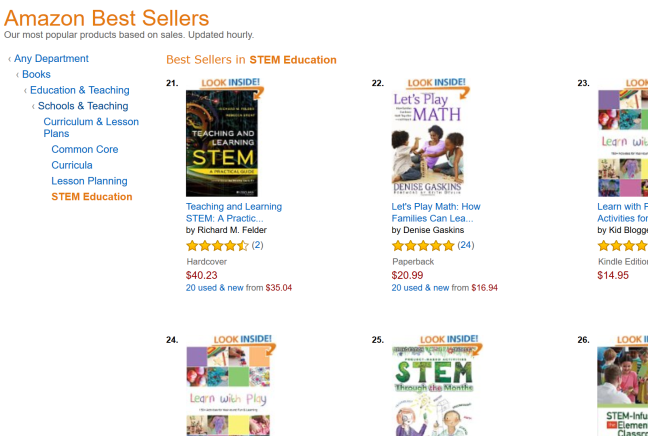
Finally, the revised and much-expanded paperback edition of Let’s Play Math: How Families Can Learn Math Together—and Enjoy It is finished and loaded up on Amazon worldwide. Other bookstores will follow as soon as they update their files.
My book shows you new ways to explore math as a family adventure:
- Introduce your kids to the “Aha!” factor, the thrill of solving a challenging puzzle.
- Help them build thinking skills with toys, games, and library books.
- Find out how to choose math manipulatives, or make your own.
- And learn how to tackle story problems with confidence.
True mathematical thinking involves the same creative reasoning that children use to solve puzzles. Let’s Play Math turns math into a learning adventure for the whole family. Your children will build a stronger foundation of understanding when you teach math as a game, playing with ideas.

- Read an excerpt: the introduction and first two chapters of Let’s Play Math
This blog originally grew out of my long-out-of-print books for homeschoolers, and now it has come full circle. The new edition of my book ripened on the vine, expanding to include families of every schooling style, with useful tips and resources for classroom teachers, too.
Wouldn’t you like to share in the harvest?
Detailed Review (and a Giveaway)
If you’d like to know more about Let’s Play Math — and have a chance to win a free copy — check out Kate Snow’s review post:
Updated to Add
More details about the book:
Understanding Math: Conclusion
Click to read the earlier posts in this series: Understanding Math, Part 1: A Cultural Problem; Understanding Math, Part 2: What Is Your Worldview?; Understanding Math, Part 3: Is There Really a Difference?; Understanding Math, Part 4: Area of a Rectangle; Understanding Math, Part 5: Multiplying Fractions; and Understanding Math, Part 6: Algebraic Multiplication.

Earlier in this blog post series, I gave you three middle-school math rules. But by exploring the concept of rectangular area as a model of multiplication, we discovered that in a way they were all the same.
The rules are not arbitrary, handed down from a mathematical Mount Olympus. They are three expressions of a single basic question: what does it mean to measure area?
There was only one rule, one foundational pattern that tied all these topics together in a mathematical web.
What Is Your Worldview?
Many children want to learn math instrumentally, as a tool for getting answers. They prefer the simplicity of memorizing rules to the more difficult task of making sense of new ideas. Being young, they are by nature short-term thinkers. They beg, “Just tell me what to do.”
But if we want our children to truly understand mathematics, we need to resist such shortcuts. We must take time to explore mathematics as a world of ideas that connect and relate to each other in many ways. And we need to show children how to reason about these interconnected concepts, so they can use them to think their way through an ever-expanding variety of problems.
Our kids can only see the short term. If we adults hope to help them learn math, our primary challenge is to guard against viewing the mastery of facts and procedures as an end in itself. We must never fall into thinking that the point of studying something is just to get the right answers.
We understand this in other school subjects. Nobody imagines that the point of reading is to answer comprehension questions.
We know that there is more to learning history than winning a game of Trivial Pursuit. But when it comes to math, too many parents (and far too many politicians) act as though the goal of our children’s education is to produce high scores on a standardized test.
What If I Don’t Understand Math?
If you grew up (as I did) thinking of math as a tool, the instrumental approach may feel natural to you. The idea of math as a cohesive system may feel intimidating. How can we parents help our children learn math, if we never understood it this way ourselves?
Don’t panic. Changing our worldview is never easy, yet even parents who suffer from math anxiety can learn to enjoy math with their children. All it takes is a bit of self-discipline and the willingness to try.
You don’t have to know all the answers. In fact, many people have found the same thing that Christopher Danielson described in his blog post “Let the children play” — the more we adults tell about a topic, the less our children learn. With the best of intentions we provide information, but we unwittingly kill their curiosity.
- If you’re afraid of math, be careful to never let a discouraging word pass your lips. Try calling upon your acting skills to pretend that math is the most exciting topic in the world.
- Encourage your children to notice the math all around them.
- Search out opportunities to discuss numbers, shapes, symmetry, and patterns with your kids.
- Investigate, experiment, estimate, explore, measure — and talk about it all.
The Science of Patterns
Patterns are so important that American mathematician Lynn Arthur Steen defined mathematics as the science of patterns.
As biology is the science of life and physics the science of energy and matter, so mathematics is the science of patterns. We live in an environment steeped in patterns — patterns of numbers and space, of science and art, of computation and imagination. Patterns permeate the learning of mathematics, beginning when children learn the rhythm of counting and continuing through times tables all the way to fractals and binomial coefficients.
— Lynn Arthur Steen, 1998
Reflections on Mathematical Patterns, Relationships, and Functions
If you are intimidated by numbers, you can look for patterns of shape and color. Pay attention to how they grow, and talk about what your children notice. For example, some patterns repeat exactly, while other patterns change as they go (small, smaller, smallest, or loud, louder, loudest).
Nature often forms fractal-like patterns: the puffy round-upon-roundness of cumulus clouds or broccoli, or the branch-upon-branchiness of a shrub or river delta. Children can learn to recognize these, not as a homework exercise but because they are interesting.
Math the Mathematician’s Way
Here is the secret solution to the crisis of math education: we adults need to learn how to think like mathematicians.
For more on what it means to think about math the mathematician’s way, check out my Homeschooling with Math Anxiety blog post series:
- Mathematicians avoid busywork as if it were an infectious disease.
- Mathematicians always ask questions.
- And most of all, mathematicians love to play.
As we cultivate these characteristics, we will help our children to recognize and learn true mathematics.

CREDITS: “Frabjous 01” photo (top, text added) by Windell Oskay and “Back to School” photo (middle) by Phil Roeder via Flicker (CC BY 2.0). “I Can Solve Problems” poster by Nicole Ricca via Teachers Pay Teachers.
This is the final post in my Understanding Math series, adapted from my book Let’s Play Math: How Families Can Learn Math Together—and Enjoy It, available at your favorite online book dealer.
Understanding Math: Algebraic Multiplication
Click to read the earlier posts in this series: Understanding Math, Part 1: A Cultural Problem; Understanding Math, Part 2: What Is Your Worldview?; Understanding Math, Part 3: Is There Really a Difference?; Understanding Math, Part 4: Area of a Rectangle; and Understanding Math, Part 5: Multiplying Fractions.
We’ve examined how our vision of mathematical success shapes our children’s learning. Do we think math is primarily a tool for solving problems? Or do we see math as a web of interrelated concepts?
Instrumental understanding views math as a tool. Relational understanding views math as an interconnected system of ideas. Our worldview influences the way we present math topics to our kids. And our children’s worldview determines what they remember.
In the past two posts, we looked at different ways to understand and teach rectangular area and fraction multiplication. But how about algebra? Many children (and adults) believe “math with letters” is a jumble of abstract nonsense, with too many formulas and rules that have to be memorized if you want to pass a test.
Which of the following sounds the most like your experience of school math? And which type of math are your children learning?
Instrumental Understanding: FOIL
Every mathematical procedure we learn is an instrument or tool for solving a certain kind of problem. To understand math means to know which tool we are supposed to use for each type of problem and how to use that tool — how to categorize the problem, remember the formula, plug in the numbers, and do the calculation.
When you need to multiply algebra expressions, remember to FOIL: multiply the First terms in each parenthesis, and then the Outer, Inner, and Last pairs, and finally add all those answers together.

Relational Understanding: The Area Model
Each mathematical concept is part of a web of interrelated ideas. To understand mathematics means to see at least some of this web and to use the connections we see to make sense of new ideas.
The concept of rectangular area has helped us understand fractions. Let’s extend it even farther. In the connected system of mathematics, almost any type of multiplication can be imagined as a rectangular area. We don’t even have to know the size of our rectangle. It could be anything, such as subdividing a plot of land or designing a section of crisscrossed colors on plaid fabric.
We can imagine a rectangle with each side made up of two unknown lengths. One side has some length a attached to another length b. The other side is x units long, with an extra amount y stuck to its end.
We don’t know which side is the “length” and which is the “width” because we don’t know which numbers the letters represent. But multiplication works in any order, so it doesn’t matter which side is longer. Using the rectangle model of multiplication, we can see that this whole shape represents the area .

But since the sides are measured in pieces, we can also imagine cutting up the big rectangle. The large, original rectangle covers the same amount of area as the four smaller rectangular pieces added together, and thus we can show that .

With the FOIL formula mentioned earlier, our students may get a correct answer quickly, but it’s a dead end. FOIL doesn’t connect to any other math concepts, not even other forms of algebraic multiplication. But the rectangular area model will help our kids multiply more complicated algebraic expressions such as .

Not only that, but the rectangle model gives students a tool for making sense of later topics such as polynomial division. And it is fundamental to understanding integral calculus.

To be continued. Next up, Understanding Math Part 7: The Conclusion…
CREDITS: “Math Workshop Portland” photo (top) by US Department of Education via Flicker (CC BY 2.0, text added).
This is the sixth post in my Understanding Math series, adapted from my book Let’s Play Math: How Families Can Learn Math Together—and Enjoy It, available at your favorite online book dealer.