Blog

Puzzle: Crystal Ball Connection Patterns

K4 matchings

In the land of Fantasia, where people communicate by crystal ball, Wizard Mathys has been placed in charge of keeping the crystal connections clean and clear. He decides to figure out how many different ways people might talk to each other, assuming there’s no such thing as a crystal conference call.

Mathys sketches a diagram of four Fantasian friends and their crystal balls. At the top, you can see all the possible connections, but no one is talking to anyone else because it’s naptime. Fantasians take their siesta very seriously. That’s one possible state of the 4-crystal system.

On the second line of the diagram, Joe (in the middle) wakes up from siesta and calls each of his friends in turn. Then the friends take turns calling each other, bringing the total number of possible connection-states up to seven.

Finally, Wizard Mathys imagines what would happen if one friend calls Joe at the same time as the other two are talking to each other. That’s the last line of the diagram: three more possible states. Therefore, the total number of conceivable communication configurations for a 4-crystal system is 10.

For some reason Mathys can’t figure out, mathematicians call the numbers that describe the connection pattern states in his crystal ball communication system Telephone numbers.

TheWizardBySeanMcGrath-small

  • Can you help Wizard Mathys figure out the Telephone numbers for different numbers of people?
    T(0) = ?
    T(1) = ?
    T(2) = ?
    T(3) = ?
    T(4) = 10 connection patterns (as above)
    T(5) = ?
    T(6) = ?
    and so on.

Hint: Don’t forget to count the state of the system when no one is on the phone crystal ball.


Feature photo at top of post by Christian Schnettelker (web designer) and wizard photo by Sean McGrath via Flickr (CC BY 2.0). This puzzle was originally featured in the Math Teachers At Play (MTaP) math education blog carnival: MTaP #76.


New Fantasy Novel by Homeschooled Teen Author

Hunted600After months of editing, formatting, proofreading, sweat, and tears:

Teresa Gaskins’s new ebook Hunted: The Riddled Stone ~ Book Two is available now at Amazon worldwide.

You can download the first five chapters here:

To celebrate the release of Hunted, the ebook version of Banished‌—‌the first book in the Riddled Stone series‌—‌will be on sale for 99 cents for the next few weeks.

Math Game: Fan Tan (Sevens)

Math Concepts: sorting by attribute (card suits), counting up, counting down, standard rank of playing cards (aces low).
Players: two or more, best with four to six.
Equipment: one complete deck of cards (including face cards), or a double deck for more than six players. Provide a card holder for young children.

How to Play

Deal out all the cards, even if some players get more than others. The player to the dealer’s left begins by playing a seven of any suit. If that player does not have a seven, then the play passes left to the first player who does.

After that, on your turn you may lay down another seven or play on the cards that are already down. If you cannot play, say, “Pass.”

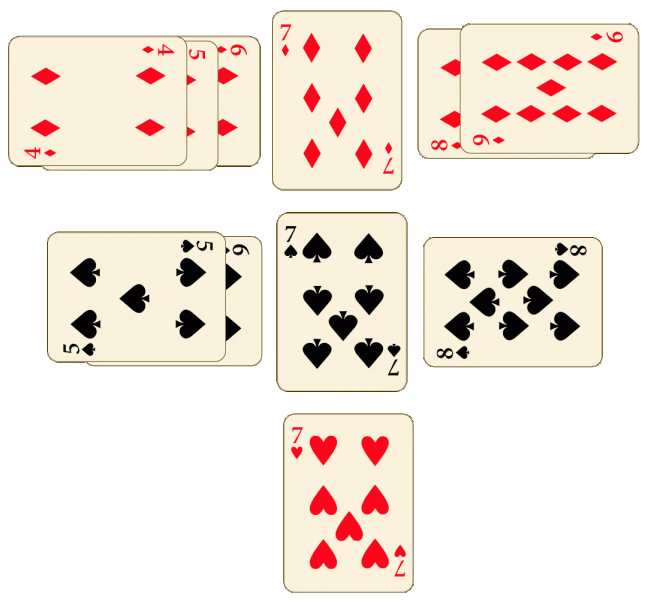
Once a seven is played in any suit, the six and the eight of that suit may be played on either side of it, forming the fan. Then the five through ace can go on the six in counting-down order, and the nine through king can go on the eight, counting up. You can arrange these cards to overlap each other so the cards below are visible, or you can square up the stacks so only the top card is seen.

A Fan Tan game in progress.

Continue reading Math Game: Fan Tan (Sevens)

Playful Math Snacks for May 2015

The May “Let’s Play Math” newsletter went out Monday morning to everyone who signed up for Tabletop Academy Press math updates.

This month’s issue focuses on math games, from Rosie’s Princess in the Dungeon to Jim Pai’s Trig & Logarithm War. What fun!

Sign Up Today

If you missed this month’s edition, no worries — there will be more playful math snacks coming soon. Click the link below to sign up today!

And remember: Newsletter subscribers are always the first to hear about new books, revisions, and sales or other promotions.

Math Games with Factors, Multiples, and Prime Numbers

Students can explore prime and non-prime numbers with these free favorite classroom games:

For $15-20 you can buy a downloadable file of the beautiful, colorful, mathematical board game Prime Climb. Or pick up the full Prime Climb game box at Amazon.

Or you can try the following game by retired Canadian education professor Jerry Ameis:

Factor Finding Game

FactorFindingGame

Math Concepts: multiples, factors, composite numbers, and primes.
Players: only two.
Equipment: pair of 6-sided dice, 10 squares each of two different colors construction paper, and the game board (click the image to print it, or copy by hand).

On your turn, roll the dice and make a 2-digit number. Use one of your colored squares to mark a position on the game board. You can only mark one square per turn.

  • If your 2-digit number is prime, cover a PRIME square.
  • If any of the numbers showing are factors of your 2-digit number, cover one of them.
  • BUT if there’s no square available that matches your number, you lose your turn.

The first player to get three squares in a row (horizontal, vertical, or diagonal) wins. Or for a harder challenge, try for four in a row.

 
* * *

This game was featured in the Math Teachers At Play (MTaP) math education blog carnival: MTaP #79. Hat tip: Jimmie Lanley.

This blog is reader-supported.

If you’d like to help fund the blog on an on-going basis, then please join me on Patreon for mathy inspiration, tips, and an ever-growing archive of printable activities.

If you liked this post, and want to show your one-time appreciation, the place to do that is PayPal: paypal.me/DeniseGaskinsMath. If you go that route, please include your email address in the notes section, so I can say thank you.

Which I am going to say right now. Thank you!

“Math Games with Factors, Multiples, and Prime Numbers” copyright © 2015 by Denise Gaskins. Image at the top of the post copyright © Jimmie via flickr (CC BY 2.0).

Math Teachers at Play #85

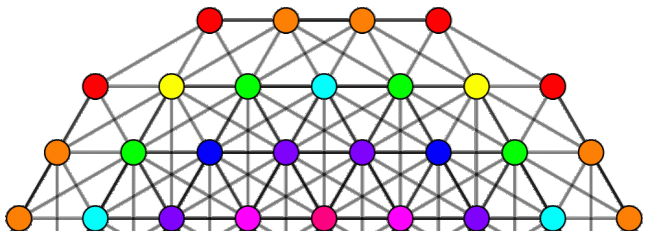
[Feature photo by Tomruen via Wikimedia Commons.]

Do you enjoy math? I hope so! If not, browsing the articles linked in this post just may change your mind.

Welcome to the 85th edition of the Math Teachers At Play math education blog carnival‌—‌a smorgasbord of links to bloggers all around the internet who have great ideas for learning, teaching, and playing around with math from preschool to pre-college.

By tradition, we start the carnival with a short puzzle or activity. But if you would like to jump straight to our featured blog posts, click here to see the Table of Contents.

Let the mathematical fun begin!

Continue reading Math Teachers at Play #85

They’re Here! Math You Can Play Weekend Sale

Featured photo above by Richard Riley via Flickr (CC BY 2.0).

Finally, the first two books of my math games series are finished and loaded up on Amazon.com (and the other Amazons worldwide). To celebrate, I’m offering an introductory sale price this weekend: US$2.99 per book, now through Monday.[Sorry, expired.]

Math Your Kids WANT To Do

Are you tired of flashcards and repetitive worksheets? Now your children can practice their math skills by playing games.

Math games pump up mental muscle, reduce the fear of failure, and develop a positive attitude toward mathematics. Through playful interaction, games strengthen a child’s intuitive understanding of numbers and build problem-solving strategies. Mastering a math game can be hard work, but kids do it willingly because it is fun.

Continue reading They’re Here! Math You Can Play Weekend Sale

Math Game: Thirty-One

Math Concepts: addition to thirty-one, thinking ahead.
Players: best for two.
Equipment: one deck of math cards.

How to Play

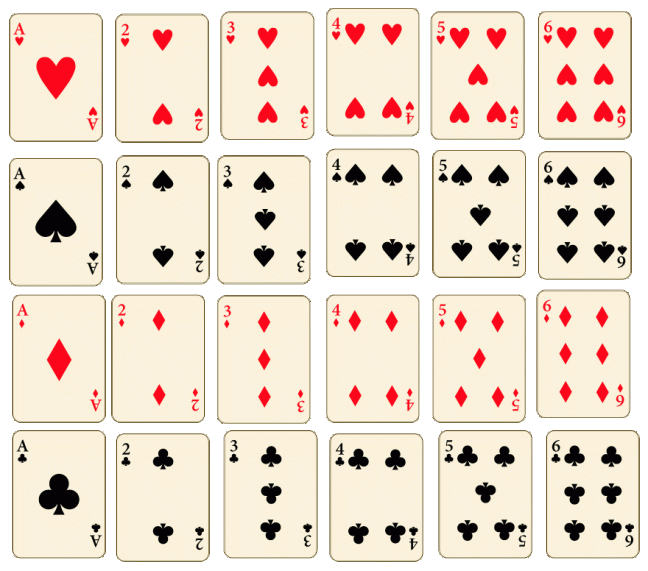
Lay out the ace to six of each suit in a row, face-up and not overlapping, one suit above another. You will have one column of four aces, a column of four twos, and so on‌—‌six columns in all.

The first player flips a card upside down and says its number value. Then the second player turns down a card, adds it to the first player’s number, and says the sum.

Players alternate, each time turning down one card, mentally adding its value to the running total, and saying the new sum out loud. The player who exactly reaches thirty-one, or who forces the next player to go over that sum, wins the game.

31-Game

Continue reading Math Game: Thirty-One

Math Game: Chopsticks

Math Concepts: counting up to five, thinking ahead.
Players: two or more.
Equipment: none.

How to Play

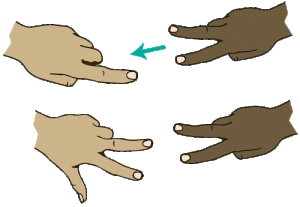
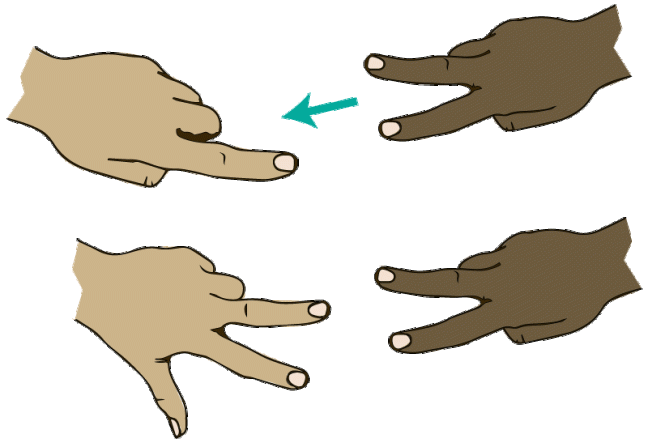
Each player starts with both hands as fists, palm down, pointer fingers extended to show one point for each hand. On your turn, use one of your fingers to tap one hand:

  • If you tap an opponent’s hand, that person must extend as many extra fingers on that hand (in addition to the points already there) as you have showing on the hand that tapped. Your own fingers don’t change.
  • If you force your opponent to extend all the fingers and thumb on one hand, that makes a “dead hand” that must be put behind the player’s back, out of the game.
  • If you tap your own hand, you can “split” fingers from one hand to the other. For instance, if you have three points on one hand and only one on the other, you may tap hands to rearrange them, putting out two fingers on each hand. Splits do not have to end up even, but each hand must end up with at least one point (and less than five, of course).
  • You may even revive a dead hand if you have enough fingers on your other hand to split. A dead hand has lost all its points, so it starts at zero. When you tap it, you can share out the points from your other hand as you wish.

The last player with a live hand wins the game.

When a two-points hand taps a one-point hand, that player must put out two more fingers.

Continue reading Math Game: Chopsticks

Playful Math Snacks for April 2015

AprilMathCalendarFeature photo above by Nicolas Raymond (CC BY 3.0).

The April “Let’s Play Math” newsletter went out Monday morning to everyone who signed up for Tabletop Academy Press math updates.

This month’s issue focused on Math Treks — math scavenger hunts in your neighborhood or at a mall or local park. What fun!

Sign Up Today

If you missed this month’s edition, no worries — there will be more playful math snacks coming soon. Click the link below to sign up today!

And remember: Newsletter subscribers are always the first to hear about new books, revisions, and sales or other promotions.