Sunday, October 21, is the worldwide hexaflexagon party in honor of Martin Gardner’s birthday. Gardner’s article about hexaflexagons launched his career as a recreational math guru who inspired people all around the world to love math.
Since the last recession, our homeschool co-op has been too small to support a blogging class, and I have seriously neglected my Blogging 2 Learn blog. So last week, I decided to refresh everything by starting up a new Blogging 101 Series. If your student has been longing to start a blog, you may want to check it out.
Nrich recently updated their amazing website. I love exploring their backlog of puzzles and games — what a mother lode of resources for math club or a homeschool co-op class!
If you are looking for some mathematical inspiration, check out this month’s Math Teachers at Play blog carnival. It’s full of activity and game ideas, puzzles and problems, and interesting mathematics for students in elementary, middle, or high school. Enjoy!
Welcome to the 55th edition of the Mathematics Teachers at Play Blog Carnival. The number 55 is the 10th Fibonacci number and the sum of the first 10 counting numbers.
Below are the entries to the 55th edition of the Math Teachers at Play Blog Carnival…
I’ve been enjoying the Introduction to Mathematical Thinking course by Keith Devlin. For the first few weeks, we mostly talked about language, especially the language of logical thinking. This week, we started working on proofs.
For a bit of fun, the professor emailed a link to this video. My daughter Kitten enjoyed it, and I hope you do, too.
Multiplication is taught and explained using three models. Again, it is important for understanding that students see all three models early and often, and learn to use them when solving word problems.
I hope you are playing the Tell Me a (Math) Story game often, making up word problems for your children and encouraging them to make up some for you. As you play, don’t fall into a rut: Keep the multiplication models from our lesson in mind and use them all. For even greater variety, use the Multiplication Models at NaturalMath.com to create your word problems.
While I was working on the next post in my PUFM Series, I stumbled on an old favorite video. Since I couldn’t think of an excuse to use it in a post about multiplication, I decided to share it today. Enjoy!
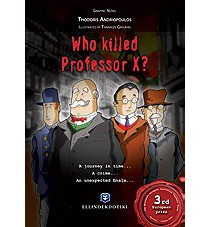
Who Killed Professor X? is a work of fiction based on actual incidents, and its heroes are real people who left their mark on the history of mathematics. The murder takes place in Paris in 1900, and the suspects are the greatest mathematicians of all time. Each suspect’s statement to the police leads to a mathematical problem, the solution of which requires some knowledge of secondary-school mathematics. But you don’t have to solve the puzzles in order to enjoy the book.
Fourteen pages of endnote biographies explain which parts of the mystery are true, which details are fictional, and which are both (true incidents slightly modified for the sake of the story).
My daughter Kitten, voracious as always, devoured it in one sitting — and even though she hasn’t studied high school geometry yet, she was able to work a couple of the problems.
Imagine that you wanted your children to learn the names of all their cousins, aunts and uncles. But you never actually let them meet or play with them. You just showed them pictures of them, and told them to memorize their names.
Each day you’d have them recite the names, over and over again. You’d say, “OK, this is a picture of your great-aunt Beatrice. Her husband was your great-uncle Earnie. They had three children, your uncles Harpo, Zeppo, and Gummo. Harpo married your aunt Leonie … yadda, yadda, yadda.



 Denise Gaskins' Let's Play Math