It’s been nearly two weeks since the blog carnival website sent me any articles for the MTaP carnival. If you tried to submit a entry for the carnival this week or last, I probably didn’t get it. Feel free to email me directly!
In the meantime, I’ve combed Google Reader and collected a nice assortment of posts for this week’s Math Teachers at Play — but there is still room for more.
Sometimes the most common indication that someone is drowning is that they don’t look like they’re drowning. They may just look like they are treading water and looking up at the deck. One way to be sure? Ask them, “Are you alright?” If they can answer at all – they probably are. If they return a blank stare, you may have less than 30 seconds to get to them. And parents — children playing in the water make noise. When they get quiet, you get to them and find out why.
If something like that seems unlikely to you, then you’d be right. Bucket drownings don’t happen often. But when they do, the parents involved never care how rare the event is for everyone else. Something very similar to the events described above happened just last month in Indiana. There was another bucket drowning reported in Illinois the month before that.
Chain several. Leave straight to work in rows, or connect into a loop. Single crochet until your patience runs out, increasing every nth stitch (add an extra sc in the same place). Experiment with different colors and patterns. This pdf will give you more ideas.
The more frequently you increase, the frillier your hyperbolic plane will be, while a less-frequent increase makes it easier for students to see the structure. Daina Taimina recommends a 12:13 ratio (increase after every 12th stitch) for classroom use.
It happens this way every summer: I think that when school’s out, I’ll have time to catch up on things. But school is never out, because we’re homeschoolers — and something else always comes up to make us even more busy than normal. This year, an emergency forced dh to move his engineering office from town to home. It’s great to have him close at hand, but spring cleaning has turned into a total house reorganization to make room.
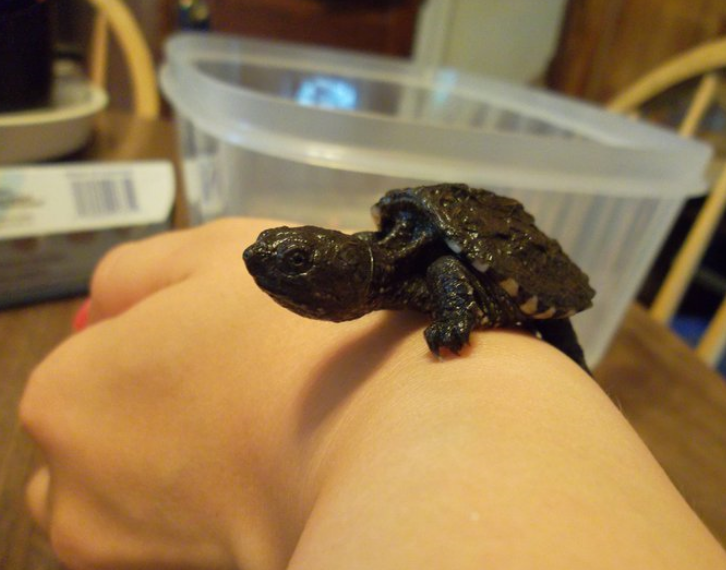
Niner's baby snapping turtle sitting on her wristAnd then Niner and Kitten adopted a couple of new pets. Here’s a picture of Niner’s new snapping turtle. The old one is getting so big he eats feeder fish by the dozen, but she plans to release him back into the creek as soon as the spring floods go down. Kitten rescued two baby birds (normally the dogs take care of wind-blown fledglings), so we have to find room for yet another cage in our menagerie.
In the meantime, this month’s Math Teachers at Play carnival is coming home to my blog, so I’d better get to work on that. If you would like to share a blog post about learning, teaching, or just playing around with math, I’d love to have you send it in. Just click here and fill out the handy automatic submission form.
Update, July 2011: Niner wrote a blog post on the turtles, with photos. Kitten had one of her babies die (sad!) but the other grew up enough to be released into the woods across the creek.
This blog originally grew out of my books, and now it’s coming full circle: New, expanded editions of my long-out-of-print books are ripening on the vine, growing out of the blog. To bring them to harvest, I’m going to need your help.
The Books
I’m working on the games books first because I think they will be the most helpful supplements to any math program.
Let’s Play Math! Number Games for All Ages
This book will include games like Tens Concentration and Hit Me, as well as tips for teaching negative numbers, the times table, and more. Never before published, because it was planned as the fifth book in my earlier how-to-teach-homeschool-math series, but my self-publishing experiment ended after book four.
Gotcha! Strategy Games for Math and Logic
This will include games like Math Club Nim and Avoid Three, as well as a lesson about logic and some Lewis Carroll puzzles. An earlier edition is currently available on Amazon for such an exorbitant price that I can’t recommend it to anyone.
Others to be announced, if I ever get the first two done…
Welcome to the 37th edition of the Math Teachers at Play blog carnival. I’m delighted to host the carnival here this month at Maths Insider!
For those new to the Math Teachers at Play carnival, this carnival celebrates some of the best maths teaching articles written by teachers, parents and bloggers each month. …
In keeping with tradition, I’ve presented a “37″ puzzle and some interesting arithmetic facts about the number 37 below. …
As I was checking through archive posts and clearing out the dead links, I found a couple of links that I thought would be dead but which are still good. So I am re-posting them here, for your browsing pleasure:
Free Shakespeare for Fun and Copywork
CurrClick (which carries the Math Mammoth workbook series) is offering Quotations from Shakespeare’s Plays as a free download. This ebook includes copywork tips from Charlotte Mason and about 30 pages of passages from Macbeth, King Lear, Much Ado About Nothing, etc.
What does it take to lead your nation through a crisis? Character, determination, wisdom, the courage of your convictions. What can we learn about leadership from those who have been there, done that?
Abraham Lincoln and Winston Churchill are two of these great leaders — men whose courage and conviction took their nations through challenging moments and forever altered the course of Western civilization…
With news reports of radiation from Japan being found from California to Massachusetts — and now even in milk — math teachers need to help our students put it all in perspective.
[T]he levels being seen now are 25 times below the level that would be of concern even for infants, pregnant women or breastfeeding women, who are the most sensitive to radiation… At this time, there is no need to take extra precautions… Iodine-131 disappears relatively quickly in the environment.
In the course of my bloggy spring cleaning, I’ve made some terrible discoveries. Some of my favorite resources have disappeared off the internet. Or perhaps they’ve moved, and I just haven’t found their new homes.
Do you know where these websites went?
A Very Short History of Mathematics
This irreverant romp through the history of mathematics by W. W. O. Schlesinger and A. R. Curtis was read to the Adams Society (St. John’s College Mathematical Society) at their 25th anniversary dinner, Michaelmas Term, 1948.
 It’s been nearly two weeks since the blog carnival website sent me any articles for the MTaP carnival. If you tried to submit a entry for the carnival this week or last, I probably didn’t get it. Feel free to email me directly!





 Denise Gaskins' Let's Play Math