For toddler Renée’s Christmas gift, Alex and Leon crafted a puzzle set of wooden blocks.
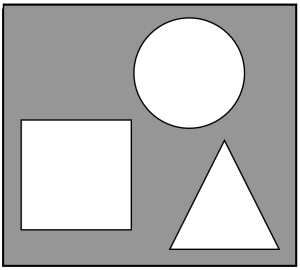
First, they made a sturdy box with circle, square, and triangle shapes cut in the lid.
To make the blocks large and baby-safe, Alex and Leon bought a 4-foot 2×2 board. Then they asked Uncle Will to help them create a set of special blocks to fit through the holes.
Each block was round and square and triangular, so it could fit exactly through any of the three holes.
Here’s how Alex created tetra-tetraflexagon Christmas cards to send to her friends:
1. Buy a pack of heavy paper at the office supply store. Regular construction paper tears too easily.
2. Measure and divide the paper into fourths one direction and thirds the other way. Fold each line backward and forward a few times.
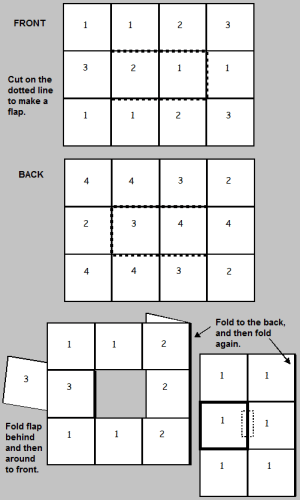
3. Number the front and back of the paper in pencil, lightly, as shown. Then carefully cut a center flap along the dotted lines.
4. Fold the paper along the dark lines as shown, so the center flap sticks out from underneath and the right-hand column shows all 2’s.
5. Fold the flap the rest of the way around to the front and fold the right-hand column under again. (Shown as dark lines on the diagram.) This makes the front of the flexagon show 1’s in every square.
6. Carefully, tape the flap to its neighbor on the folded column. Don’t let the tape stick to any but these two squares.
7. Gently erase your pencil marks.
Find All the Faces
A tetra-tetraflexagon has four faces: front, back, and two hidden. It is shaped like a tetragon — better known as a rectangle.
Here’s how to flex your tetra-tetraflexagon card:
Face 1 is easy to find. It’s on top when you make the card.
Turn the card over to find Face 2.
Face 3 is hidden behind Face 2. Fold your flexagon card in half (vertically) so that Face 1 disappears. Unfold Face 2 at the middle, like opening a book. Face 3 should appear like magic.
Face 4 is hidden behind Face 3. Fold the card (vertically) to hide Face 2, then open the middle of Face 3. Face 2 vanishes, and Face 4 is finally revealed.
When Faces 2 and 3 are folded to the back, you will notice that any pictures you drew on them will look scrambled. What happened?
Add Your Designs
Alex wrote a holiday greeting on Face 1. Then she drew Christmas pictures on the other three faces of her card.
Alexandria Jones and her family are fictional characters from my old Mathematical Adventures newsletter. Their stories appear sporadically as I find time to transcribe them from the back-issues. You can find them all on this blog page.
Here are all the Alexandria Jones stories Christmas stories, with activity and craft ideas…
Alexandria Jones and the Christmas Present Quandary
Alex designs tessellation wrapping paper, hunts for the perfect Christmas tree, and comes up with a lively present for her brother. We meet the rest of Alex’s family — her father was introduced in an earlier issue — along with historical figures Maria Agnesi and Leonhard Euler, and we take a brief glance at mathematics from China.
And New This Year: Alexandria Jones and the Magic Christmas Cards
Dr. Jones suggests a way to make the “best Christmas cards ever” (according to Alex), and the Jones children create geometric gifts to celebrate the holiday.
Back when we were still homeschooling, I always dropped the “regularly scheduled program” in December. School plus holiday prep added up to one stressed-out mom.
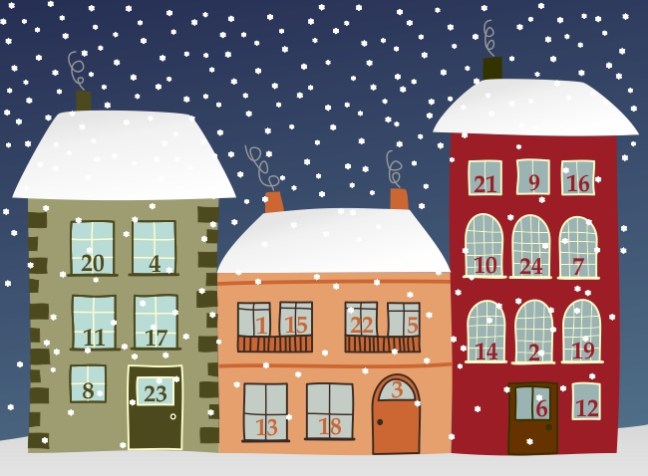
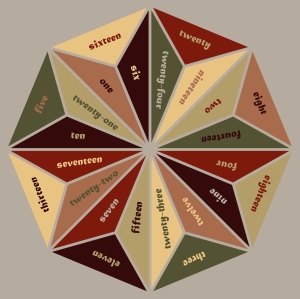
Instead, we read plenty of library books. And we played around with informal activities like the NrichMaths Advent Calendars:
For older students and adults, the online Plus Magazine offers a calendar of daily tidbits from their “Maths in a minute” series, explaining important mathematical concepts in just a few words”
How do you handle schoolwork during this busy season? I’m collecting new links for an updated Holiday Math post next month. I’d love to hear your ideas!
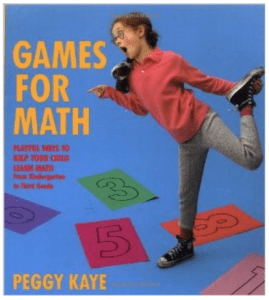
“Games put children in exactly the right frame of mind for learning difficult things.
“Children relax when they play — and they concentrate. They don’t mind repeating certain facts or procedures over and over, if repetition is part of the game.
“Children throw themselves into playing games the way they never throw themselves into filling out workbook pages.
“The games solidify the achievements of children who are already good at math, and they shore up children who need shoring up. They teach or reinforce many of the skills that a formal curriculum teaches, plus one skill that formal teaching sometimes leaves out — the skill of having fun with math, of thinking hard and enjoying it.
“If you play these games and your child learns only that hard mental effort can be fun, you will have taught something invaluable.”
If you’d like to help fund the blog on an on-going basis, then please join me on Patreon for mathy inspiration, tips, and an ever-growing archive of printable activities.
If you liked this post, and want to show your one-time appreciation, the place to do that is PayPal: paypal.me/DeniseGaskinsMath. If you go that route, please include your email address in the notes section, so I can say thank you.
Each week, we’ll be playing with the math, language, and logic topics found in a single chapter. I’ll be posting ideas for extension activities, videos demonstrating the concepts for the week, and additional resources. I’m really excited for the opportunity to share all the extra ideas that have been floating around my brain which I didn’t have room to include in the book (as in Marco Polo’s famous words: “I did not tell half of what I saw.”)
— Lilac Mohr
Here’s a Quick Taste of Week One
This Week’s Activities
Lilac’s blog post includes a full schedule for the eleven-week book club, featuring plenty of classic math puzzlers to play with. Here are the topics for this week.
Read Chapter 1: Mrs. Magpie’s Manual
Alliteration
Memorizing digits of Pi
Palindromes
Calculating your age on other planets
It looks like a lot of fun. I highly recommend the book (read my review), and I’m sure you and your children will enjoy discovering math and magic with Lulu and Elizabeth.
If you’d like to help fund the blog on an on-going basis, then please join me on Patreon for mathy inspiration, tips, and an ever-growing archive of printable activities.
If you liked this post, and want to show your one-time appreciation, the place to do that is PayPal: paypal.me/DeniseGaskinsMath. If you go that route, please include your email address in the notes section, so I can say thank you.
I’m planning ahead for my fall semester homeschool co-op math class. Definitely going to try this with the kids…
Encourage your children to have some fun this week with this Exploding Dots math puzzle from The Global Math Project. What do they notice? Does it make them wonder?
More Explosive Math
You may recognize the connection between Exploding Dots and binary numbers. Or not — the puzzle is accessible to people at almost any age and level of mathematical sophistication.
But what I find amazing is that this puzzle can help us understand all sorts of topics in elementary arithmetic and algebra. So cool!
June 17 marks World Tessellation Day, a holiday I created to bring awareness to the fun of finding and making tessellations.
Will you celebrate with us?
Here are 10 great ways to play with tessellations, learn about them, and introduce your children to a math concept that opens a variety of creative learning opportunities.
1) Learn about tessellations with your kids.
A tessellation is a tiled mosaic pattern of the same shape laid out over and over again, repeating into infinity. Tessellations can be found in nature, or they can be created by people. Learn more at these websites:
I love it when a plan — or rather, a series of math thoughts — comes together.
On Monday, Emily Grosvenor (author of the Tessalation! picture book) asked me how parents who are insecure in math could help their children learn through play, and I responded with this quote from my Let’s Play Math book:
If you are intimidated by numbers, you can look for patterns of shape and color. Pay attention to how they grow. Talk about what your children notice.
But I wasn’t entirely satisfied with that answer. So many adults have come away from their own school experience thinking math is only numbers. Even with shapes, isn’t it the numbers about them — how many sides, what size of angles, calculate the the area or perimeter — that are important? That’s what school math tends to focus on.
Those of us who are comfortable with math know that there are many more things to notice and think about than just numbers. We know that it’s this noticing, thinking, and wondering that is at the heart of math. And that just playing with shapes can build a powerful foundation for future math learning.
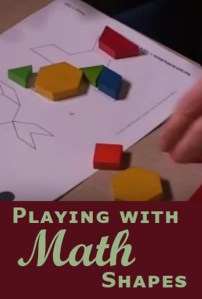
The ability to create, and maintain, and manipulate shapes mentally — that’s the goal. Just like kids who can put numbers together in their heads, kids who can rotate, flip, and think of how shapes fit together in their heads have a powerful tool to analyze not only simple shape puzzles, but dividing up an area that’s a more complex room shape … to look at a piece of artwork … or look at a building … For these kids, all the world around becomes a playground to use mathematical ideas.
Of course, pattern blocks are good for much more than just filling in worksheet pictures. But I love this peek into how a child’s understanding grows, in bits and spurts — without any numbers at all — until the world itself becomes a playground for mathematical ideas.
Want more?
You know what? Children like mathematics. Children see the world mathematically … When we do a puzzle, when we count things, when we see who’s got more, or who’s taller … Play and mathematics are not on opposite sides of the stage.
You could say that Tessalation is a book about tessellations (repeating tiled patterns), but it is really a children’s picture book about discovering order in a chaotic world.
— Emily Grosvenor
Seeing Math in the World
In taking a playful approach to mathematics, I hope to open children’s eyes to math in their world. Schooly math lessons have led many of my math group kids to think a “pattern” has to be a strictly repeating (and rather boring) series of shapes or colors.
But in the real world, patterns are so important that American mathematician Lynn Arthur Steen defined mathematics as the science of patterns.
“As biology is the science of life and physics the science of energy and matter, so mathematics is the science of patterns,” Steen wrote. “We live in an environment steeped in patterns — patterns of numbers and space, of science and art, of computation and imagination. Patterns permeate the learning of mathematics, beginning when children learn the rhythm of counting and continuing through times tables all the way to fractals and binomial coefficients.”
Tessa Truman-Ling’s delight in patterns is contagious. And it will provide a wonderful jumping-off point for a variety of math activities.
Visit Grosvenor’s Kickstarter page to find out more about her lovely book:
 For toddler Renée’s Christmas gift, Alex and Leon crafted a puzzle set of wooden blocks.

 Here’s how Alex created tetra-tetraflexagon Christmas cards to send to her friends:
 Back when we were still homeschooling, I always dropped the “regularly scheduled program” in December. School plus holiday prep added up to one stressed-out mom.


 I love it when a plan — or rather, a series of math thoughts — comes together.

