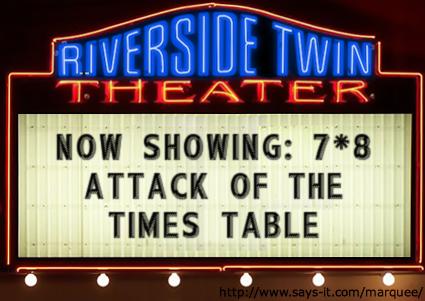
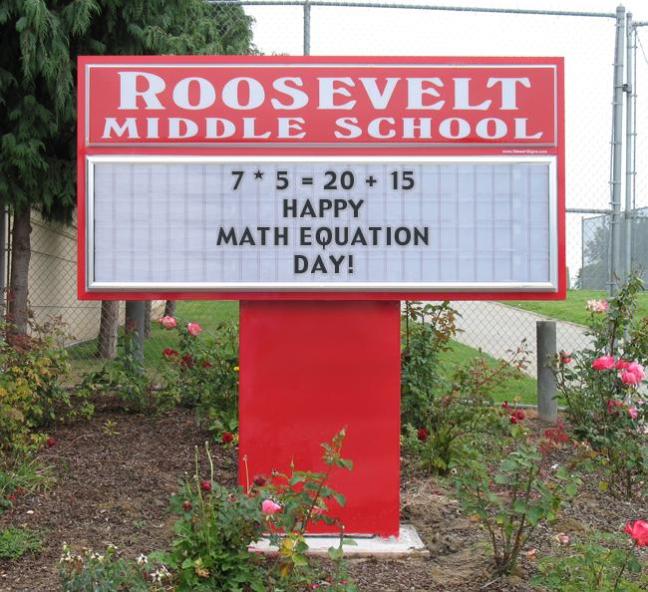
Happy Multiplication Day!
For help learning the Times Table facts, check out my multiplication blog post series:
Encourage your family to play with math every day:

For help learning the Times Table facts, check out my multiplication blog post series:
Encourage your family to play with math every day:

I’m still having fun with David Coffey’s meme, which started a couple of years ago with this blog post:
Would you like to create a math holiday, too? Try one of these sign generators:
What kind of math will you celebrate? Leave a link to your Happy Math Day post in the comments below!
Math Concepts: division as equal sharing, naming fractions, adding fractions, infinitesimals, iteration, limits
Prerequisite: able to identify fractions as part of a whole
This is how I tell the story:
Continue reading Infinite Cake: Don Cohen’s Infinite Series for Kids
Math Concepts: basic facts of addition, multiplication.
Players: one.
Equipment: one deck of math cards (poker- or bridge-style playing cards with the face cards and jokers removed).
The best way to practice the math facts is through the give-and-take of conversation, orally quizzing each other and talking about how you might figure the answers out. But occasionally your child may want a simple, solitaire method for review.
In the land of Fantasia, where people communicate by crystal ball, Wizard Mathys has been placed in charge of keeping the crystal connections clean and clear. He decides to figure out how many different ways people might talk to each other, assuming there’s no such thing as a crystal conference call.
Mathys sketches a diagram of four Fantasian friends and their crystal balls. At the top, you can see all the possible connections, but no one is talking to anyone else because it’s naptime. Fantasians take their siesta very seriously. That’s one possible state of the 4-crystal system.
On the second line of the diagram, Joe (in the middle) wakes up from siesta and calls each of his friends in turn. Then the friends take turns calling each other, bringing the total number of possible connection-states up to seven.
Finally, Wizard Mathys imagines what would happen if one friend calls Joe at the same time as the other two are talking to each other. That’s the last line of the diagram: three more possible states. Therefore, the total number of conceivable communication configurations for a 4-crystal system is 10.
For some reason Mathys can’t figure out, mathematicians call the numbers that describe the connection pattern states in his crystal ball communication system Telephone numbers.
Hint: Don’t forget to count the state of the system when no one is on the phone crystal ball.
Feature photo at top of post by Christian Schnettelker (web designer) and wizard photo by Sean McGrath via Flickr (CC BY 2.0). This puzzle was originally featured in the Math Teachers At Play (MTaP) math education blog carnival: MTaP #76.
Math Concepts: sorting by attribute (card suits), counting up, counting down, standard rank of playing cards (aces low).
Players: two or more, best with four to six.
Equipment: one complete deck of cards (including face cards), or a double deck for more than six players. Provide a card holder for young children.
Deal out all the cards, even if some players get more than others. The player to the dealer’s left begins by playing a seven of any suit. If that player does not have a seven, then the play passes left to the first player who does.
After that, on your turn you may lay down another seven or play on the cards that are already down. If you cannot play, say, “Pass.”
Once a seven is played in any suit, the six and the eight of that suit may be played on either side of it, forming the fan. Then the five through ace can go on the six in counting-down order, and the nine through king can go on the eight, counting up. You can arrange these cards to overlap each other so the cards below are visible, or you can square up the stacks so only the top card is seen.

Students can explore prime and non-prime numbers with these free favorite classroom games:
For $15-20 you can buy a downloadable file of the beautiful, colorful, mathematical board game Prime Climb. Or pick up the full Prime Climb game box at Amazon.
Or you can try the following game by retired Canadian education professor Jerry Ameis:
Math Concepts: multiples, factors, composite numbers, and primes.
Players: only two.
Equipment: pair of 6-sided dice, 10 squares each of two different colors construction paper, and the game board (click the image to print it, or copy by hand).
On your turn, roll the dice and make a 2-digit number. Use one of your colored squares to mark a position on the game board. You can only mark one square per turn.
The first player to get three squares in a row (horizontal, vertical, or diagonal) wins. Or for a harder challenge, try for four in a row.
* * *
This game was featured in the Math Teachers At Play (MTaP) math education blog carnival: MTaP #79. Hat tip: Jimmie Lanley.
This blog is reader-supported.
If you’d like to help fund the blog on an on-going basis, then please join me on Patreon for mathy inspiration, tips, and an ever-growing archive of printable activities.
If you liked this post, and want to show your one-time appreciation, the place to do that is PayPal: paypal.me/DeniseGaskinsMath. If you go that route, please include your email address in the notes section, so I can say thank you.
Which I am going to say right now. Thank you!
“Math Games with Factors, Multiples, and Prime Numbers” copyright © 2015 by Denise Gaskins. Image at the top of the post copyright © Jimmie via flickr (CC BY 2.0).
Math Concepts: addition to thirty-one, thinking ahead.
Players: best for two.
Equipment: one deck of math cards.
Lay out the ace to six of each suit in a row, face-up and not overlapping, one suit above another. You will have one column of four aces, a column of four twos, and so on‌—‌six columns in all.
The first player flips a card upside down and says its number value. Then the second player turns down a card, adds it to the first player’s number, and says the sum.
Players alternate, each time turning down one card, mentally adding its value to the running total, and saying the new sum out loud. The player who exactly reaches thirty-one, or who forces the next player to go over that sum, wins the game.

Math Concepts: counting up to five, thinking ahead.
Players: two or more.
Equipment: none.
Each player starts with both hands as fists, palm down, pointer fingers extended to show one point for each hand. On your turn, use one of your fingers to tap one hand:
The last player with a live hand wins the game.

Six years ago, my homeschool co-op classes had fun creating this April calendar to hand out at our end-of-semester party. Looking at my regular calendar today, I noticed that April this year starts on Wednesday, just like it did back then. I wonder when’s the next time that will happen?
A math calendar is not as easy to read as a traditional calendar — it is more like a puzzle. The expression in each square simplifies to that day’s date, so your family can treat each day like a mini-review quiz: “Do you remember how to calculate this?”
The calendar my students made is appropriate for middle school and beyond, but you can make a math calendar with puzzles for any age or skill level. Better yet, encourage the kids to make puzzles of their own.
At home:
Post the calendar on your refrigerator. Use each math puzzle as a daily review “mini-quiz” for your children (or yourself).
In the classroom:
Post today’s calculation on the board as a warm-up puzzle. Encourage your students to make up “Today is…” puzzles of their own.
As a puzzle:
Cut the calendar squares apart, then challenge your students to arrange them in ascending (or descending) order.
If you like, you may use the following worksheet:
Submission details here: Kids’ Project — More Math Calendars?