Nrich recently updated their amazing website. I love exploring their backlog of puzzles and games — what a mother lode of resources for math club or a homeschool co-op class!

Nrich recently updated their amazing website. I love exploring their backlog of puzzles and games — what a mother lode of resources for math club or a homeschool co-op class!
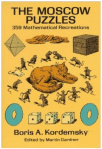
Dover Publications is offering a free sample chapter from The Moscow Puzzles.
Cat and Mice
Purrer has decided to take a nap. He dreams he is encircle by 13 mice: 12 gray and 1 white. He hears his owner saying: “Purrer, you are to eat each thirteenth mouse, keeping the same direction. The last mouse you eat must be the white one.”
And here is yet more fun from Education Unboxed. This type of page was always one of my my favorites in Miquon Math.
Handmade “How Crazy…?” worksheets are wonderful, but if you want something a tad more polished, I created a printable. The first page has a sample number, and the second is blank so that you can fill in any target:
Add an extra degree of freedom: students can fill in the blanks with equivalent and non-equivalent expressions. Draw lines anchoring the ones that are equivalent to the target number, but leave the non-answers floating in space.
Or don’t draw lines. Let the kids create a worksheet for you to solve. After they finish their expressions, can you figure out which ones connect to the target number?

I love logic puzzles! Nrich Maths offers four fun Olympics Logic puzzles. And be sure to check out the rest of their Nrich Olympics Math as well.

Medals Count
Given the following clues, can you work out the number of gold, silver and bronze medals that France, Italy and Japan got in this international sports competition?
- Japan has 1 more gold medal, but 3 fewer silver medals, than Italy.
- France has the most bronze medals (18), but fewest gold medals (7).
- Each country has at least 6 medals of each type.
- Italy has 27 medals in total.
- Italy has 2 more bronze medals than gold medals.
- The three countries have 38 bronze medals in total.
- France has twice as many silver medals as Italy has gold medals.
Yet more fun from Rosie at Education Unboxed. I found these while looking for videos to use in my PUFM Subtraction post. Rosie says:
This is seriously embarrassing and I debated whether to put this video online or not because this is NOT my normal personality, but my girls made up this game and will play it for over an hour and ask for it repeatedly… so I figured someone out there might be able to use it with their kids, too.
If you know me, please don’t ever ask me to do this in public. I will refuse.
Princess in the Dungeon, Part 1 – Fractions with Cuisenaire Rods
Education Unboxed has posted some playful addition games for young learners. And there’s much more on their website. Be sure to click around and explore!
Six is Having a Party! – Math Facts with Cuisenaire Rods

[Feature photo above by Keoni Cabral via Flickr (CC BY 2.0).]
My favorite playful math lessons rely on adult/child conversation — a proven method for increasing a child’s reasoning skills. What better way could there be to do math than snuggled up on a couch with your little one, or side by side at the sink while your middle-school student helps you wash the dishes, or passing the time on a car ride into town?
As soon as your little ones can count past five, start giving them simple, oral story problems to solve: “If you have a cookie and I give you two more cookies, how many cookies will you have then?”
The fastest way to a young child’s mind is through the taste buds. Children can easily visualize their favorite foods, so we use mainly edible stories at first. Then we expand our range, adding stories about other familiar things: toys, pets, trains.

photo by puuikibeach via flickr
Our homeschool co-op held an end-of-semester assembly. Each class was supposed to demonstrate something they had learned. I planned to set up a static display showing some of our projects, like the fractal pop-up card and the game of Nim, but the students voted to do a skit based on the logic puzzles of Raymond Smullyan.
We had a small class (only four students), but you can easily divide up the lines make room for more players. We created signs from half-sheets of poster board with each native’s line on front and whether she was a knight or knave on the flip side. In the course of a skit, there isn’t enough time to really think through the puzzles, so the audience had to vote based on first impressions — which gave us a fair showing of all opinions on each puzzle.
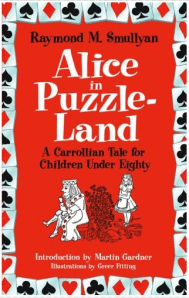
To celebrate their re-release of his classic puzzle books, the Dover Math and Science Newsletter featured an interview with Raymond Smullyan, as well as several extended excerpts from his books. (For my math club students: Professor Smullyan invented the Knights and Knaves puzzles.) Enjoy!

photo by Creativity103 via flickr
For our homeschool, January is the time to assess our progress and make a few New Semester’s Resolutions. This year, we resolve to challenge ourselves to more math puzzles. Would you like to join us? Pump up your mental muscles with the 2012 Mathematics Game!
Use the digits in the year 2012 to write mathematical expressions for the counting numbers 1 through 100.
- You must use all four digits. You may not use any other numbers.
- You may use +, -, x, ÷, sqrt (square root), ^ (raise to a power), ! (factorial), and parentheses, brackets, or other grouping symbols.
- You may use a decimal point to create numbers such as .2, .01, etc.
- You may create multi-digit numbers such as 10 or 202, but we prefer solutions that avoid them.
Bonus Rules
You may use the overhead-bar (vinculum), dots, or brackets to mark a repeating decimal.You may use multifactorials:
- n!! = a double factorial = the product of all integers from 1 to n that have the same parity (odd or even) as n.
- n!!! = a triple factorial = the product of all integers from 1 to n that are equal to n mod 3
[Note to teachers: Math Forum modified their rules to allow double factorials, but as far as I know, they do not allow repeating decimals or triple factorials.]
 Denise Gaskins' Let's Play Math