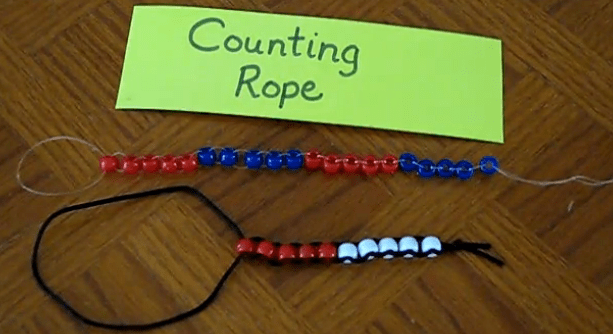
Krista at the LivingMathForum wrote, “We’ve used these for several years. My son even made a bunch of them a few years ago and sold them at a homeschool resource fair. We always have one in most of our board games to help younger children add up their die rolls. I find them relaxing for some reason, just moving the beads along the cord, and my son will sometimes sit and listen to me reading, etc., and just manipulate the beads.”
Playful Math Lessons
You can use these math activities to play with your counting rope:
We continue with our counting lessons — and once again, Kitten proves that she doesn’t think the same way I do. In fact, her solution is so elegant that I think she could have a future as a mathematician. After all, every aspiring novelist needs a day job, right?
If only I could get her to give up the idea that she hates math…
Permutations with Complications
How many of the possible distinct arrangements of 1-6 have 1 to the left of 2?
The MathCounts Club Program provides enrichment activities and puzzles for 6th-8th grade math clubs within schools — and homeschool groups may join, too! Participants receive a free Club in a Box Resource Kit, which includes the Club Resource Guide, two game boards to accompany one of the meeting plans, 12 MathCounts pencils, and a MathCounts tote bag for the coach. (Apparently they had good intentions, but they didn’t follow through. My box had no tote.)
A school (or homeschool group) may choose to participate in the Club Program, the competition or both programs. Since these programs can complement each other, any school that registers for the MathCounts competition automatically gets the Club in a Box Resource Kit, too.
In a lazy, I-don’t-want-to-do-school mood, Princess Kitten was ready to stop after three math problems. We had gotten two of them correct, but the last one was counting the ways to paint a cube in black and white, and we forgot to count the solid-color options.
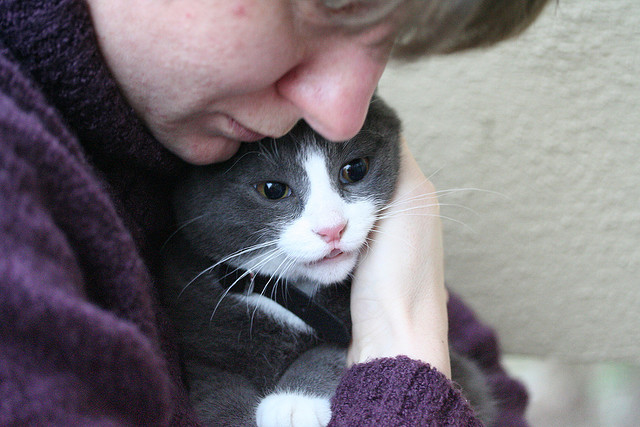
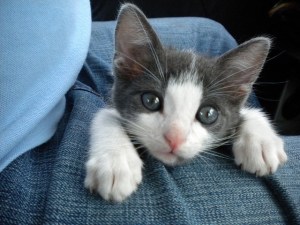
For my perfectionist daughter, one mistake was excuse enough to quit. She leaned her head against me as we sat together on the couch and said, “We’re done. Done, done, done.” If she could, she would have started purring — one of the most manipulative noises known to humankind. I’m a soft touch. Who can work on math when there’s a kitten to cuddle?
by tanjila ahmed via flickr
Still, I managed to squeeze in one more puzzle. I picked up my whiteboard marker and started writing:
Kitten complained that some math programs keep repeating the same kind of problems over and over, with bigger numbers: “They don’t get any harder, they just get longer. It’s boring!”
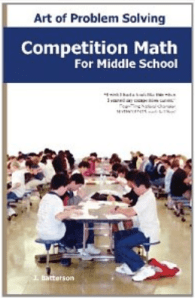
So we pulled out the Counting lessons in Competition Math for Middle School. [Highly recommended book!] Kitten doesn’t like to compete, but she enjoys learning new ideas, and Batterson’s book gives her plenty of those, well organized and clearly explained.
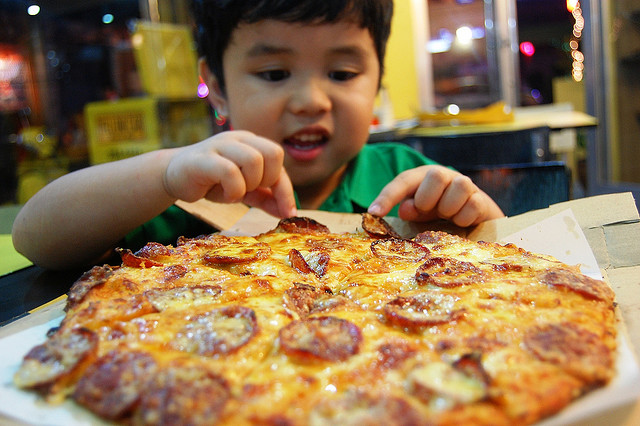
Pizzas at Mario’s come in three sizes, and you have your choice of 10 toppings to add to the pizza. You may order a pizza with any number of toppings (up to 10), including zero. How many choices of pizza are there at Mario’s?
[The book said 9 toppings, but I was skimming/paraphrasing aloud and misread.]
Chain several. Leave straight to work in rows, or connect into a loop. Single crochet until your patience runs out, increasing every nth stitch (add an extra sc in the same place). Experiment with different colors and patterns. This pdf will give you more ideas.
The more frequently you increase, the frillier your hyperbolic plane will be, while a less-frequent increase makes it easier for students to see the structure. Daina Taimina recommends a 12:13 ratio (increase after every 12th stitch) for classroom use.
I’ve been working on a book of math games for homeschoolers and other teachers. I hope to get it published later this year, but the editing drags on. Would anybody like to draw the illustrations?
Meanwhile, here’s a 2-player game your students may enjoy…
Set Up
Print out a blank times table chart and place it between the players. Each player will need a colored marker, and the colors must be different enough to be easily distinguished.
Remove the jokers and kings from a deck of poker-style playing cards, but leave the jacks (= 11) and queens (= 12). Shuffle the deck, and place the stack face down as a draw pile.