Math Game Monday: Clock Math

Learn a new math game every week, for free

This game encourages players of all ages to think creatively with numbers.

Many parents remember struggling to learn math. We hope to provide a better experience for our children.

And one of the best ways for children to enjoy learning is through hands-on play.

Clock Math

Math Concepts: arithmetic, number properties, mixed operations.

Players: any number.

Equipment: clock, pencil and paper or markers and whiteboard.

Continue reading Math Game Monday: Clock Math

Thinking Thursday: Estimation

Thinking Thursday math journal prompt

Writing to Learn Math: Research prompts help students view math as a human endeavor.

Do you want your children to develop the ability to reason creatively and figure out things on their own?

Help kids practice slowing down and taking the time to fully comprehend a math topic or problem-solving situation with these classic tools of learning: Notice. Wonder. Create.

Continue reading Thinking Thursday: Estimation

Homeschool Memories: Bill Gates Proportions II

Woman on a shopping spree to buy books

Once upon a time, when my kids and I were young…

Later the same year, not too long after our discussion of the Bill Gates proportions, I stumbled on some more data. I discovered that the median American family’s net worth was $93,100 in 2004, most of that being home equity.

This gave me another chance to play around with proportions. And since I was preparing a workshop for our regional homeschooling conference, I wrote a sample problem:

The median American family has a net worth of about $100 thousand. Bill Gates has a net worth of $56 billion. If Average Jane Homeschooler spends $100 in the vendor hall, what would be the equivalent expense for Gates?

In the last post, I explained that a proportion sets two ratios equal to each other, like equivalent fractions. Each ratio must compare similar thing to similar thing in the same order.

In this case, we are interested in the ratio “Expense compared to Net Worth.”

Continue reading Homeschool Memories: Bill Gates Proportions II

Homeschool Memories: Putting Bill Gates in Proportion

Money Bag, dollar banknotes and stacked coins on wooden table

Once upon a time…

We were getting ready for the annual homeschool co-op speech contest, and a friend emailed me for help.

“Can you help us figure out how to figure out this problem?

    “This is related to C’s speech. I think we have all the information we need, but I’m not sure:

      “The average household income in the United States is $60,000/year. And a man’s annual income is $56 billion.

        “Is there a way to figure out what this man’s value of a million dollars would be, compared to the person who earns $60,000/year? In other words, I would like to say—$1,000,000 to us is like 10 cents to Bill Gates.”

        We found out later that her son’s numbers weren’t exactly right. He hadn’t understood the difference between income and net worth, so he made Gates sound richer than reality.

        But the basic math principles never change, and it’s fun to play with big numbers.

        Continue reading Homeschool Memories: Putting Bill Gates in Proportion

        What Is Thinking Thursday?

        Thinking Thursday math journal prompt

        There’s a new math journaling prompt this week.

        Have your kids tried it yet?

        This week’s prompt features one of my explain-your-reasoning to get kids thinking (and writing) about math while avoiding the formality that turns so many students away from geometry proofs. Or you might prefer last week’s prompt, featuring a classic math brainteaser and encouraging students to create their own related puzzles.

        Or, if you’re reading this post later and missed those, there’s another great new prompt this week for you to explore.

        Check it out:

        Visit Thinking Thursday

        Continue reading What Is Thinking Thursday?

        What Is Math Game Monday?

        Learn a new math game every week, for free

        There’s a new Math Game Monday this week.

        Have your kids tried it yet?

        This week’s game is one of my favorites for upper-elementary and middle school students, offering plenty of practice doing estimation and mental math with fractions. Or you might prefer last week’s game, featuring a classic two-player logic puzzle that develops strategic reasoning.

        Or, if you’re reading this post later and missed those, there’s another great new game this week for you to play.

        Check it out:

        Visit Math Game Monday

        Continue reading What Is Math Game Monday?

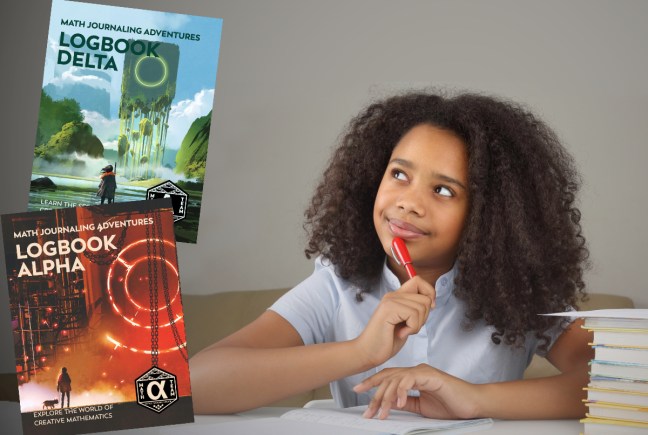
        FAQ: Playful Math Journaling

        Girl student thinking about her math journal prompt

        Ever since the school year started, I’ve been getting questions about how to use my new Math Journaling Adventures logbooks.

        [SIDE NOTE: These logbooks are included in this month’s Thanksgiving Sale! You’ll get an automatic 10% discount off all print books, applied at checkout, no special code required.]

        “I love the way your math books get my children thinking.

          “Finally, they are having fun with math!

            “But sometimes I have no idea what the journaling prompt is all about or how to teach it. Where can I buy a solutions manual?”

            Um, that’s not how math journals work.

            The cool thing about journaling prompts is that they have no “right” answer. They are explorations into different parts of the world of math, nature walks in the land of numbers, shapes, and patterns. Springboards into whatever our children want to investigate, whatever sparks their interest.

            A few of the problem-solving prompts may have specific answers, but it really doesn’t matter if our kids find the exact solution a math professional might give. If they write what makes sense to them, they’ve accomplished the goal.

            If later, they think of something they hadn’t noticed, or they want to change their answer — well, that is mathematical thinking, too.

            Continue reading FAQ: Playful Math Journaling
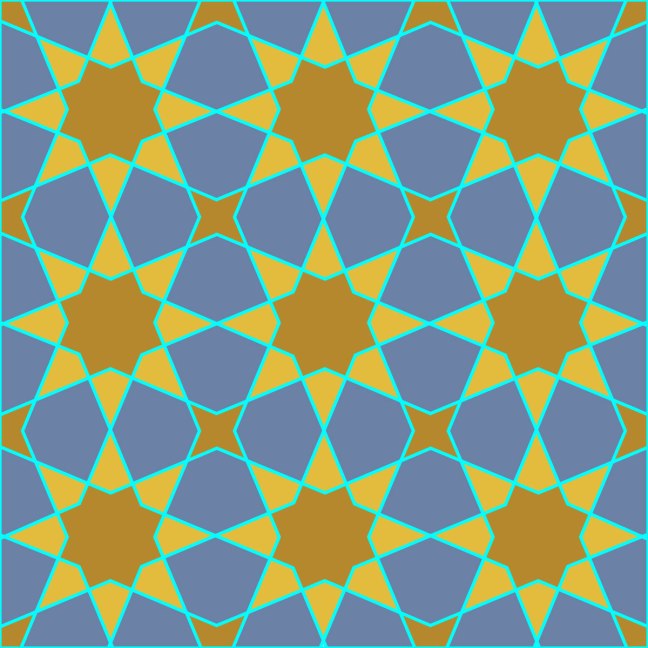
            Geometric Math Art, Recovered

            Geometric pattern by Denise Gaskins

            I’ve been updating my old book files to a new publishing program, and in the process discovering anew how often websites change and disappear. So frustrating!

            Thankfully, the Internet Archive keeps some things that we can look back at. It doesn’t always work, but today it came to the rescue and let me recover the wonderful workbook from the Metropolitan Museum of Art, Islamic Art And Geometric Design, plus some of the pattern pages at the old School of Islamic Geometric Design.

            I reference these pages in my Geometric Coloring Designs series (available at my Playful Math Store), so I was glad to find they weren’t lost forever.

            Math Art = a great way to spark energy when your students hit the mathematical doldrums.

            If you’d like to play around with math art patterns, each image below links to Eric Broug’s step-by-step instructions for creating the design. Also, Broug made printable pages to get students started, which you can download here. No compass construction required!

            Pattern 1

            Geometric design pattern by Eric Broug

            Pattern 2

            Geometric design pattern by Eric Broug

            Pattern 3

            Geometric design pattern by Eric Broug

            There are two more patterns on the old SIGD site, but I can’t get those instructions to load. That might be my antique rural internet connection, however, so feel free to do some exploring on your own.

            And have fun drawing math with your kids!

             
            * * *

            Are you looking for more creative ways to play math with your kids? Check out all my books, printable activities, and cool mathy merch at Denise Gaskins’ Playful Math Store. Or join my email newsletter.

            This blog is reader-supported. If you’d like to help fund the blog on an on-going basis, then please join me on Patreon for mathy inspiration, tips, and an ever-growing archive of printable activities.

            “Geometric Math Art, Recovered” copyright © 2025 by Denise Gaskins. Image at the top of the post copyright © Denise Gaskins.

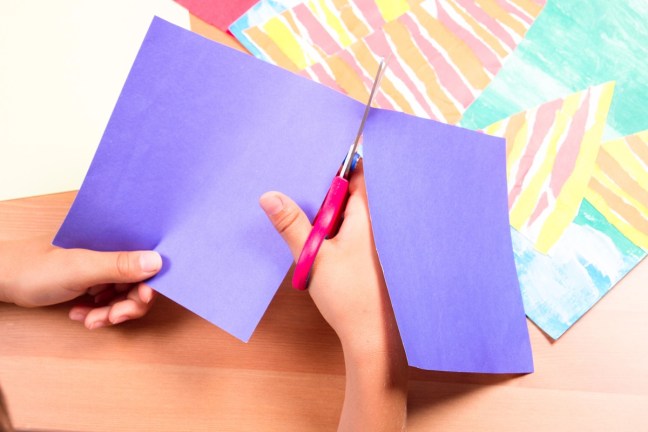
            Two Hands-On Craft Projects

            photo: Cutting a paper square

            Here are a couple of fun foldable projects to try with your kids.

            Both of the projects below start with squares of paper. Do you know how to convert any piece of paper into a square? Here are two methods.

            • Can you tell why they work, how each method creates a true square?
            • What if you didn’t have a rectangular page to start with — could you still create a square?

            Minecraft Endless Card

            A square flexagon. If you don’t care for Minecraft, just create four square designs of your own to fold, cut, and paste.

            https://hattifant.com/minecraft-endless-card-paper-craft

            What math do you notice in the finished card? What questions can you ask?

            Origami Puzzle Purse

            Write a decorative note to a friend, then fold it into a compact little puzzle.

            https://hannaleetidd.com/blogs/news/how-to-make-a-victorian-love-token

            What do you notice? What do you wonder?

            Have fun folding math with your kids!

             
            * * *

            Are you looking for more creative ways to play math with your kids? Check out all my books, printable activities, and cool mathy merch at Denise Gaskins’ Playful Math Store. Or join my free email newsletter.

            This blog is reader-supported. If you’d like to help fund the blog on an on-going basis, then please join me on Patreon for mathy inspiration, tips, and an ever-growing archive of printable activities.

            “Two Hands-On Craft Projects” copyright © 2025 by Denise Gaskins. Image at the top of the blog copyright © Vejaa / Depositphotos.

            Hints for the Patty Paper Trisection

            drafting tools

            No peeking! This post is for those of you who have given the trisection proof a good workout on your own.

            If you have a question about the proof or a solution you would like to share, please post a comment here.

            But if you haven’t yet worked at the puzzle, go back and give it a try.

            When someone just tells you the answer, you miss out on the fun. Figure it out for yourself — and then check the answer just to prove that you got it right.

            Continue reading Hints for the Patty Paper Trisection