Pre-Algebra Picture Puzzles

Balance problem

Maria at Homeschool Math Blog has posted a fun set of worksheets:
Pan balance problems to teach algebraic reasoning.

Princess Kitten, at nearly 9yo, keeps telling me, “I hate math, but I like algebra.” So I printed all four pages for her to try. These get pretty complicated, and the 2-variable problems had her flummoxed for awhile. But after an explanation and bit of pouting (I think she hates math because she’s such a perfectionist that she can’t bear to get something wrong, even the first time), she came back and conquered the toughest ones.

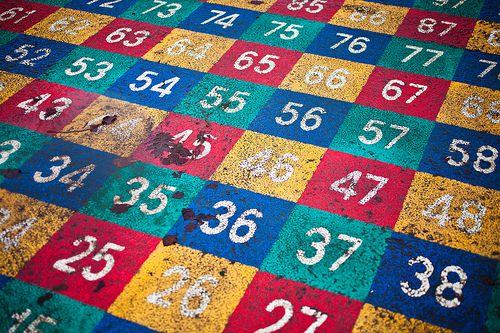
Game: Hundred Chart Nim

Photo by Håkan Dahlström via flickr.

Math concepts: addition and subtraction within 100, logical strategy
Number of players: 2 or 3
Equipment: printed hundred chart (also called a hundred board) and beans, pennies, or other tokens with which to mark numbers — or use this online hundred chart

Set Up

Place the hundred chart and a small pile of tokens where both players can reach them.

Continue reading Game: Hundred Chart Nim

Egyptian Math: The Answers

Remember the Math Adventurer’s Rule: Figure it out for yourself! Whenever I give a problem in an Alexandria Jones story, I will try to post the answer soon afterward. But don’t peek! If I tell you the answer, you miss out on the fun of solving the puzzle. So if you haven’t worked these problems yet, go back to the original posts. Figure them out for yourself—and then check the answers just to prove that you got them right.

Continue reading Egyptian Math: The Answers

Writing to Learn Math

2009 Challenge - Day 72: Pencil
Image by ☼zlady via Flickr

Have you considered experimenting with writing in your math class this year? It seems that math journals are a growing fad, and for good reason:

Writing is how we think our way into a subject and make it our own.

William Zinsser
Writing to Learn

Math journal entries can be as simple as class notes, or they can be research projects that take hours of experimentation and pondering. Students may use the journal to store their thoughts as they work several days to solve a challenge problem of the week, or they might jot down quick reflections about what they learned in today’s math class.

Continue reading Writing to Learn Math

7 Things to Do with a Hundred Chart


This post has been revised to incorporate all the suggestions in the comments below, plus many more activities. Please update your bookmarks:

Or continue reading the original article…


Continue reading 7 Things to Do with a Hundred Chart

Puzzle: Random Blocks

Red block puzzle

In the first section of George Lenchner’s Creative Problem Solving in School Mathematics, right after his obligatory obeisance to George Polya (see the third quote here), Lechner poses this problem. If you have seen it before, be patient — his point was much more than simply counting blocks.

A wooden cube that measures 3 cm along each edge is painted red. The painted cube is then cut into 1-cm cubes as shown above. How many of the 1-cm cubes do not have red paint on any face?

And then he challenges us as teachers:

Do you have any ideas for extending the problem?
If so, then jot them down.

This is strategically placed at the end of a right-hand page, and I was able to resist turning to read on. I came up with a list of 15 other questions that could have been asked — some of which will be used in future Alexandria Jones stories. Lechner wrote only seven elementary-level problems, and yet his list had at least two questions that I had not considered. How many can you come up with?

Continue reading Puzzle: Random Blocks

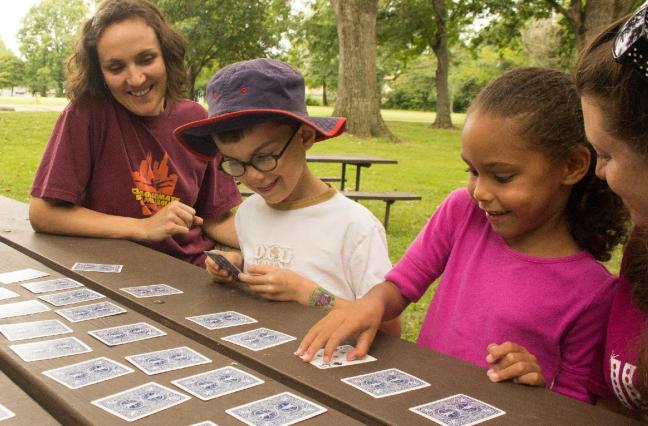
Game: Tens Concentration

Math concepts: addition, number bonds for 10, visual memory
Number of players: any number, mixed ages
Equipment: math cards, one deck

Set Up

Each player draws a card, and whoever choses the highest number will go first. Then shuffle the cards and lay them all face down on the table, spread out so no card covers any other card. There are 40 cards in a deck, so you can make a neat array with five rows of eight cards each, or you may scatter them at random.

Continue reading Game: Tens Concentration

How to Make Math Cards

Many of the games on this blog call for Math Cards. You do not need to look for these in stores or in your school supply catalog. Math cards are simply a modified deck of normal, poker-style playing cards. Remove all face cards and jokers from the deck, leaving the ace through ten of each suit. Or use a set of Rook cards, without the bird.

Using the ace as a one, this gives you four sets of numbers 1-10, and you will be ready to play your way to fluency in almost any arithmetical topic: addition, subtraction, multiplication, division, greater-than/less-than, fractions, negative numbers, and more.

Card Holder for Young Hands

Math card holder

Little hands often have trouble holding more than a few cards at a time. Your child may enjoy making and using a card holder.

Save the plastic lids from two large margarine tubs or similar containers. Place the lids together, top to top. Line up the edges, then staple them together, putting two or three staples near the center of the lids. Let your child decorate the card holder with stickers, if desired.

To use the card holder, slip playing cards between the two lids and fan them out. The lids will hold the cards upright, so the child can easily see them all.

 
* * *

This blog is reader-supported.

If you’d like to help fund the blog on an on-going basis, then please join me on Patreon for mathy inspiration, tips, and an ever-growing archive of printable activities.

If you liked this post, and want to show your one-time appreciation, the place to do that is PayPal: paypal.me/DeniseGaskinsMath. If you go that route, please include your email address in the notes section, so I can say thank you.

Which I am going to say right now. Thank you!

“How to Make Math Cards” copyright © 2007 by Denise Gaskins.

How To Start a Homeschool Math Club

From a recent e-mail:

“Hello! I am on the board of a homeschool co-op. We have had requests for a math club and wondered if you have any tips for starting one. We service children from K-10th and would need to try to meet the needs of as many ages as possible.”

There are several ways you might organize a homeschool math club, depending on the students you have and on your goals. I think you would have to split the students by age groups — it is very hard to keep that wide of a range of students interested. Then decide whether you want an activity-oriented club or a more academic focus.

When I started my first math club, I raided the math shelves in the children’s section at my library (510-519) for anything that interested me. I figured that if an activity didn’t interest me, I couldn’t make it fun for the kids. Over the years we have done a variety of games, puzzles, craft projects, and more — always looking for something that was NOT like whatever the kids would be doing in their textbooks at home.

Continue reading How To Start a Homeschool Math Club