The Mysterious Temporal Freeze

Pyramids clip artAlexandria Jones stepped into the huge tent that protected her father’s excavation site from the desert winds. She laughed to herself. It was like walking into a circus.

She knelt down to whisper in the ear of her faithful dog Ramus. “In this ring, grad students carefully brush away another layer of sand. In the next ring, the artist sketches every piece as it is found.” She waved her arm. “And over there, our flashiest attraction — drum roll, please — the photographers shoot each shard of pottery from every possible angle. But where is the Master of Ceremonies?”

Alex and Rammy found Professor Jones near the back of the tent, talking to another student. While she waited for her dad, she looked through an assortment of numbered artifacts that were ready to be packed and sent to the museum.

Continue reading The Mysterious Temporal Freeze

Hints and Solutions: Patty Paper Trisection

No peeking! This post is for those of you who have given the trisection proof a good workout on your own. If you have a question about the proof or a solution you would like to share, please post a comment here.

But if you haven’t yet worked at the puzzle, go back and give it a try. When someone just tells you the answer, you miss out on the fun. Figure it out for yourself — and then check the answer just to prove that you got it right.

Continue reading Hints and Solutions: Patty Paper Trisection

Puzzle: Patty Paper Trisection

[Feature photo above by Michael Cory via Flickr (CC BY 2.0).]

trisection

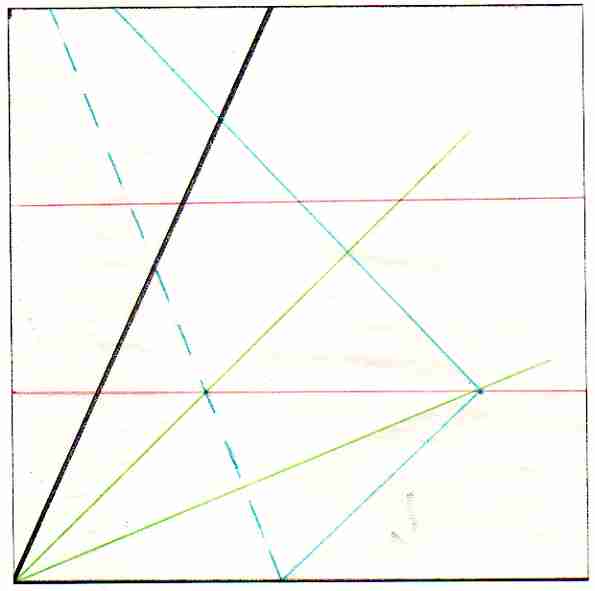
One of the great unsolved problems of antiquity was to trisect any angle using only the basic tools of Euclidean geometry: an unmarked straight-edge and a compass. Like the alchemist’s dream of turning lead into gold, this proved to be an impossible task. If you want to trisect an angle, you have to “cheat.” A straight-edge and compass can’t do it. You have to use some sort of crutch, just as an alchemist would have to use a particle accelerator or something.

One “cheat” that works is to fold your paper. I will show you how it works, and your job is to show why.

Continue reading Puzzle: Patty Paper Trisection

Geometry: Can You Find the Center of a Circle?

Is it possible that AB is a chord but NOT a diameter? That is, could circle ABC have a center that is NOT point O?

For the last couple of days, I have been playing around with this geometry puzzle. If you have a student in geometry or higher math, I recommend you print out the original post (but not the comments — it’s no fun when someone gives you the answer!) and see what he or she can do with it.

[MathNotations offers many other puzzles for 7-12th grade math students. While you are at his blog, take some time to browse past articles.]

Skit: The Handshake Problem

[Feature photo above by Tobias Wolter (CC-BY-SA-3.0) via Wikimedia Commons.]

If seven people meet at a party, and each person shakes the hand of everyone else exactly once, how many handshakes are there in all?

In general, if n people meet and shake hands all around, how many handshakes will there be?

Our homeschool co-op held an end-of-semester assembly. Each class was supposed to demonstrate something they had learned. I threatened to hand out a ten question pop quiz on integer arithmetic, but instead my pre-algebra students presented this skit. You may adjust the script to fit the available number of players.

Continue reading Skit: The Handshake Problem

Story Problem Challenge Revisited

Well, I didn’t get any takers with the last story problem challenge. But school is in full session now, and we’re doing story problems in Math Club this Friday, so I thought I’d try again.

Here’s the challenge: Can you and your students make up some original math problems?

In Math Club, we always start by reading part of the book Math by Kids for inspiration. I can’t print those stories here, however, because of copyright rules, so I’ll share some of the stories my past students have made, arranged in roughly increasing order of difficulty. After you solve a couple of these problems with your children, encourage them to try making some of their own.

And please, share their gems with us!

Update

The problems below are now available as a printable handout: Story Problem Challenge.

Continue reading Story Problem Challenge Revisited

Confession: I Am Not Good at Math

I want to tell you a story. Everyone likes a story, right? But at the heart of my story lies a confession that I am afraid will shock many readers. People assume that because I teach math, blog about math, give advice about math on internet forums, and present workshops about teaching math — because I do all this, I must be good at math.

Apply logic to that statement. The conclusion simply isn’t valid. …

Update: This post has moved.

Click here to read the new, expanded version

Number Bonds = Better Understanding

[Rescued from my old blog.]

number bondsA number bond is a mental picture of the relationship between a number and the parts that combine to make it. The concept of number bonds is very basic, an important foundation for understanding how numbers work. A whole thing is made up of parts. If you know the parts, you can put them together (add) to find the whole. If you know the whole and one of the parts, you take away the part you know (subtract) to find the other part.

Number bonds let children see the inverse relationship between addition and subtraction. Subtraction is not a totally different thing from addition; they are mirror images. To subtract means to figure out how much more you would have to add to get the whole thing.

Continue reading Number Bonds = Better Understanding