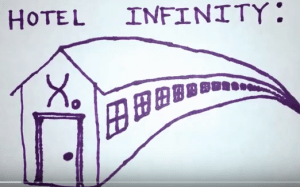
Tova Brown dives deeper into Hilbert’s Hotel Paradox, considering the difference between rational numbers and reals.
You run an infinitely large hotel, and are happy to realize that you can accommodate an infinite number of infinite groups of guests.
However, a delicate diplomatic situation arises when a portal to another universe opens, introducing a different kind of guest, in a different kind of group.
Tova Brown continues to examine Hilbert’s Hotel Paradox, pondering infinite sets of infinite sets.
As the proprietor of an infinitely large hotel, you pride yourself on welcoming everyone, even when the rooms are full. Your hotel becomes very popular among infinite sports teams, as a result.
Recruitment season presents a challenge, however, when many infinite teams arrive at once. How many infinite teams can stay in a single infinite hotel?
Tova Brown explores the second part of Hilbert’s Hotel Paradox. What’s infinity plus infinity?
Running an infinite hotel has its perks. Even when the rooms are full you can always find space for new guests, so you proudly welcome everyone who appears at your door.
When two guests arrive at once, you make room. When ten guests arrive, you accommodate them easily. When a crowd of hundreds appears, you welcome them all.
Tova Brown’s introduction to Hilbert’s Hotel Paradox, a riddle about the nature of infinity…
Once upon a time, there was a hotel with an infinite number of rooms. You might be thinking this is impossible, and if so you’re right. A hotel like this could never exist in the real world.
But fortunately we’re not talking about the real world, we’re talking about math. And when we do math we can make up whatever rules we want, just to see what happens.
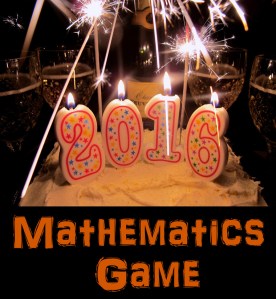
Have you made a New Year’s resolution to spend more time with your family this year, and to get more exercise? Problem-solvers of all ages can pump up their (mental) muscles with the Annual Mathematics Year Game Extravaganza. Please join us!
For many years mathematicians, scientists, engineers and others interested in math have played “year games” via e-mail. We don’t always know whether it’s possible to write all the numbers from 1 to 100 using only the digits in the current year, but it’s fun to see how many you can find.
Use the digits in the year 2016 to write mathematical expressions for the counting numbers 1 through 100. The goal is adjustable: Young children can start with looking for 1-10, middle grades with 1-25.
You must use all four digits. You may not use any other numbers.
Solutions that keep the year digits in 2-0-1-6 order are preferred, but not required.
You may use a decimal point to create numbers such as .2, .02, etc., but you cannot write 0.02 because we only have one zero in this year’s number.
You may create multi-digit numbers such as 10 or 201 or .01, but we prefer solutions that avoid them.
My Special Variations on the Rules
You MAY use the overhead-bar (vinculum), dots, or brackets to mark a repeating decimal. But students and teachers beware: you can’t submit answers with repeating decimals to Math Forum.
You MAY use a double factorial, n!! = the product of all integers from 1 to n that have the same parity (odd or even) as n. I’m including these because Math Forum allows them, but I personally try to avoid the beasts. I feel much more creative when I can wrangle a solution without invoking them.
Check out this new puzzle book for upper-level high school students & adults:
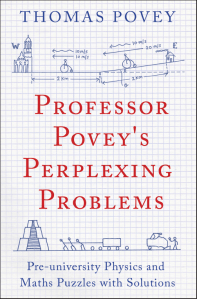
Thomas Povey is a Professor of Engineering Science at the University of Oxford, where he researches jet-engine and rocket technology. In his new book Professor Povey’s Perplexing Problems, he shares his favorite idiosyncratic stumpers from pre-university maths and physics.
These problems “should test your ability to grapple with the unfamiliar,” Povey writes. “You will learn to tease new problems apart, and apply things you already know in ways you had never considered. You have all the tools you need, but you should see what amazing things you can do with them.”
Can You Solve This?
Alex Bellos shared one of Professor Povey’s puzzles in The Guardian. Can you figure it out?
The book starts off with geometry, but most of the chapters focus on various topics from physics. Some of the puzzles are accessible through applied common sense, but for many of them, it helps to have taken an algebra-based (high school level) physics course.
Kitten is just finishing up her physics textbook, and she still has one more year of homeschooling. I’m hoping to work several of these puzzles into our schedule this year. It should be great fun!
Spoiler
If like me you’re a bit rusty on your physics, don’t worry. Each answer is thoroughly explained—in fact, it takes a bit of discipline to close the book and try your hand at each problem before reading on. I wish they’d put the solutions in the back rather than in the main text, to make it easier to browse the problems without reading spoilers.
Speaking of which, here’s the answer to the video puzzle above…
The August “Let’s Play Math” newsletter went out last week to everyone who signed up for Tabletop Academy Press math updates. This month’s issue focuses on logic puzzles for all ages, including a newly-discovered deleted scene from Harry Potter and the Sorcerer’s Stone. What fun!
If you missed this month’s edition, no worries—here are some great puzzles from the Let’s Play Math blog archive:
The discussion matters more than the final answer.
One of the most persistent math myths in popular culture is the idea that mathematics is primarily about getting right answers.
The truth is, the answer doesn’t matter that much in math. What really matters is how you explain that answer. An answer is “right” if the explanation makes sense.
And if you don’t give an explanation, then you really aren’t doing mathematics at all.
Try This Number Puzzle
Here is a short sequence of numbers. Can you figure out the rule and fill in the next three blanks?
2, 3, 5, 7, ___, ___, ___, …
Remember, what’s important is not which numbers you pick, but rather how you explain your answer.
Possibility 1
Perhaps the sequence is the prime numbers?
2, 3, 5, 7, 11, 13, 17, …
The prime numbers make a wonderful sequence, though it isn’t the one I was thinking of.
Math Concepts: division as equal sharing, naming fractions, adding fractions, infinitesimals, iteration, limits Prerequisite: able to identify fractions as part of a whole
This is how I tell the story:
We have a cake to share, just the two of us. It’s not TOO big a cake, ‘cuz we don’t want to get sick. An 8 × 8 or 16 × 16 square on the graph paper should be just right. Can you cut the cake so we each get a fair share? Color in your part.
How big is your piece compared to the whole, original cake?
But you know, I’m on a diet, and I just don’t think I can eat my whole piece. Half the cake is too much for me. Is it okay if I share my piece with you? How can we divide it evenly, so we each get a fair share? How big is your new piece? Color it in.
How much of the whole, original cake do you have now? How can you tell?
I keep thinking of my diet, and I really don’t want all my piece of cake. It looks good, but it’s still just a bit too big for me. Will you take half of it? How big is that piece?
Now how much of the whole, original cake do you have? How could we figure it out?
[Teaching tip: Don’t make kids do the calculation on paper. In the early stages, they can visualize and count up the fourths or maybe the eighths. As the pieces get smaller, the easiest way to find the sum is what Cohen does in the video below—identify how much of the cake is left out.]
Even for being on a diet, I still don’t feel very hungry…
 Tova Brown dives deeper into Hilbert’s Hotel Paradox, considering the difference between rational numbers and reals.







 Denise Gaskins' Let's Play Math
