A-Hunting They Will Go

Alexandria Jones and her family piled into the car for a drive in the country. This year, they were determined to find an absolutely perfect Christmas tree at Uncle William Jones’s tree farm.

“I want the tallest tree in Uncle Will’s field,” Alex said.

“Hold it,” said her mother. “I refuse to cut a hole in the roof.”

“But, Mom!” Leon whined. “The Peterkin Papers…”

“Too bad. Our ceiling will stay a comfortable 8 feet high.”
Continue reading A-Hunting They Will Go

The Christmas Present Quandary

Alexandria Jones hated using store-bought wrapping paper at Christmas. She tried to wrap each present as a hand-crafted work of art.

Last year, she did mini-scenes with plastic figures building cotton snowmen or skating on aluminum-foil ponds — and, for her brother Leonhard’s gift, her favorite creation: toy dinosaurs having a snowball fight. But those 3-D scenes got knocked about under the Christmas tree.

This year, she decided, she would wrap the packages flat. But then, how could she make them special?

Continue reading The Christmas Present Quandary

Looking Ahead with Alexandria Jones

We have now finished three back issues of my old Mathematical Adventures newsletter. Our next story will be from the November/December 1998 issue: Alexandria Jones and the Christmas Present Quandary. I plan to take a couple of months off to find my rhythm with co-op and homeschooling classes, and we will pick up Alex’s adventures (and meet her mother, Maria Jones) in November.

In case you missed any of them, here are all the Alexandria Jones stories so far…

Continue reading Looking Ahead with Alexandria Jones

Egyptian Math: The Answers

Remember the Math Adventurer’s Rule: Figure it out for yourself! Whenever I give a problem in an Alexandria Jones story, I will try to post the answer soon afterward. But don’t peek! If I tell you the answer, you miss out on the fun of solving the puzzle. So if you haven’t worked these problems yet, go back to the original posts. Figure them out for yourself—and then check the answers just to prove that you got them right.

Continue reading Egyptian Math: The Answers

Egyptian Geometry and Other Challenges

Rhind papyrus

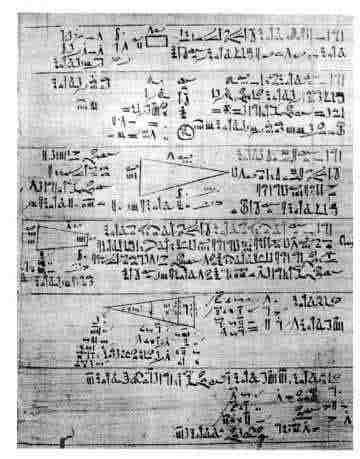
Would you like to study “the knowledge of all existing things and all obscure secrets”? That is how Scribe Ahmose (also translated Ahmes) described his mathematical papyrus. Ahmose’s masterpiece is now called the Rhind Papyrus, after Alexander Henry Rhind, a Scotsman who was one of the first archaeologists to make meticulous records of his excavations (rather than simply hunting for treasures). Rhind purchased the papyrus from an antiquities dealer in Luxor, Egypt, in 1858.

Ahmose’s writing included a huge table of fractions as well as story problems, geometry, algebra, and accounting. Can you solve any of Scribe Ahmose’s problems?

Continue reading Egyptian Geometry and Other Challenges

Another Egyptian Math Puzzle

Pyramids clip artI have one last puzzle for those of you who are following my Alexandria Jones series on hieroglyphic math and the Egyptian scribe’s method of multiplication by doubling. Here is the “teaser” problem from the cover of the Sept./Oct.1998 issue of my newsletter:

One more Egyptian math puzzle (pdf, 53KB)

Continue reading Another Egyptian Math Puzzle

Egyptian Math Puzzles

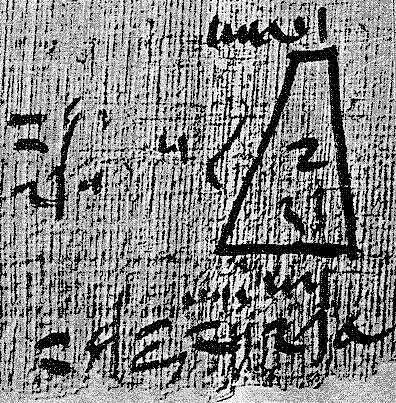
What we know about ancient Egyptian mathematics comes primarily from two papyri, the first one written around 1850 BC. Moscow papyrus problem 14This is called the Moscow papyrus, because it now belongs to Moscow’s Pushkin Museum of Fine Arts. The scroll contains 25 problems, mostly practical examples of various calculations. Problem 14, which finds the volume of a frustrum (a pyramid with its top cut off), is often cited by mathematicians as the most impressive Egyptian pyramid of all.

Continue reading Egyptian Math Puzzles

Alex’s Puzzling Papyrus

(In the last episode, Dr. Fibonacci Jones discovered a torn scrap of papyrus, covered with hieroglyphic numbers. He promised to teach his daughter, Alexandria, how the ancient Egyptian scribes worked multiplication problems using only the times-two table.)

Back at their tent, Dr. Jones handed the papyrus scrap to Alexandria. “What do you see?” he asked.

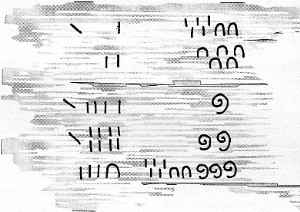
“Well, there are two columns of numbers,” Alex said. “Let me write them down.” She got a piece of notebook paper and translated the hieroglyphs. Papyrus fragment

Click on the image for a larger view. Translate the numbers for yourself before reading on. If you need help, read Egyptian Math in Hieroglyphs.

Continue reading Alex’s Puzzling Papyrus

Egyptian Math in Hieroglyphs

Egyptians wrote in hieroglyphs, a type of picture writing, and in hieratics, which were like a cursive form of hieroglyphs.

Hieroglyphs came first. They were carved in the stone walls of temples and tombs, written on monuments, and used to decorate furniture. But they were a nuisance for scribes, who simplified the pictures and slurred some lines together when they wrote in ink on paper-like papyrus. This hieratic writing — like some people’s cursive today — can be hard to read, so we are only using hieroglyphic numbers on this blog.

Download this page from my old newsletter, and try your hand at translating some Egyptian hieroglyphs:

Then try writing some hieroglyphic calculations of your own.

Edited to add: The answers to these puzzles (and more) are now posted here.

To Be Continued…

Read all the posts from the September/October 1998 issue of my Mathematical Adventures of Alexandria Jones newsletter.

The Thief in the Night

Alexandria Jones and her faithful dog Ramus slipped out of the tent when the talking started. One of Dad’s assistants had made the long drive into town to bring back pizza for supper. But now, all the adults would be working past midnight to finish the final site report.

Paperwork was necessary, she knew, but so-o-o boring.

Alex and Rammy wandered around the nearly-dark camp. Many of the tents were down. Crates stood near the road. All the artifacts had been carefully cleaned and labeled, and some were already shipped to the museum lab.

She ran a hand over the edge of a crate, then jerked back, wincing at the splinter that dug into her palm.

Continue reading The Thief in the Night