Sue VanHattum and I were chatting about her young adult math books.
[Sue would love to get your help with beta-reading her books. Scroll down to the bottom of this post for details.]
In the first book of the series, Althea and the Mystery of the Imaginary Numbers, Althea learns that Tartaglia came up with a formula to solve cubic equations and wrote about it in a poem.
Sue had discovered an English translation of that poem and shared it with me. (You can read it on JoAnne Growney’s blog.) Then we wondered whether we could come up with a simpler poem, something an algebra student might be able to follow.
Perhaps you and your kids would enjoy making up poems, too. An algebra proof-poem might be too difficult for now, but check out my blog for math poetry ideas.
On May 5, we celebrate one of the rarest math holidays: Square Root Day, 5/5/25.
Here are a few ideas for playing math with squares and roots.
What is a Square Root?
Five is the square root of twenty-five, which means it is the number we can “square” (multiply times itself) to get 25.
The root is the base number from which the square grows. In physical terms, it is the side of the square.
Imagine a straight segment of length 5, perhaps a stick or a piece of chalk. Now lay that segment down and slide it sideways for a distance equal to its length. Drag the stick across sand, or pull the chalk across paper or a slate.
Notice how this sideways motion transforms the one-dimensional length into a two-dimensional shape, a square.
The area of this shape is the square of its root: 5 × 5 = 25.
What do you think would happen if you could drag the square through a third dimension, or drag that resulting shape through a fourth dimension?
How many shapes do you suppose might grow from that original root of 5?
So I thought this week, I’d share some of my favorites with you. First up: Problem Solving Tips from James Tanton.
You may know Tanton from the popular Exploding Dots and other activities at the Global Math Project website. But he’s been busy for decades sharing the delight and the beauty of the subject. He currently serves as the Mathematician-at-Large for the Mathematical Association of America.
Read on to discover several of Tanton’s best problem-solving tips for middle school and older students.
Have fun exploring math with your kids!
How to Think like a School Math Genius
In this 4-video series, Tanton presents five key principles for brilliant mathematical thinking, along with loads and loads of examples to explain what he means by each of them. He says it’s “a call for parents and teachers to be mindful of the life thinking we should foster, encourage, promote, embrace and reward — even in a math class!”
Two Key — but Ignored —Steps to Solving Any Math Problem
How many degrees in a Martian circle?Every challenge or problem we encounter in mathematics (or life!) elicits a human response. The dryness of textbooks and worksheets in the school world might suggest otherwise, but connecting with one’s emotions is fundamental and vital for success — and of course, joy — in doing mathematics.
Essays and videos showing how to approach math puzzles in a way that a) is relevant and connected to the curriculum, and b) revels in deep, joyous, mulling and flailing, reflection, intellectual play and extension, insight, and grand mathematical delight.
Scroll down and start with the Ten Problem-Solving Strategies.
“The true joy in mathematics, the true hook that compels mathematicians to devote their careers to the subject, comes from a sense of boundless wonder induced by the subject.
“There is transcendental beauty, there are deep and intriguing connections, there are surprises and rewards, and there is play and creativity.
“Mathematics has very little to do with crunching numbers. Mathematics is a landscape of ideas and wonders.”
—James Tanton
CREDITS: Feature photo (top) by Ian Stauffer via Unsplash.com.
The all-time most-visited page on this site is my post about Math War: The Game That Is Worth 1,000 Worksheets. It’s easy to adapt to almost any math topic, simple to learn, and quick to play. My homeschool co-op students love it.
But Math War isn’t just for elementary kids. Several teachers have shared special card decks to help middle and high school students practice math by playing games.
Take a look at the links below for games from prealgebra to high school trig. And try the Math War Trumps variation at the end of the post to boost your children’s strategic-thinking potential.
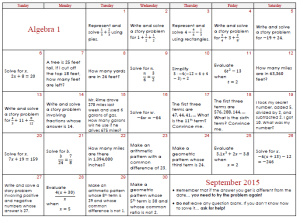
There are no explicit instructions about process being more important than the answer on these, so you’ll need to stress that in class.
I remind students that everyone already knows the answer to each of the questions, and that one of the things we’re practicing is explaining our reasoning…
Enjoy!
And if anyone else has a math review calendar to share, for any grade level, please add your link in the comment section below.
Math Concepts: division as equal sharing, naming fractions, adding fractions, infinitesimals, iteration, limits Prerequisite: able to identify fractions as part of a whole
This is how I tell the story:
We have a cake to share, just the two of us. It’s not TOO big a cake, ‘cuz we don’t want to get sick. An 8 × 8 or 16 × 16 square on the graph paper should be just right. Can you cut the cake so we each get a fair share? Color in your part.
How big is your piece compared to the whole, original cake?
But you know, I’m on a diet, and I just don’t think I can eat my whole piece. Half the cake is too much for me. Is it okay if I share my piece with you? How can we divide it evenly, so we each get a fair share? How big is your new piece? Color it in.
How much of the whole, original cake do you have now? How can you tell?
I keep thinking of my diet, and I really don’t want all my piece of cake. It looks good, but it’s still just a bit too big for me. Will you take half of it? How big is that piece?
Now how much of the whole, original cake do you have? How could we figure it out?
[Teaching tip: Don’t make kids do the calculation on paper. In the early stages, they can visualize and count up the fourths or maybe the eighths. As the pieces get smaller, the easiest way to find the sum is what Cohen does in the video below—identify how much of the cake is left out.]
Even for being on a diet, I still don’t feel very hungry…
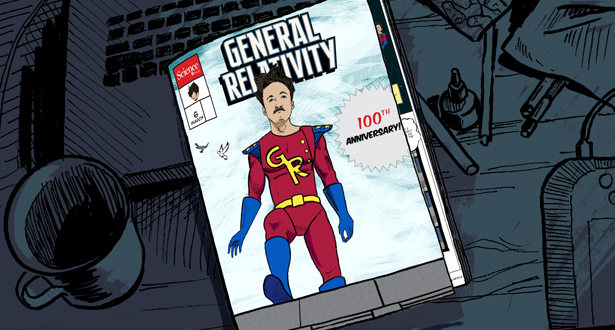
Don’t forget that Pi Day is also Albert Einstein’s birthday! And this year marks the 100th anniversary of his Theory of General Relativity. So Science Magazine has a special Einstein issue online, featuring this interactive comic:



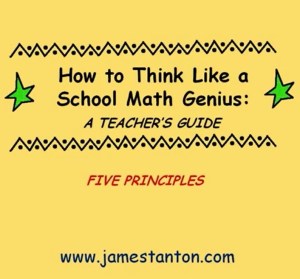 In this 4-video series, Tanton presents five key principles for brilliant mathematical thinking, along with loads and loads of examples to explain what he means by each of them. He says it’s “a call for parents and teachers to be mindful of the life thinking we should foster, encourage, promote, embrace and reward — even in a math class!”
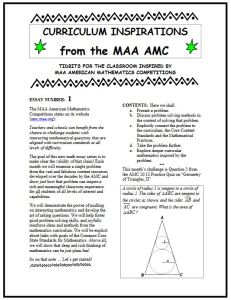 Essays and videos showing how to approach math puzzles in a way that a) is relevant and connected to the curriculum, and b) revels in deep, joyous, mulling and flailing, reflection, intellectual play and extension, insight, and grand mathematical delight.
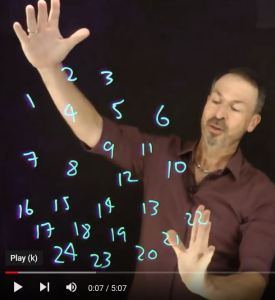 Here are some essays illustrating astounding tidbits of mathematical delight. And here are some purely visual puzzles to surprise.



 Denise Gaskins' Let's Play Math