Algebra for (Almost) Any Age

VisualPatterns-org2

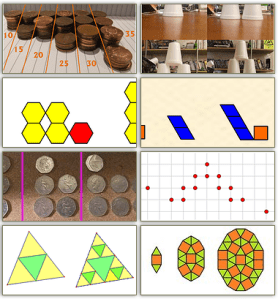
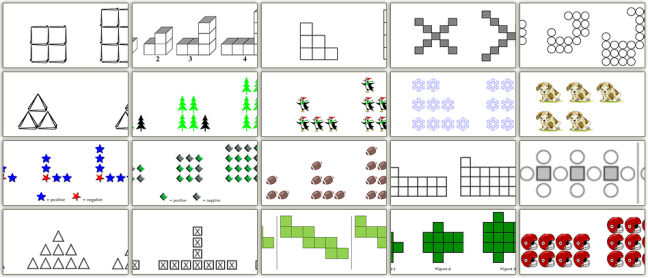
Fawn Nguyen’s Visual Patterns website just keeps getting better and better. Check it out:

In addition to the 115 puzzle patterns (as of this writing), the site features a Gallery page of patterns submitted by students. And under the “Teachers” tab, Fawn shares a form to guide students in thinking their way through to the algebraic formula for a pattern.

How can you use these patterns to develop algebraic thinking with younger students? Mike Lawler and sons demonstrate Pattern #1 in the YouTube video below.

Logic: The Centauri Challenge

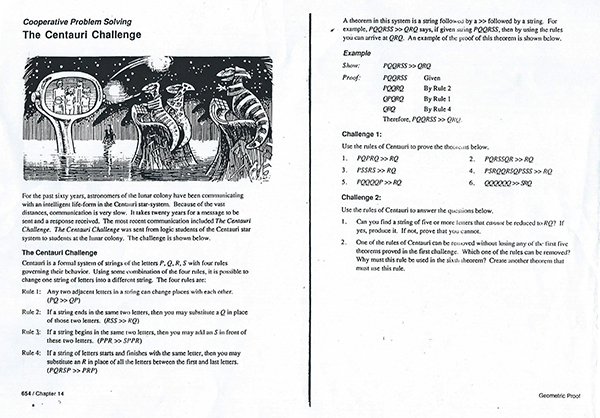
Another fun discovery from the #MTBoS Challenge: Brian Miller (@TheMillerMath) posted this interstellar puzzle on his blog today.

centaurichallenge
[Right-click image to download a pdf you can print for your students.]

More Logic Puzzles

If you liked the Centauri Challenge, you may also enjoy the following blog posts:

Puzzle: Algebra on Rectangles

Gordon Hamilton of Math Pickle recently posted these videos on how to make algebra 1 puzzles on rectangles. As I was watching, Kitten came in and looked over my shoulder. She said, “Those look like fun!”

They look like fun to me, too, and I bet your beginning algebra students will enjoy them:

Continue reading Puzzle: Algebra on Rectangles

How To Master Quadratic Equations

G'Day Math logo

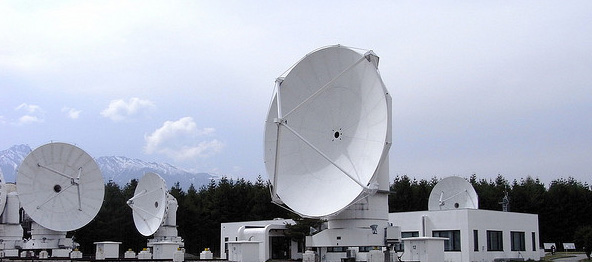
Feature photo above by Junya Ogura via Flickr (CC BY 2.0).

A couple of weeks ago, James Tanton launched a wonderful resource: a free online course devoted to quadratic equations. (And he promises more topics to come.)

Kitten and I have been working through the lessons, and she loves it!

We’re skimming through pre-algebra in our regular lessons, but she has enjoyed playing around with simple algebra since she was in kindergarten. She has a strong track record of thinking her way through math problems, and earlier this year she invented her own method for solving systems of equations with two unknowns.

I would guess her background is approximately equal to an above-average Algebra 1 student near the end of the first semester.

After few lessons of Tanton’s course, she proved — within the limits of experimental error — that a catenary (the curve formed by a hanging chain) cannot be described by a quadratic equation. Last Friday, she easily solved the following equations:

\left ( x+4 \right )^2 -1=80

and:

w^2 + 90 = 22 w - 31

and (though it took a bit more thought):

4x^2 + 4x + 4 = 172

We’ve spent less than half an hour a day on the course, as a supplement to our AoPS Pre-Algebra textbook. We watch each video together, pausing occasionally so she can try her hand at an equation before listening to Tanton’s explanation. Then (usually the next day) she reads the lesson and does the exercises on her own.

So far, she hasn’t needed the answers in the Companion Guide to Quadratics, but she did use the “Dots on a Circle” activity — and knowing that she has the answers available helps her feel more independent.

Continue reading How To Master Quadratic Equations
Homeschooling High School Math

photo by ddluong via flickr

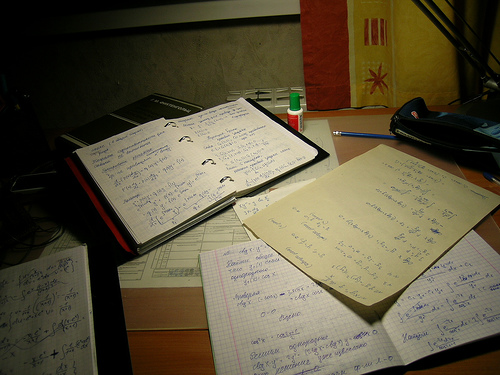
Feature photo (above) by Sphinx The Geek via flickr.

Most homeschoolers feel at least a small tinge of panic as their students approach high school. “What have we gotten ourselves into?” we wonder. “Can we really do this?” Here are a few tips to make the transition easier.

Before you move forward, it may help to take a look back. How has homeschooling worked for you and your children so far?

If your students hate math, they probably never got a good taste of the “Aha!” factor, that Eureka! thrill of solving a challenging puzzle. The early teen years may be your last chance to convince them that math can be fun, so consider putting aside your textbooks for a few months to:

On the other hand, if you have delayed formal arithmetic, using your children’s elementary years to explore a wide variety of mathematical adventures, now is a good time to take stock of what these experiences have taught your students.

  • How much of what society considers “the basics” have your children picked up along the way?
  • Are there any gaps in their understanding of arithmetic, any concepts you want to add to their mental tool box?

Continue reading Homeschooling High School Math

Quotable: Why Study Algebra?

Blocks

[Photo by AlphaTangoBravo / Adam Baker via flickr.]

One reason to study algebra: because it’s a building block. And just as it was really hard at first to get those blocks to do what you wanted them to do, so also it can be really hard at first to get algebra to work. But if you persevere, who knows what you might build someday?

Algebra is the beginning of a journey that gives you the skills to solve more complex problems.

So, try not to think of Algebra as a boring list of rules and procedures to memorize. Consider algebra as a gateway to exploring the world around us all.

— Jason Gibson
Why Study Algebra?