These puzzles look like a lot of fun for whole number and integer arithmetic review. I think they would make a great warm-up at the beginning of a class or math club meeting.
Hat tip: MathPuzzle.com
These puzzles look like a lot of fun for whole number and integer arithmetic review. I think they would make a great warm-up at the beginning of a class or math club meeting.
Hat tip: MathPuzzle.com

[Feature photo above by Tobias Wolter (CC-BY-SA-3.0) via Wikimedia Commons.]
If seven people meet at a party, and each person shakes the hand of everyone else exactly once, how many handshakes are there in all?
In general, if n people meet and shake hands all around, how many handshakes will there be?
Our homeschool co-op held an end-of-semester assembly. Each class was supposed to demonstrate something they had learned. I threatened to hand out a ten question pop quiz on integer arithmetic, but instead my pre-algebra students presented this skit. You may adjust the script to fit the available number of players.
[Feature photo above by Carla216 via flickr (CC BY 2.0). This post was rescued from my old blog.]
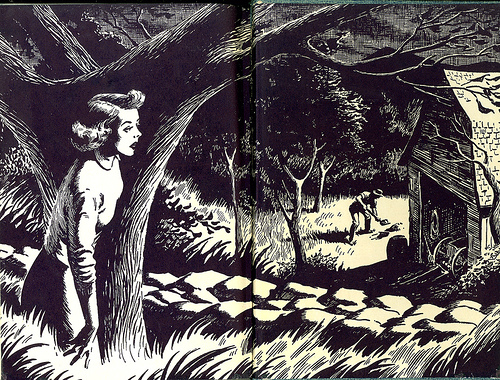
I love story problems. Like a detective, I enjoy sifting out clues and solving the mystery. But what do you do when you come across a real stumper? Acting out story problems could make a one-page assignment take all week.
You don’t have to bake a pie to study fractions or jump off a cliff to learn gravity. Use your imagination instead. The following suggestions will help you find the clues you need to solve the case.
Well, I didn’t get any takers with the last story problem challenge. But school is in full session now, and we’re doing story problems in Math Club this Friday, so I thought I’d try again.
Here’s the challenge: Can you and your students make up some original math problems?
In Math Club, we always start by reading part of the book Math by Kids for inspiration. I can’t print those stories here, however, because of copyright rules, so I’ll share some of the stories my past students have made, arranged in roughly increasing order of difficulty. After you solve a couple of these problems with your children, encourage them to try making some of their own.
And please, share their gems with us!
The problems below are now available as a printable handout: Story Problem Challenge.
I want to tell you a story. Everyone likes a story, right? But at the heart of my story lies a confession that I am afraid will shock many readers. People assume that because I teach math, blog about math, give advice about math on internet forums, and present workshops about teaching math — because I do all this, I must be good at math.
Apply logic to that statement. The conclusion simply isn’t valid. …
Update: This post has moved.
I found two helpful articles at squareCircleZ.
Ten Ways to Survive the Math Blues
General tips on how to learn as much as possible from any math course.The need for further exploration
What to do after you find the answer to a math problem.
[Rescued from my old blog.]
Percents are one of the math monsters, the toughest topics of elementary and junior high school arithmetic. The most important step in solving any percent problem is to figure out what quantity is being treated as the basis, the whole thing that is 100%. The whole is whatever quantity to which the other things in the problem are being compared.
[Rescued from my old blog.]
Paraphrased from a homeschool math discussion forum:
“I am really struggling with percents right now, and feel I am in way over my head!”
Percents are one of the math monsters, the toughest topics of elementary and junior high school arithmetic. Here are a few tips to help you understand and teach percents.
Are your students ready for a challenge?
The Math Forum: 2007 Mathematics Game will be a tricky one:
Use the digits in the year 2007 and the operations +, -, x, ÷, sqrt (square root), ^ (raise to a power), and ! (factorial), along with grouping symbols, to write expressions for the counting numbers 1 through 100.
- All four digits must be used in the expression.
- Only the digits 2, 0, 0, 7 may be used.
- Multi-digit numbers such as 20, 207, or .02 MAY be used this year.
- The square function may NOT be used.
- The integer function may NOT be used.

[Rescued from my old blog.]
Would you like to introduce your students to negative numbers before they study them in pre-algebra? With a whimsical number line, negative numbers are easy for children to understand.
Get a sheet of poster board, and paint a tree with roots — or a boat on the ocean, with water and fish below and bright sky above. Use big brushes and thick poster paint, so you are not tempted to put in too much detail. A thick, permanent marker works well to draw in your number line, with zero at ground (or sea) level and the negative numbers down below.
 Denise Gaskins' Let's Play Math
