Things To Do with a Hundred Chart #30

100chartpuzzle

Here’s one more entry for my 20+ Things to Do with a Hundred Chart post, thanks to David Radcliffe in the comments on Monday’s post:

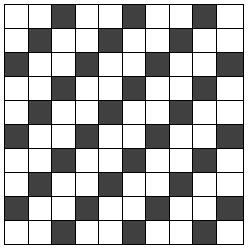
(30) Can you mark ten squares Sudoku-style, so that no two squares share the same row or column? Add up the numbers to get your score. Then try to find a different set of ten Sudoku-style squares. What do you notice? What do you wonder?
[Suggested by David Radcliffe.]

Share Your Ideas

Can you think of anything else we might do with a hundred chart? Add your ideas in the Comments section below, and I’ll add the best ones to our master list.

Things To Do with a Hundred Chart #29

100chart puzzle

Here’s a new entry for my 20+ Things to Do with a Hundred Chart post:

(29) Blank 100 Grid Number Investigations: Challenge your students to deduce the secret behind each pattern of shaded squares. Then have them make up pattern puzzles of their own.
[Created by Stuart Kay. Free registration required to download pdf printable.]

Share Your Ideas

Can you think of anything else we might do with a hundred chart? Add your ideas in the Comments section below, and I’ll add the best ones to our master list.

A Pretty Math Problem?

As we were doing Buddy Math (taking turns through the homework exercises) today, my daughter said, “Oooo! I want to do this one. It’s pretty!”

CodeCogsEqn

She has always loved seeing patterns in math. I remember once, years ago, when she insisted that we change the problems on a worksheet to make the answers come out symmetrical. 🙂

Math That Is Fun: Infinite Primes

Oh, my! Ben Orlin over at Math with Bad Drawings just published my new favorite math proof ever:

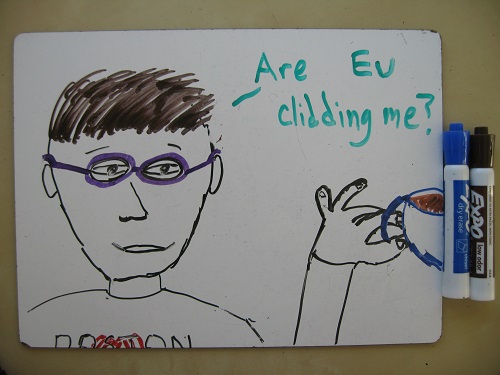
I had a fight with Euclid on the nature of the primes.
It got a little heated – you know how the tension climbs.

It started out most civil, with a honeyed cup of tea;
we traded tales of scholars, like Descartes and Ptolemy.
But as the tea began to cool, our chatter did as well.
We’d had our fill of gossip. We sat silent for a spell.
That’s when Euclid turned to me, and said, “Hear this, my friend:
did you know the primes go on forever, with no end?” …

15-eu-must-be-clidding

Click here to read the whole post at Math with Bad Drawings.

Problem-Solving Poll: What’s Your Answer?

[Photo by Alex E. Proimos via flickr.]

Patrick Vennebush, author of Math Jokes 4 Mathy Folks (the book and the blog) wants to know how you and your children would answer a tricky math problem.

He’s taking a poll:

I have often heard that, “Good teachers borrow, great teachers steal.” So today, I am stealing one of Marilyn Burns’s most famous problems. She takes this problem to the streets, and various adults give lots of different answers. When I’ve used it in workshops, even among a mathy crowd, I get lots of different answers, too.

What’s your answer?

“A man buys a truck for $600, then sells it for $700. Later, he decides to buy it back again and pays $800 dollars. However…”

Go to Patrick’s blog to read the whole problem and submit your answer. Let everybody in the family try it!

Update: Patrick posted the solution and percentages correct for students of various ages.

Lockhart’s Measurement

After watching the video on the Amazon.com page, this book has jumped to the top of my wish list.

You may have read Paul Lockhart’s earlier piece, A Mathematician’s Lament, which explored the ways that traditional schooling distorts mathematics. In this book, he attempts to share the wonder and beauty of math in a way that anyone can understand.

According to the publisher: “Measurement offers a permanent solution to math phobia by introducing us to mathematics as an artful way of thinking and living. Favoring plain English and pictures over jargon and formulas, Lockhart succeeds in making complex ideas about the mathematics of shape and motion intuitive and graspable.”

If you take any 4-sided shape at all — make it as awkward and as ridiculous as you want — if you take the middles of the sides and connect them, it always makes a parallelogram. Always! No matter what crazy, kooky thing you started with.

That’s scary to me. That’s a conspiracy.

That’s amazing!

That’s completely unexpected. I would have expected: You make some crazy blob and connect the middles, it’s gonna be another crazy blob. But it isn’t — it’s always a slanted box, beautifully parallel.

WHY is it that?!

The mathematical question is “Why?” It’s always why. And the only way we know how to answer such questions is to come up, from scratch, with these narrative arguments that explain it.

So what I want to do with this book is open up this world of mathematical reality, the creatures that we build there, the questions that we ask there, the ways in which we poke and prod (known as problems), and how we can possibly craft these elegant reason-poems.

— Paul Lockhart
author of Measurement